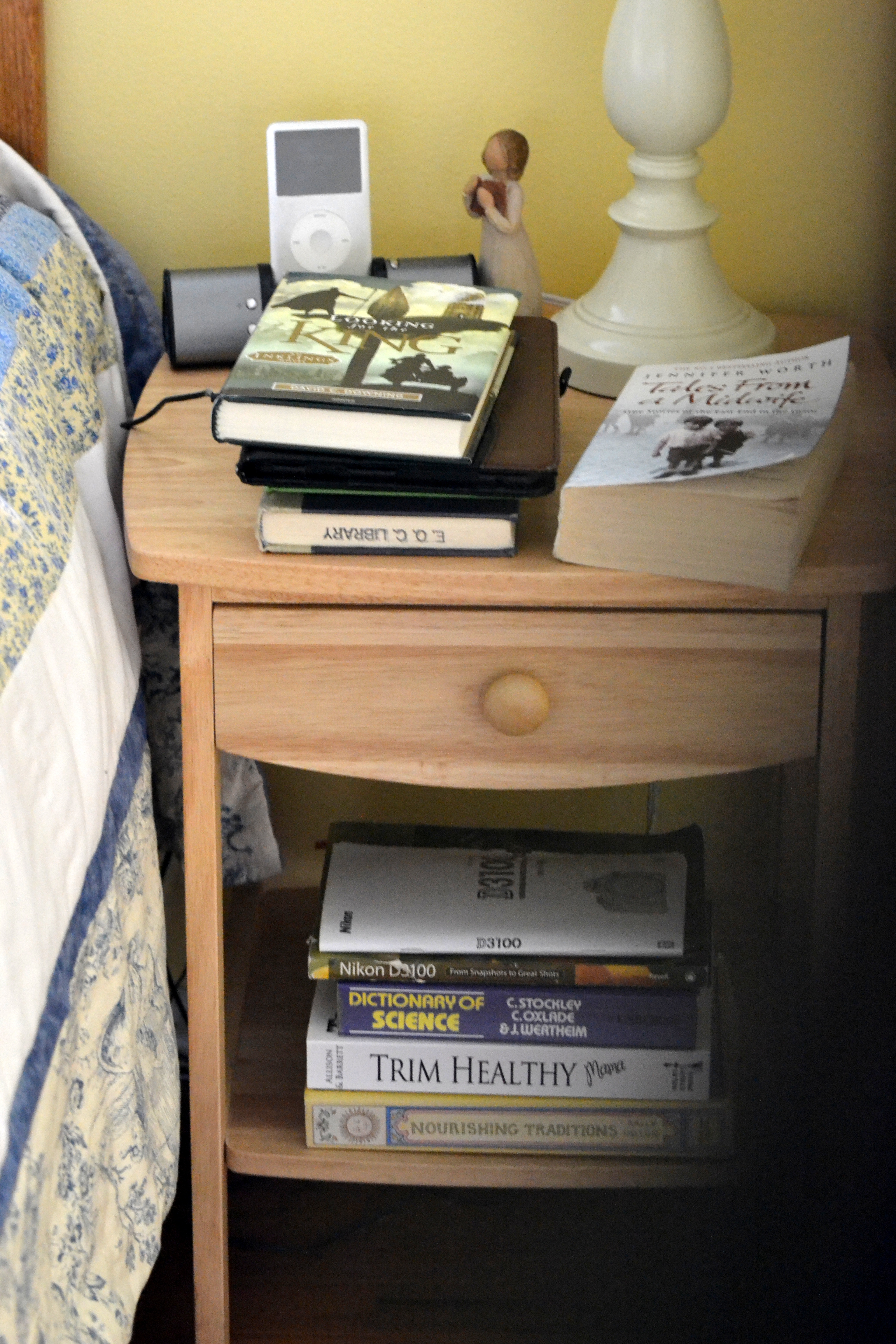
What’s on Your Nightstand, March 24

DSC_3970Although I love the concept of What’s on Your Nightstand, a monthly overview of one’s reading, I have only participated a few times. In a rare and wonderful synchronicity, I  deep cleaned my nightstand area yesterday.

My husband had surgery two weeks ago (he’s fine, thank you) that allowed me seven hours of reading in the waiting room. There was a huge flat-screen TV that looped through Travels in Europe with Rick Steves for 4.5 hours. Eventually, a penguin documentary came on. Occasionally I glanced up, but it wasn’t bad background sound.

Keeping my mind occupied was A Pianist’s Landscape, a book of essays about playing, learning, performing and teaching the piano. This was a book sale find. The cover and title drew me in. Carol Montparker is a Steinway Artist; her essays have been in the New York Times. Delightful!

I’m working on consistently reading poetry. It’s one of those things that takes an effort, but offers rich rewards. I found Wis£awa Szymborska (w sounds like /v/, £ sounds like /w/; thus, Vees WAH vah shin BORE skuh) funny, dark, random, full of irony, beauty and profundity. Many poems didn’t strike a chord in me. But some did. When asked why she didn’t write more poems, her answer was “because I have a trash can at home.” I kept forgetting that these poems had been translated from Polish. The translations are magnificent!

“Disappointing” — two historical novels. Widow of the South centers on the Carnton Plantation near Franklin, TN. I didn’t like that a major part of the plot centered on a contrived and fictitious relationship between Carrie McGavock and one soldier/patient. It was a weird Jayber Crow-ish intimacy.

A Separate Country tells the story of defeated Confederate General John Bell Hood’s life after the war in New Orleans. He marries Anna Maria Hennen, a young society belle, and they have 11 children in 10 years, including three sets of twins. The author uses a scaffolding of facts but most of the story is fanciful. The tone and language is a bit salty for my taste.

I made small progress on my goal to read through Shakespeare’s canon with Henry IV, Part 1 and Part 2. Before I read these, I had thought Falstaff was witty and clever. No, sirrah! His self-aggrandizing, manipulative, lying behavior erased any gladsome thoughts of this main Shakespearean character.

My Kindle read – did you know if you have Amazon Prime you can borrow a book a month on your Kindle? I’m a junkie for books on how to write. To say I have dozens would be only a minor stretch. I love to read them, to re-read them, and to promise myself that someday I will do what they say.

I was reminded to slash away at adverbs and adjectives. Yes. But I really enjoyed Rosenblatt’s comments on education: “Teaching takes a lot of wheedling and grappling but basically it is the art of seduction. Observing a teacher who is lost in the mystery of the material can be oddly seductive.”

Audiobook  This long audio book was mostly tedious, but I was so glad I finished this life of Anna Leonowens. I was reminded how powerful a teacher can be. Prince Chulalongkorn attributed to Anna the decision he made to abolish slavery (without war!) in Siam (Thailand).

For Fun   I love Jane Austen, but I don’t consider myself a Janeite. Among the Janeites was an entertaining read. What struck me was how many ways there are to read Austen. People see virtue, wisdom, feminism, eroticism, autism, therapy, and more in her books.

DSC_3968Reading in preparation for Easter: Silence, by Shushaku Endo and Nikki Grime’s At Jerusalem’s Gate, Poems of Easter.

Patterns in 2014 Reading

Serre_cactees_JdPSo much about the reading life delights me, but the interconnectedness, the synchronicity, of reading bedazzles me. Much could be written (perhaps later) about the thrill of recognition.

It happens when we watch movies and see an actor we know from a previous movie. As I ended the year listening to All the Light We Cannot See, a private knowledge bubbled inside me. The story begins at Le Jardin des Plantes—a botanical garden— in Paris. I practically own Le Jardin! No, but I know it, a primary location in my 2010 read, Zarafa: A Giraffe’s True Story, from Deep in Africa to the Heart of Paris. The thrill of recognition, indeed!

I love knowing what feeds folks’ reading lists. Sometimes a book is a random choice: a compelling cover, a familiar author, a recommendation. I love the patterns. Because every compelling book I read ends up adding more books to my TBR list. So here are some groupings of books read in 2014

Southern Literature  Always a meaning-to category, I finally made some progress.

Music  Romance on 3 Legs put me into a month-long Glenn Gould fixation

Adams, Eisenhowers, Nixons  two groups I put together

Poetry some gems in this pattern

World War II  the stories keep coming

Books that Stuck with Me Long After I Finished (not listed elsewhere)
• The Approaching Storm, by Nora Waln (Amazon has no image)

Science  My weakest area. I now know the term neuroplasticity! YES!

I am an Amazon Associate: buying a book through these links won’t cost you any extra money, but will add a few pennies to my Amazon account. Thanks!

The Approaching Storm

german-wine_2492047kNora Waln’s book, The Approaching Storm: One Woman’s Story of Germany, 1934-1938 is a portrait of a culture. I read it to get insight into the Nazification of Germany from a ground level view. Waln, a Quaker pacifist, and her husband moved to Germany for his musical studies. They had extended visits throughout Germany, Austria and Czechoslovakia.

Much about the culture was winsome. Here, regarding music:

It was usual to see people whose hands were callous with toil playing musical instruments. No gathering was without its song. They scattered music over their great river, over their wine-clad hills, and along their forest ways. (p.53)

About books:

I had entered Germany with the feeling that these people had no money for luxuries, and I had not yet learned that among vast numbers of them a book is not counted a luxury. I had never heard anyone express surprise on learning that a person had gone without meals or material things to buy a book. (p.118)

By far, my favorites passages were about the vineyards. If you’ve read Wendell Berry you will appreciate this. There were pages about tending vines, cultivating soil:

A vineyard keeper worthy of his title has his wood lot for poles, his field for potatoes, his orchard of fruit trees, his stabled cows, his dwelling house, and his vines. He eats bread of his wife’s making which is baked in the village oven, and the fire is banked over Sunday. His laundry is rubbed clean at home, rinsed in the clear waters of the Ahr, and bleached on the grass. He walks without arrogance but with self-respecting dignity. And, Protestant or Catholic, he brings his children up to earn their keep, pay their debts, revere God, and love the Fatherland. (p.151)

Beautiful roads:

The Germans build well. The roads are not ugly scars across their land they are things of beauty, exciting in their charm. They are invisible a short distance off; then one comes on them—silver ribbons. No telegraph poles, advertisements, rows of refreshment stands, gasoline stations, or ugly houses line their banks. (p.138)

I needed the review of the Reichs:
First Reich (Deutsche) the Holy Roman Empire established by Otto the First 962-1806  Second Reich (Second) Otto von Bismark, Hohenzollern Kings of Prussia 1862-1918
Third Reich (Drittle) National Socialist government, the Nazis

Wien_-_Stephansdom_(1)I learned about a cathedral to Saint Stephan in Vienna, the “Stefansdom”.

The Stefansdom has been raised in the same way [as Mongolian prayer mounds]. It is a heap of gifts to God. Each generation has made its offering in the fashion of the time—Romanesque, Gothic, baroque, and nineteenth century. Each piece is beautiful. (p.263)

But then she describes Hitler’s rule. It was impossible for a young boy to escape being in Hitler’s Youth. While they were often given extra latitude (Hitler had read and enjoyed a previous book Waln wrote) they saw the troubles their friends experienced. Soldiers were optimistic and accepted injustices to themselves with a spirited defense of the army.

One story about a Christmas dinner captured me. The hosts guests included  Christians of Jewish descent. The maid and butler made a brouhaha, refused to serve the Jews, and quit in the middle of service. The hosts refused to let their friends leave and carried on amidst their own embarrassment.
Waln said that she was so traumatized in 1938 that she was unable to write.

I’m glad I read this book. Most of my questions weren’t answered, but one thing was clear. Most citizens were in denial as they gave up freedoms one by one.

Riding a Bike around Ireland

bikeagainstwallThe whole pattern of my life, with occasional flurries of enthusiasm for health and exercise against the general background of ageing, slackening and fattening, betrays a slothful indulgent core, more interested in pleasure than in work, happiest when work is enjoyable.

Malachi O’Doherty’s memoir of biking himself back into shape, On My Own Two Wheels: Back in the Saddle at 60, caught my eye when I was researching another author. I enjoy memoirs; I adore Ireland; I fight a family history of diabetes; and sixty is suddenly not such an ethereal concept. It was a soft sell.

What I found was an honest depiction of how he arrived at diabetes, and what he did to change his life. O’Doherty preaches peckishness, one of my new favorite words. [It means hunger.] In short: Love peckishness and trust it to go away.

Temptation had to be treated with contempt and abruptly. When Satan, masquerading as my own thoughts, said things like, ‘One more spud is hardly going to hurt you,’ I had to cast him from me, into the fiery pit. I needed my inner voice to be a disciplinarian, a real tub-thumper, fine-tuned to condemn sugar.

O’Doherty returned to bicycling. He had cycled around Ireland in his younger days as well as a means of commute, and just fell out of the habit. His trips aid in his fitness and bring out the philosopher in him. I followed along à la Google, reveling in the beauty of Achill Island, Kylemore Abbey, the tiny village of Doolin, and Donegal Bay. After some intense trips, he settles into tootling—relaxed cycling for the joy of it. Rain or no rain.

If you let the weather stop you, you’ll do nothing.

I enjoyed the story; I like most Irish literary voices, and this one was winsome with that self-deprecating charm.

Further discoveries: First, O’Doherty has an audio blog (archived, the last entry is in 2011) called Arts Talk that has two readings by Seamus Heaney. Ahhhh. Also, O’Doherty mentions an Irish traveller, Manchán Magan. I watched four episodes of a television show with the boyish-faced Magan about his quest to consume and use only Irish products. He explores transportation, food, clothing and entertainment. Most of the dialogue is in Irish with English subtitles. It wasn’t earth-shattering, but it amused me.

The Best Book of 2014

I told myself I’d go slow. No big gulps. Savor the words. Take my time. Reflect. Enjoy.

And I did…the first 36 hours. But last night I had three hours open and three hours left of reading. Turn the light off at 10:00? C’est impossible!

Somewhere Safe with Somebody Good, dear reader, is the best book Jan Karon has written. Like a master chef with discerning taste, Karon has adjusted the flavor of her writing so it is not too sweet, not too bitter, not too peppery, not too bright; but the perfect combination of spices, textures, and taste. There are overtones, undertones, aromas, and the kind of finish that both satisfies and makes you yearn for more.

Laughter plays peek-a-boo throughout the text. Last night I read a section to my husband that required a working knowledge of both The Cat in the Hat and Poe’s The Raven to fully understand the rich humor. When Curt roared at the punchline, I loved him more than I had the minute before. There is humor on the surface, too: the spray tan provides more than a few guffaws.
There are three scenes that sing to the deep recesses of my soul. They, alone, are why I know I will be reading this book again and again. And, perhaps, again.

Jan Karon nourishes. Literary quotes to ponder, authors and titles to explore, music to review, idioms to delight in. And a bookstore—Happy Endings—that  plays a big part in the plot. There are also problems that can’t be fixed, people that fail, people that never fail to irritate.

If you’ve read certain kinds of Christian fiction, you are familiar with what I call the two-dimensional didactic. The pasted-on-the-end moral message, the perfect hero and wicked villain, the thin patina of plot splashed on the important main point. Gag. No. Thank. You.

When you read  Somewhere Safe with Somebody Good, you learn without any awareness that you are being taught. The subjects are wide ranging: diabetes, exercise, how to help the bereaved (be there), how to say ‘no’, how to cope with retirement, how to give and receive grace.

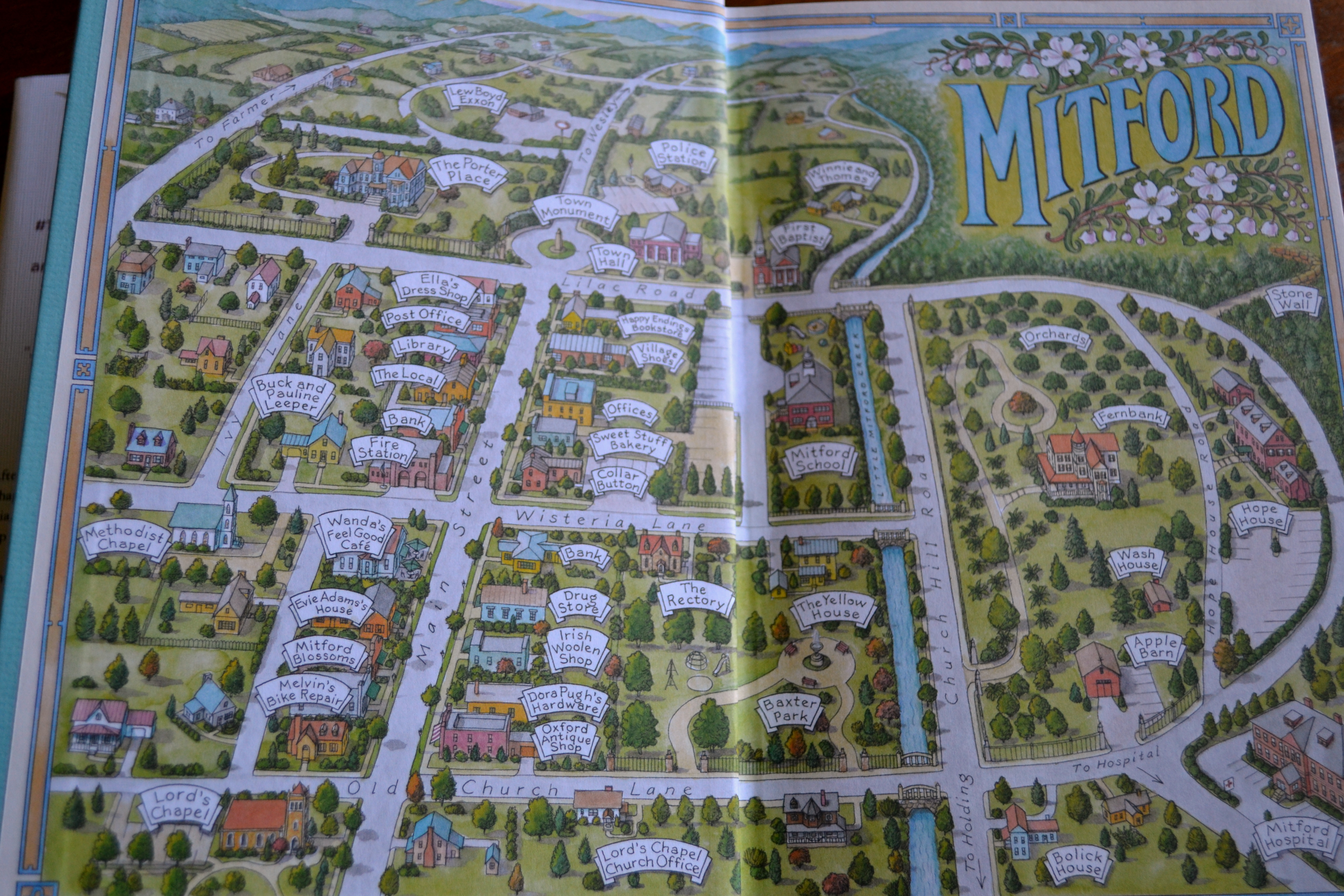
DSC_1740I love the map of Mitford. I love these phrases:

the benediction of her father’s deep tenderness /
a selfish view that masquerades as noble /
that they would be shielded in their joy /
his favorite tryst for plain talk /
under the stairs, a good place to have a cry /

My favorite phrase describes this book: a plenitude of grace.

The Education of Henry Adams

Henry_Adams_seated_at_desk_in_dark_coat,_writing,_photograph_by_Marian_Hooper_Adams,_1883What one knows is, in youth, of little moment;
they know enough, who know how to learn.”

The reader is subject to serial passions. One series is a fascination with the Adams family. After reading about John Adams, Abigail Adams, John and Abigail’s marriage, John Quincy Adams — the reader took up The Education of Henry Adams.  This was not her first attempt, but she was determined to see it through to the end. It took great determination; at the end of Disc 16, she let out a whoop of relief.

Henry Adams was a lifetime learner, an attribute that caused a small measure of affinity between the reader and the subject of the book. (The reader shall be named Lifetime Learner Carol, or LLC.) Adams scorned his formal education in Quincy and at Harvard College, claiming he learned more through travel, studies abroad, friends and mentors. He called this learning “an accidental education.”

Some parts interested LLC: the view of the War Between the States from England; his perspective on Henry Cabot Lodge and Teddy Roosevelt; his opinion of politics, the extensive travels. Other parts,  e.g. conflict between Lord Palmerston and Earl Russell, were snoozers. LLC lacked the mental agility to follow the philosophy of the Unity and the Multiplicity. How a man who was a Darwinian for fun, inclined towards anarchy, became enamored with the Virgin Mary…that confused LLC. The distance in thought between John Adams and his great-grandson Henry Adams — more confusion.

Henry Adams omits twenty years of his education, the most painful span of his life. In those decades he married his wife Clover; twelve years later she, in a bout of depression, committed suicide. Some are aghast that Adams does not mention his wife, but LLC believes the omission is consistent the clinical tone of the book.

Adams closes the book, writing about 1905, “For the first time in fifteen hundred years a true Roman pax was in sight…”  Tragically, the twentieth century was the least peaceful period of history.

One element is memorable: Henry Adams writes his autobiography in the third person. LLC decided to mimic Henry in this review. If one wants to glean the pithy quotes, one does not need to read 505 pages or listen to 16 discs; look here or here or here.

LLC finds that one book completed yields two books to finish: Henry Adams’ Mont Saint-Michel and Chartres (and then it is good-bye Henry!) and David McCullough’s The Greater Journey, Americans in Paris (but McCullough is always a hello!).


(photograph of her husband taken by Marian “Clover” Hooper Adams, 1883)

A Wreath for Emmett Till

emmetttillThis squeezed all the breath out of my soul. Horror. Sorrow from Emmett’s lynching. Beauty—so sharp it stings—of the words woven so we remember Emmett Till.

Emmett Louis Till (1941-1955) was a Chicago boy visiting relatives in Mississippi. Believing that he whistled at a white woman, two men took him from his uncle’s house and murdered him. Mutilated him. The alleged murderers were found ‘not guilty’  but those ‘innocent’ men openly explained how they killed Emmett months after the trial. Emmett’s mother, Mamie, became an activist for civil rights.

Marilyn Nelson’s poem is a heroic crown of sonnets. A sonnet is a fourteen-line rhyming poem. A crown of sonnets links each sonnet together: the last line of the preceding sonnet is the first line of the next sonnet. A heroic crown has fourteen sonnets followed by a fifteenth, made up of the first lines of the first fourteen. This for a boy whose years were fourteen.

Nelson writes:

The strict form became a kind of insulation, a way of protecting myself from the intense pain of the subject matter, and a way to allow the Muse to determine what the poem would say.

The poem is a masterpiece of form, a crown that circles around to the beginning. It is a gruesome subject, but we must bear witness to atrocity. Notes in the back explain what Nelson had in mind with each sonnet, pointing out allusions. This, dear reader, is not obscure poetry. Here is the final sonnet, an acrostic collection of fourteen first lines.

Rosemary for remembrance, Shakespeare wrote.
If I could forget, believe me, I would.
Pierced by the screams of a shortened childhood,

Emmett Till’s name still catches in my throat.
Mamie’s one child, a body thrown to bloat,
Mutilated boy martyr. If I could
Erase the memory of Emmett’s victimhood,
The memory of monsters … That bleak thought
Tears through the patchwork drapery of dreams.
Let me gather spring flowers for a wreath:
Trillium, apple blossoms, Queen Anne’s lace,
Indian pipe, bloodroot, white as moonbeams,
Like the full moon, which smiled calmly on his death,
Like his gouged eye, which watched boots kick his face.

There is an idea, an ancient idea, that flowers represent ideas. If you’ve read or seen Hamlet, you’ll remember Ophelia’s line, “There’s rosemary, that’s for remembrance.” My sister-in-law and I were talking about this last month; she told me that she often puts some rosemary in a note of condolence. The wreath is woven not only with words, but with flowers as tropes.

Someone—bless you!—recommended Marilyn Nelson’s book, Carver: a life in poems, which I got from the library. I read a third of the way through, stopped and bought the book. The same with Emmett Till: a library book on my Kindle, but I needed to own it. I now anticipate reading all Nelson’s books. Along with Wendell Berry and Billy Collins, Marilyn Nelson is in my list of favorite living poets.

Between Silk and Cyanide, A Codemaker’s War

“Put down on a half a sheet of paper what difference silk codes would make to our agents.”
“Half a sheet at most!” echoed Davies.
‘I think it could be done in a phrase, sir!’
‘Oh?’ said Courtauld. ‘We’d be interested to hear it.’
‘It’s between silk and cyanide.’

“This book is not a casual read,” I thought, as I waited for my tire to be repaired. A gargantuan TV, three feet away from me, was blaring the Country Music Awards; I was mouth-breathing, an inefficacious strategy to ignore the overwhelming smell of rubber, and reading three times a paragraph on coded message, attempting to comprehend it. After failed attempts at deciphering acronyms, I made my own code on the inside cover with their meanings.

84-charing-cross-road Knowing the author, Leo Marks, was the son of the owner of the bookshop made famous in Helene Hanff’s 84, Charing Cross Roadwas a big draw to this book. There are many references to the bookshop; it would be helpful, but not essential to have read it first. Although Hanff’s story is set after the war, knowing it provides a fun context.

At twenty Marks begins fighting the Fuhrer with his cryptography skills. He trained agents headed for enemy territory to send and receive messages in a code based on a famous poem the agent had memorized. The problem with poem-codes is that the enemy cryptographers could break the code if they figured out which poem was used. If an agent was captured, he or she would swallow cyanide to keep from telling secrets under torture. The enemy would often continue sending and receiving messages, concealing the knowledge of the capture.

Even as an understudy, Marks understands the the system’s vulnerability. He begins writing original poems for use, a few of which have become famous. Over time he threads together a remarkable innovation to use a one-time, disposable code printed on silk, easily burned after use. This book is the story of his failure and success to spin his silk idea to his superiors.

Marks’ agility with language delights.
→ As a boy he studied the mating habits of the alphabet.
→ A superior officer had a knack for switching on silence as if it were air conditioning.
→ He writes about a desk so small, it was like keeping vigil on a splinter.
Could we have a quick word? He was a verbal weight-watcher.

Marks relates the story of his intelligence with self-deprecating jabs.

The need to justify and its sister frailty, the need to boast, were lethal weaknesses in SOE, and the shock discovery that I was prone to both started me worrying about the coders of Grendon.

While his acute concern and the initiatives he made to protect the safety of the agents shows remarkable maturity for a young twenty to twenty-three year man, the bawdiness that occasionally pops up reminds the reader that he was indeed still close to adolescence.

The story of the code-war fascinated me. I enjoyed the book more after I stopped trying to be an agent in training, when I kept going after I read the explanation without understanding. <grin>

On Christmas Eve, 1943, Leo Marks got word that his girlfriend Ruth had been killed in a plane crash in Canada. He wrote this short poem, which he later gave to an agent Violet Szabo. Wikipedia tells me this poem was read at Chelsea Clinton’s wedding.

The life that I have
Is all that I have
And the life that I have
Is yours.

The love that I have
Of the life that I have
Is your and yours and yours.

A sleep I shall have
A rest I shall have
Yet death will be but a pause.

For the peace of my years
In the long green grass
Will be yours and yours and yours.

Ruth Reichl’s Mom

“I am so sorry I didn’t pursue a career. In the end it is meaningful work—serving people—that matters most. It is what we are made for.”         — Miriam B. Reichl

I stumbled onto Ruth Reichl (RYE-shell) browsing the stacks at my local library. Her voice captured me, her stories engaged me. One by one, I read her memoirs, trying a few recipes tucked in at chapter ends. You could say that she opened the door and welcomed me into the foodie world. I’m still standing in the vestibule, not sure if I belong here, but it is fun looking around.

August and September are months when I listen to audio books by the dozen while I put up food from the garden. I was delighted to rediscover Ruth Reichl and quickly downloaded Not Becoming My Mother: and Other Things She Taught Me Along the Way . (The title changed to For You Mom, Finally when it was issued in paperback.)

Reichl interprets her mother’s life through the lens of family letters and private notes found after her mom’s death. Miriam (“Mim”) was remarkable: got a PhD in music from Paris when she was nineteen, opened a bookshop in her twenties, formed friendships with famous authors, critics, musicians. Thwarted from becoming a physician, told that she was too homely to attract a husband, bereaved of her sister, a disappointment to her parents, she carries an “unhappiness that is palpable”, sits through years of psychotherapy, tries pharmacotherapy, alienates her kids, spirals into deep depression.

RUTH-REICH-MEMOIR-COVER-TITLE-NOT-BECOMING-MY-MOTHMim’s misery, Reichl insists, stems from the fact that she lacked a career. In the fifties she was one of the smart, competent women twiddling their thumbs. She hated housework, was a dangerous cook, lived in chaos. Out of her extraordinary generosity, the best gift she gave her daughter was permission to defy her. Well, now.

While the sadness clings, I just don’t buy the message. My opinion? Mim was miserable. If she had had a career she still would have been an unhappy career woman.

I applaud when Ruth Reichl in another context says “I don’t think there’s one thing more important you can do for your kids than have family dinner.”  But she strikes out with this book.

Where Did English Really Come From?

Have you ever stumbled upon one side of an internet debate about a subject which seems obscure to you but is consuming the person writing?  That’s what it was like reading John McWhorter’s contrarian book, Our Magnificent Bastard Tongue.

The essence of the argument is this:

The real story of English is about what happened when Old English was battered by the Vikings and bastardized by Celts. The real story of English shows us how English is genuinely weird—miscegenated, abbreviated.

[Miscegenation = sexual relations between people of two different races, from Latin miscere (to mix) + genus (race)] There is a Celtic impact on English, McWhorter says, especially from the Welsh and Cornish languages. This Celticness of English has not been acknowledged, so McWhorter is jumping up and down, flinging evidence around to convince the reader, sure, ’tis so.

The first chapter is The Welshness of English.  Sigh... I want to visit Wales.

The first chapter is The Welshness of English. Sigh… I want to visit Wales.

Only language-lovers should read this book of strange focus. Follow the arguments, raise your eyebrow, smile at the coincidences. Just keep reading to scoop up the pearls.

My heap of gems includes:

• Albanian is about 60 percent Greek, Latin, Romanian, Turkish, Serbian, and Macedonian. (My girlfriend has learned Albanian in the last five years: kudos to her!)

• Basque is a language related to no other. (HOW did that happen?)

• English’s closest relative if Frisian, a Dutch relative spoken in the Netherlands.

• This quote made me fizzy with excitement. It still does!

To strike an archaic note, in English we start popping off hithers and thithers. Come hither, go thither, but stay here or stay there. Hither, thither, and whither were the “moving” versions of here, there, and where in earlier English.

• If you’ve read C.S. Lewis’ Surprised by Joy, you know ‘Balder the beautiful is dead.’  The Phoenician-German connection made me say Aha!

And then, the Phoenicians were also given to referring to Baal as Baal Addir (“God great”) — that is, Great God. Sometimes they would write it as one word, Baliddir, or even a shorter version Baldir. And there in that Old High German document is a god called Balder.

I went through the index counting languages which are referenced. Seventy!
I can’t say I was fascinated reading this book, but I can say it was fun reading!