Flannery in Janu’ry

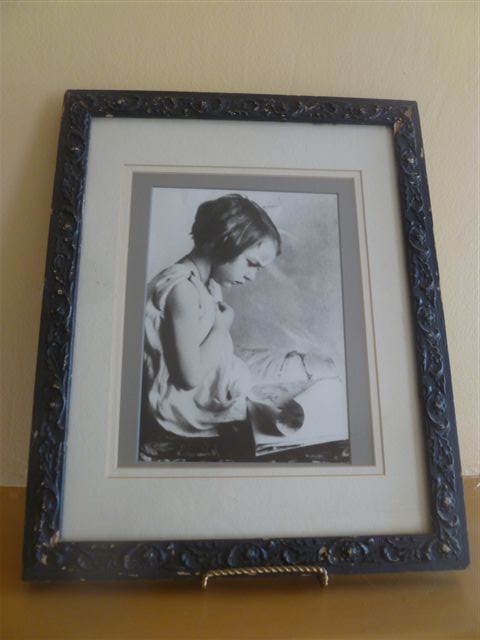
Flannery child.Flannery O’Connor, from her childhood home (picture by K. Harper)

I committed myself to reading Flannery O’Connor’s The Complete Stories as part of Books and Movie’s “I’ve Always Meant to Read That” challenge. In the past few years, I’ve acquired everything published by Flannery (except for A Prayer Journal, just released in November). The Challenge gave me a needed push to dive in.

It was more a belly flop than a dive. I collared my young friend Matthew, who counts FOC as one of his favorite authors, and asked him why I should be reading this depressing stuff. His answer:

“Every Christian needs to read O’Connor, to get the pettiness and self-absorption out of their systems.”

And, you know, Flannery grew on me. The later stories made more sense, were more accessible. “More mature,” a lit major would murmur, cigarette dangling between his knuckles.

It has been a baptism by immersion. Two things helped me immensely: I read Brad Gooch’s Flannery: A Life of Flannery O’Connor, which made me sympathetic to her and helped me to see her vision. I borrowed two audio books, A Good Man Is Hard to Find, and Every Thing That Rises Must Converge, which included many of the stories in The Complete Stories. I took 4 mile walks, listening and concentrating. When I had the time, I listened and read along.

No question, the girl was brilliant. I felt kinship with the reviews of her first novel. “They all recognized her power but missed her point.” Here’s an example: In one story, a grandfather is confronted with a woman who claims his grandson ran into her and broke her ankle. He replies, “I don’t know him. I’ve never seen him before.” A clear allusion to Peter denying Christ the night before the crucifixion. Sooooo. What does it mean?

Flannery herself described her stories as odd, disturbing, unconventional. And the irony? With Flannery, irony is a contact sport. Wickedly funny. But it seems her goal was to smack us in the face so we would see ourselves correctly. These stories have much more than entertainment in mind.

Now that I’ve read through The Complete Stories, I’m ready to read through Mystery and Manners: Occasional Prose and The Letters of Flannery O’Connor: The Habit of Being.

I hoped that O’Connor was filmed giving one of her lectures. I didn’t find that, but I found an audio track of her reading one of her most famous stories, “A Good Man Is Hard to Find.” This would give someone a taste of Flannery.

I found it interesting that Flannery substitutes “colored” for the n-word in this reading.

Edith Irvine, Photographer of SF Earthquake

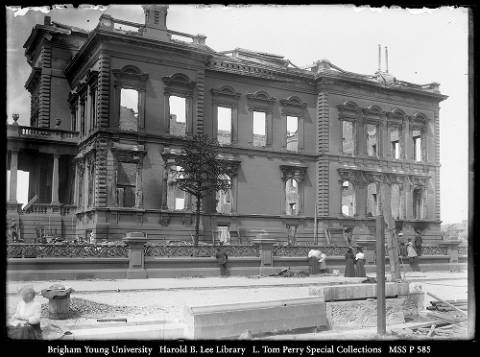
City_Hall(1)Kristiana Gregory’s YA book, Earthquake at Dawn, was my bonus read this month. It is historical fiction at its best: a tragic and fascinating story based on and including primary sources. Through this book I learned about Edith Irvine, an extraordinary photographer. In a mighty strange convergence, Edith, 22, was in a boat about to dock at 5:12 a.m. April 18, when the shaking and quaking of the 1906 Earthquake began.

Gutted_AreaA photojournalist at heart, she went into the city and started to take pictures. She had to be surreptitious, because the city government wanted to minimize both the death toll and the damage. With martial law in effect, Irvine took great risks in documenting the destruction.

Flood_Mansion_California_Street__Mason_StreetA few sentences from a letter written on May 1, 2006 by Mary Exa Atkins Campbell head every chapter.

Streams of people in white and colored garments poured into the streets and for a time we remained, a mourning, groaning, sobbing, wailing, weeping and praying crowd. The most pathetic of all were the poor half-clad women clasping little infants in their arms and begging for mercy.

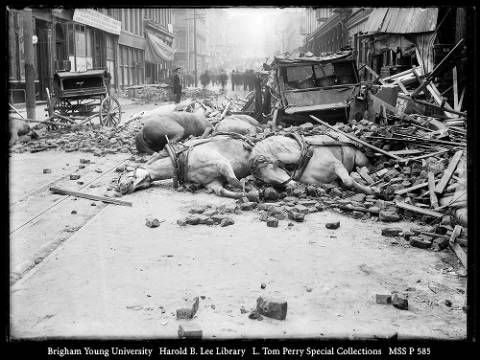
Produce_areaThe picture of the horses killed by the falling bricks is the most famous photograph of Edith Irvine’s.

Residents_with_Bundled_Possessions_on_Van_Ness_Ave

Martial law went into effect, with no due process regarding crime. Mary Exa, again:

The big fire in the mission [district] was caused by a man and woman who, after being made to put out the first fire they made, built another as soon as the policeman left. He came back, saw what they had done, called them out and shot them dead.

Hordes of people were displaced; they camped out at Golden Gate Park Mary Exa wrote that sixteen little babies were born in the Park the day after the quake and one woman had triplets.

Edith Irvine overwhelmed my imagination. Irvine, CA, is named after her family. I have been slowly browsing the 293 photos in the online collection at Brigham Young University. There are photos of Yosemite, the mining town she grew up in, dams being built, cats, horses, portraits and scenes from everyday life.

Half_Dome_Yosemite (1)All photographs are from the Brigham Young University library. You can see the entire collection online.

Flannery O’Connor and Downton Abbey

101_4129

We hear many complaints about the prevalence of violence in modern fiction, and it is always assumed that this violence is a bad thing and meant to be an end in itself. It is the extreme situation that best reveals what we are essentially, and I believe these are times when writers are more interested in what we are essentially than in the tenor of our daily lives.      — Flannery O’Connor

I am working through Flannery O’Connor’s The Complete Stories this month. The stories aren’t enjoyable and they aren’t light reading. But I trust the folks who have urged me to read her and I get occasional glimpses of the glory that is Flannery.

Clearly, her stories are deep and infused with meaning. O’Connor explains a few things in Mystery and Manners. I came across this quote about violence; it immediately brought to mind the bad thing that happened to Anna in a recent episode of Downton Abbey.

What do you think? I’m mulling this over, differentiating violence in print—where you imagine what happens— and on screen, where an image is deposited in your brain vault.


10 Quotes I Copied

DSC_1936You could call my method of reading and copying quotes in my journal cumbersome…and you would be correct. It slows me down, my reading gets ahead of my copying, I end up going through each book twice. Say what you’re thinking: inefficient!

But I can’t articulate the joy that I get from reliving the delight in a well-turned phrase or a clearly expressed thought when I go back through my journal. It brings back the memory of the experience of reading that book. At the top of some pages there is a date and a short description of where I am when I am copying, i.e. 5-13-13, day after Mother’s Day, at the river with Scott, Dad and Mom. Or on the plane to Raleigh-Durham, 11-8-13.

My husband is patient with my quirkiness, but he scratches his head and asks, “What am I supposed to do with these journals if you die before I do?” You know, I don’t care! They have proved their value to me here and now. Here, in chronological order of copying into my journal, are ten great quotes of 2013.

1. In his solitude he can sunder and besmirch the fellowship, or he can strengthen and hallow it. Every act of self-control of the Christian is also a service to the fellowship.
— Diietrich Bonhoeffer, Life Together

2. Distillation is selection, and selection, as I am hardly the first to affirm, is the essence of writing history. It is the cardinal process of composition, the most difficult, the most delicate, the most fraught with error as art. Ability to distinguish what is significant from what is insignificant is sine qua non. Failure to do so means that the point of the story, not to mention the reader’s interest, becomes lost in a morass of undifferentiated matter. What it requires is simply the courage and self-confidence to make choices and, above all, to leave things out. — Barbara Tuchman in Practicing History

3. Seed biscuits and milk! I hated Mrs. Mullet’s seed biscuits the way Saint Paul hated sin. Perhaps even more so. I wanted to clamber up onto the table, and with a sausage on the end of a fork as my sceptor, shout in my best Laurence Olivier voice, “Will no one rid us of the turbulent pastry cook?” — Alan Bradly in The Sweetness at the Bottom of the Pie

4. She was beloved by friends and family for her unique wit perfectly blended with a gift for hospitality and kindness to others.  — Billee Ratzlaff 1926-2013

5.  It is a rare person who isn’t somewhat traumatized by the state of his or her desk. — David Levy in Scrolling Forward

6.  In Africa, you do not view death from the auditorium of life, as a spectator, but from the edge of the stage, waiting only for your cue. You feel perishable, temporary, transient. You feel mortal.  —Peter Godwin in When a Crocodile Eats the Sun

7. There is so much in the world for us all if we only have the eyes to see it, and the heart to love it, and the hand to gather it to ourselves—so much in men and women, so much in art and literature, so much everywhere in which to delight, and for which to be thankful. — Lucy Maud Montgomery in Anne of the Island

8.  Her thoughts were always directed outward toward others, and never inward towards herself. She never in all her life knew an introspective moment. Because of this there was no murky fog of self-consciousness between herself and others. She saw not her own disabilities but them and like unclouded sunshine her warmth and light were theirs without hindrance. No one was ever shy of Peronelle—she did not give them time to be shy. She looked at them, she loved them, and with one leap she had curled herself inside their hearts. — Elizabeth Goudge in Island Magic

9.  Drink your wine. Laugh from your gut. Burden your moments with thankfulness. Be as empty as you can be when that clock winds down. Spend your life. And if time is a river, you may leave a wake.  — N.D. Wilson in Death by Living

10. To sum up, analysis and abstraction are not demons to exorcise, but like the machine, to be mastered, not obeyed. To live amid lax words and dim thoughts more or less translatable into concreteness depletes energy and deadens the joy of life. — Jacques Barzun in From Dawn to Decadence.

Figaro, John and Abigail

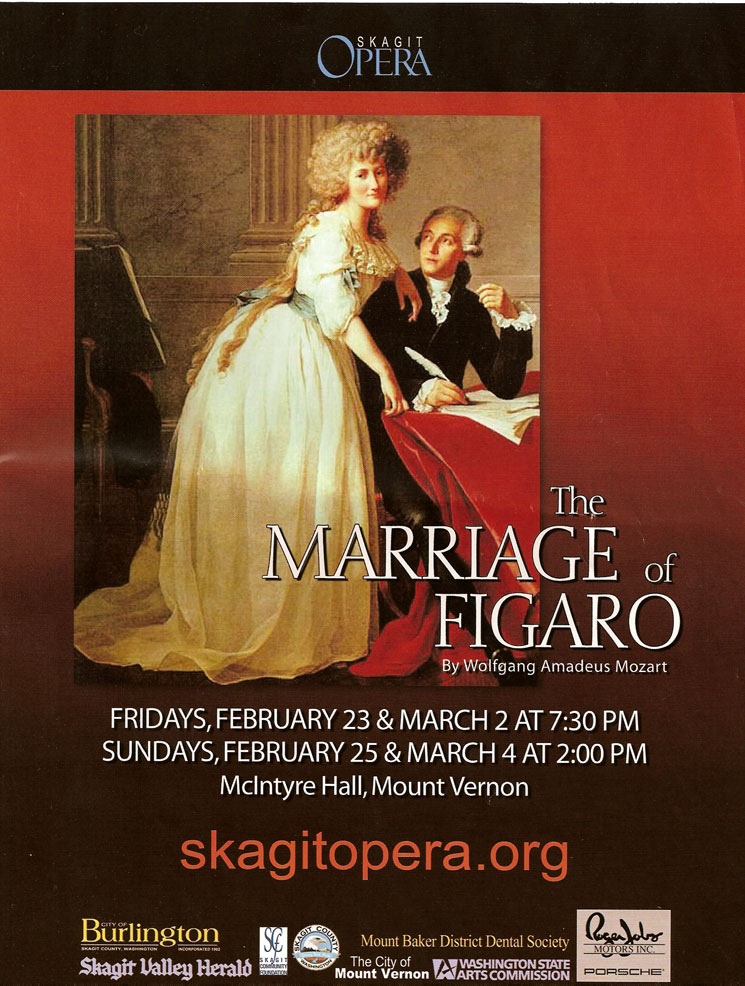
marriage-of-figaro-program Mental Multivitamin calls it synthesis / serendipity / synchronicity. It’s that glorious connection between what you just read/saw/heard and—in an unexpected way—what you are currently reading/seeing/hearing.

The practice of reading (deep and wide) is in effect laying down a swath of Velcro loops. And along comes something that enhances, expands, expatiates on what you already know: those are the Velcro hooks.

That aha! moment brings me great joy. My husband wishes he had written down every hunting experience he’s had since he was seven…for the pleasure of reliving them. I wish I had noted each experience of synthesis / serendipity / synchronicity in my reading life; for there have been many and, alas, my mind grows dim.

::today’s synthesis::

For a year I have been plowing through Jacques Barzun’s From Dawn to Decadence: 500 Years of Western Cultural Life 1500 to the Present. It is demanding and daunting. Twenty years ago I wouldn’t have had the fortitude and background knowledge to pull through. But it is rewarding in the same way that losing thirty pounds is rewarding.

Barzun writes several pages about Beaumarchais, the author of The Marriage of Figaro, artisan, wit, pamphleteer, and secret agent. Have you heard of him? Me, neither. Barzun calls him “the most effective helper of the [American] colonists in their war.” Do you find that an arresting description?

Mozart wrote an opera based on Beaumarchais’ story which challenged the French aristocracy, making Figaro, a valet (or barber), more noble than his master.

:: Pause, Barzun. ::

When I’ve been home alone this week, I have listened to Joseph J. Ellis’ history, First Family: Abigail and John Adams. After a five year separation, Abigail and her daughter Nabby joined John and John Quincy in Paris. The Adams family “attended an early performance of The Marriage of Figaro.”  Hello! I just read about significance of Figaro!! I reveled in the realization that for a time John and Abigail Adams and Mozart were both living and breathing in relative proximity.

::Pause, Abigail and John::

Three weeks ago I visited my friend Lisa in North Carolina. She had been culling books from her shelves and gave me a quaint 1913 book called Opera Synopses. In it I found more information on The Marriage of Figaro ; I learned the story is a direct continuation of Rossini’s opera The Barber of Seville (created by Beaumarchais).

::return to Barzun::

Fascinating! I went back to Barzun’s tome and there it all was: “the man who wrote The Barber of Seville and The Marriage of Figaro before the librettists of Rossini and Mozart gave the two plays another meaning for the musical state.”

I had previously read that sentence, but because I didn’t have any Velcro loops of interest or connection, that fact just bounced off my brain. The synthesis, the recognition, made those words adhere.

So what? Although I am familiar with the overture and several arias, I have never seen the opera. I started to watch it on YouTube this morning, while I wrapped Christmas presents, but quickly realized that three hours of opera wasn’t on the agenda today. And if I’m going to be thorough (cough, cough) I should start by watching The Barber of Seville first.

So little time…

E. Goudge’s Island Magic

0848813421When Hope at Worthwhile Books reviewed Elizabeth Goudge’s first novel, I wanted to read it.  The setting is St. Pierre, the capital of Guernsey, a channel island between England and France. Island Magic quenches two of my current fascinations: island culture and late 19th century rural life.

André and Rachell du Frocq are barely eeking out a living on a farm called Bon Repos (“Good Rest” or, as I like to translate it, “Sweet Tranquility”), a place that comes with a benediction written on stone outside the farmhouse:

Harbour and good rest to those who enter here,
courage to those who go forth.
Let those who go and those who stay forget not God.

The characters of André, Rachell, their five children, Grandpapa, and the stranger Ranulph— who is taken in after a shipwreck—, are vivid and unique; they linger in my thoughts days after I finished the book. Among the five siblings are a humanitarian, a poet, a failed academic, an adventurer, and a joyspring.

The story is sad and yet not without hope. The children have individual minor tragedies, they also have the confidence and security of being part of a bustling family. The tension resides between husband and wife as they begin to think about conceding failure at farming. The stranger’s assistance is helping the bottom line, but brings more marital conflict.

Typical of Goudge, there is a fairy element in the story. Themes of faith, bitterness, the value of beauty, hard work, service, gratitude, grief and sacrifice make the story shimmer. One point of the plot beggars belief. Of course I can’t identify it without giving away part of the story.

Rarely—and happily— I come across a sentence, with which I can fully relate, and about something I’ve never before seen in literature. Island Magic delivered! This is used to be me!!

How thankful she was for her one great gift—the gift of making her nose bleed at will.

Here is a great Christmas quote:

Christmas Day at Bon Repos was something terrific. The du Frocqs took the whole of December preparing for it and the whole of January recovering from it.

Goudge’s mother was a native of Guernsey; summer visits to the grandparents were part of Goudge’s childhood. Her final thoughts on island living in this book are a bit idealistic, but they reflect some of the necessities of interpersonal relationships in a closed society.

You can’t be an individualist on our Island. There’s so much magic packed into so small a space. With the sea flung round us and holding us so tightly we are all thrown into each other’s arms—souls and seasons and birds and flowers and running water. People understand unity who live on an island. And peace. Unity is such peace.