Flannery in Janu’ry

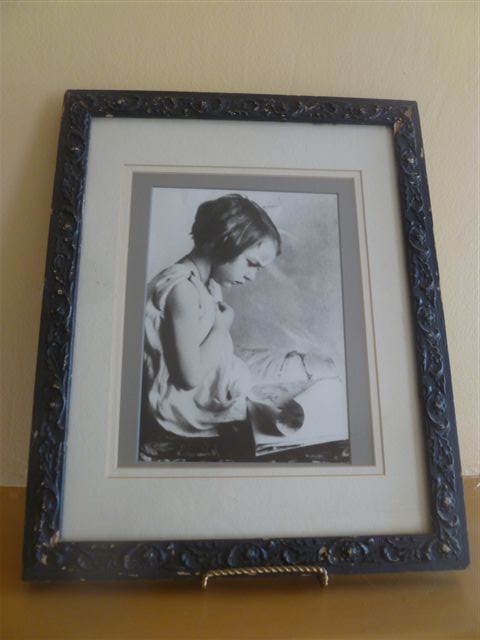
Flannery child.Flannery O’Connor, from her childhood home (picture by K. Harper)

I committed myself to reading Flannery O’Connor’s The Complete Stories as part of Books and Movie’s “I’ve Always Meant to Read That” challenge. In the past few years, I’ve acquired everything published by Flannery (except for A Prayer Journal, just released in November). The Challenge gave me a needed push to dive in.

It was more a belly flop than a dive. I collared my young friend Matthew, who counts FOC as one of his favorite authors, and asked him why I should be reading this depressing stuff. His answer:

“Every Christian needs to read O’Connor, to get the pettiness and self-absorption out of their systems.”

And, you know, Flannery grew on me. The later stories made more sense, were more accessible. “More mature,” a lit major would murmur, cigarette dangling between his knuckles.

It has been a baptism by immersion. Two things helped me immensely: I read Brad Gooch’s Flannery: A Life of Flannery O’Connor, which made me sympathetic to her and helped me to see her vision. I borrowed two audio books, A Good Man Is Hard to Find, and Every Thing That Rises Must Converge, which included many of the stories in The Complete Stories. I took 4 mile walks, listening and concentrating. When I had the time, I listened and read along.

No question, the girl was brilliant. I felt kinship with the reviews of her first novel. “They all recognized her power but missed her point.” Here’s an example: In one story, a grandfather is confronted with a woman who claims his grandson ran into her and broke her ankle. He replies, “I don’t know him. I’ve never seen him before.” A clear allusion to Peter denying Christ the night before the crucifixion. Sooooo. What does it mean?

Flannery herself described her stories as odd, disturbing, unconventional. And the irony? With Flannery, irony is a contact sport. Wickedly funny. But it seems her goal was to smack us in the face so we would see ourselves correctly. These stories have much more than entertainment in mind.

Now that I’ve read through The Complete Stories, I’m ready to read through Mystery and Manners: Occasional Prose and The Letters of Flannery O’Connor: The Habit of Being.

I hoped that O’Connor was filmed giving one of her lectures. I didn’t find that, but I found an audio track of her reading one of her most famous stories, “A Good Man Is Hard to Find.” This would give someone a taste of Flannery.

I found it interesting that Flannery substitutes “colored” for the n-word in this reading.

Edith Irvine, Photographer of SF Earthquake

City_Hall(1)Kristiana Gregory’s YA book, Earthquake at Dawn, was my bonus read this month. It is historical fiction at its best: a tragic and fascinating story based on and including primary sources. Through this book I learned about Edith Irvine, an extraordinary photographer. In a mighty strange convergence, Edith, 22, was in a boat about to dock at 5:12 a.m. April 18, when the shaking and quaking of the 1906 Earthquake began.

Gutted_AreaA photojournalist at heart, she went into the city and started to take pictures. She had to be surreptitious, because the city government wanted to minimize both the death toll and the damage. With martial law in effect, Irvine took great risks in documenting the destruction.

Flood_Mansion_California_Street__Mason_StreetA few sentences from a letter written on May 1, 2006 by Mary Exa Atkins Campbell head every chapter.

Streams of people in white and colored garments poured into the streets and for a time we remained, a mourning, groaning, sobbing, wailing, weeping and praying crowd. The most pathetic of all were the poor half-clad women clasping little infants in their arms and begging for mercy.

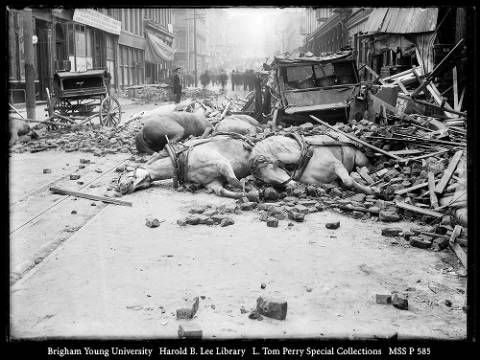
Produce_areaThe picture of the horses killed by the falling bricks is the most famous photograph of Edith Irvine’s.

Residents_with_Bundled_Possessions_on_Van_Ness_Ave

Martial law went into effect, with no due process regarding crime. Mary Exa, again:

The big fire in the mission [district] was caused by a man and woman who, after being made to put out the first fire they made, built another as soon as the policeman left. He came back, saw what they had done, called them out and shot them dead.

Hordes of people were displaced; they camped out at Golden Gate Park Mary Exa wrote that sixteen little babies were born in the Park the day after the quake and one woman had triplets.

Edith Irvine overwhelmed my imagination. Irvine, CA, is named after her family. I have been slowly browsing the 293 photos in the online collection at Brigham Young University. There are photos of Yosemite, the mining town she grew up in, dams being built, cats, horses, portraits and scenes from everyday life.

Half_Dome_Yosemite (1)All photographs are from the Brigham Young University library. You can see the entire collection online.

A Kid’s Book About Venezuela

I bought Roberto’s Trip to the Top because the authors are Katherine Paterson’s husband and son. And I’m happy that I did.

Roberto is a young boy living in Caracas, Venezuela. He is excited to ride up a cable car to the top of a mountain and hike around with his father. The story is told in English with Spanish words sprinkled on each page. An alert reader will understand the Spanish by the context, but there is also a glossary in back.

I like the way the authors present problems in the trip, letting them exist without facile solutions. Roberto’s disappointments are acknowledged, but he has to deal with them. It was refreshing to read about a hike along a risky path without guardrails. I think I like this book because its tone matches my parenting style.

Renalto Arlacao’s illustrations are vivid and engaging.

My only reservation is that I don’t know if the book will hold a child’s interest through multiple readings. It would be fun to quiz a primary child on the Spanish words. What does barrio mean? It is a good book for exposing children to other cultures and a few words of Spanish.

This post contains Amazon affiliate links.

Reading Year in Retrospect

DSC_1833“I am an inveterate browser of people’s bookshelves, always curious to see what other people have been reading, and which books they choose to display. but I am equally curious about the manner in which they array them. Are their books neatly aligned, like the leatherbound books in the Levenger catalog, or do they teeter on the shelf at odd angles?”  — David Levy in Scrolling Forward: Making Sense of Documents in the Digital AgeI love looking back at my reading year, and yet I also shrink from the raised eyebrow of my inner critic. Deciding on categories and distributing my titles in those gives the same thrill that I get in organizing my books. This is my reading year in retrospect.

My own Book of the Year? It’s a tie! N.D. Wilson’s Death by Living: Life Is Meant to Be Spent was both the slowest and most profound read. I read it aloud to my husband a page or even a paragraph at a time. But reading through Jacques Barzun’s From Dawn to Decadence was also deeply satisfying. (confession: I have 60 pages to finish)

Africa
This Rich & Wondrous Earth Linda Burklin (life in boarding school)
When a Crocodile Eats the SunPeter Godwin (living in Zimbabwe)
The Elephant Whisperer: My Life with the Herd in the African Wild Lawrence Anthony (animal conservation)

British
Over the Gate Miss Read (cozy read)
Lark Rise to Candleford(trilogy) Flora Thompson (a portrait of a culture)
Lady Anna Anthony Trollope (novel of a marriage)
Cousin Henry Anthony Trollope (a study of a guilty conscience)
Tyler’s Row Miss Read (not my favorite Miss Read)

Catholic
The World, the Flesh, and Father Smith Bruce Marshall (story of a Scottish Priest)
Father Hilary’s HolidayBruce Marshall (priest gets involved in political intrigue)

Christian
Death by Living N.D. Wilson (memoir/family heritage/travelogue/random thoughts)
Life Together: The Classic Exploration of Faith in Community Dietrich Bonhoeffer (crammed with good stuff)
The Secret Thoughts of an Unlikely Convert Rosaria Butterfield (unusual story)

Culture
From Dawn to Decadence Jacques Barzun (500 years of cultural history, EXCELLENT) Scrolling Forward David Levy (e-book or bound book debate, written a decade ago)

Early American
Rip Van Winkle & Other Stories Washington Irving (some classics improve as we age)

Family
Fit to Burst : Abundance, Mayhem, and the Joys of Motherhood Rachel Jancovik (wise)
Real Marriage Mark and Grace Driscoll (yes and no: all the stats got old)

French
Lest Innocent Blood Be Shed Philip Hallie (5K Jews saved by people of Le Chambon)
The Elegance of the Hedgehog Muriel Barbery (postmodern novel, quotable sections)

History
First Family: Abigail and John Adams Joseph Ellis (very enjoyable read)

Kid Lit
Anne of Green Gables L.M. Montgomery (priceless)
Anne of Avonlea LMM (sad to lose Matthew Cuthbert)
Anne of the Island LMM (away at school)
Anne of Windy Poplars LMM (winning over the Pringles and Katherine Brooke)
Anne’s House of Dreams LMM (early marriage, bereavement)
Anne of Ingleside LMM (a houseful of kids and dear Susan)
Rainbow Valley LMM (add the Meredith kids to the Blythes: delightful)
Rilla of Ingleside LMM (I love Rilla; more Susan; a great view of WWI at home)
Chronicles of Avonlea LMM (12 short stories, Anne is just a cameo)
Further Chronicles of Avonlea LMM (includes a delicious story of a revival meeting)
The Story Girl LMM (she can make a story reciting the multipication tables)
The Golden Road LMM (a hilarious mistaken identity story)
Kilmeny of the Orchard LMM (a mute girl plays the violin)
Emily of New Moon LMM (appeals to all aspiring writers)
Emily Climbs LMM (word lovers will love Emily)
Emily’s Quest LMM (overcoming obstacles to writing)
The Blythes are Quoted LMM (more short stories)
Charlotte’s Web E.B. White, (classic, test-drove with a grandson)
Island Magic Elizabeth Goudge (Guernsey family, classic Goudge)

Memoir/Biography
The Story of the Trapp Family Singers Maria Augusta Trapp (must read for S o M fans)
God’s Arms Around Us William Moule (heart-pounding tale of family in WW2 Philippines)
Thinking in Pictures: My Life with Autism Temple Grandin (she translates autism)
The End of Your Life Book Club Will Schwalbe (terminally ill mom and son read books)
A Little Moule History William Moule (life of a vagabond adventurer)
Appetite for Life Noel Riley Fitch (bio of Julia Child)
The Bookseller of Kabul Asne Seierstad (daily life in Afghanistan)
The Alpine Path LMM (frustrating in its brevity)

Mystery
The Sweetness at the Bottom of the Pie Alan Bradley (I ♥ Flavia de Luce)
Speaking from Among the Bones Alan Bradley (another Flavia book)
Chop Shop Tim Downs (Bug Man is a forensic entomologist)
First the Dead Tim Downs (almost had a heart attack reading this)
Less than Dead Tim Downs (difficulty breathing while reading this thriller)

Plays
Twelfth Night W. Shakespeare (mistaken identities)
The Tempest Shakespeare (full fathom five thy father lies)
The Comedy of Errors Shakespeare (TWO sets of identical twins)

Recovery
Little Black Sheep Ashley Cleveland (the gift of willingness)
Sober Mercies: How Love Caught Up with a Christian Drunk Heather Kopp (story of addiction)

Science
The Immortal Life of Henrietta Lacks Rebecca Skloot (spellbinding story of HeLa cells)

TV Reading (one-night read without substance)
A Lancaster County Christmas Suzanne Woods Fisher (English stranded with Amish)

Travel
Shadow of the Silk Road Colin Thubron (China-Turkey by one of my fave travel writers)
In a Sunburned Country Bill Bryson (winsome writing…mostly)
Stephen Fry in America Stephen Fry (witty, sometimes coarse flyover)
Roads : Driving America’s Great Highways Larry McMurtry (he drives the interstates)

Western
The Whistling Season Ivan Doig (the Wendell Berry of Montana)

What have you been reading?

(This post contains Amazon affiliate links, which allows me to buy perhaps one or two new books a year. But I’m thankful if you decide to buy a book through the links.)

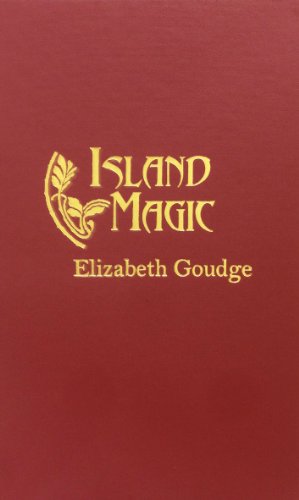
E. Goudge’s Island Magic

0848813421When Hope at Worthwhile Books reviewed Elizabeth Goudge’s first novel, I wanted to read it.  The setting is St. Pierre, the capital of Guernsey, a channel island between England and France. Island Magic quenches two of my current fascinations: island culture and late 19th century rural life.

André and Rachell du Frocq are barely eeking out a living on a farm called Bon Repos (“Good Rest” or, as I like to translate it, “Sweet Tranquility”), a place that comes with a benediction written on stone outside the farmhouse:

Harbour and good rest to those who enter here,
courage to those who go forth.
Let those who go and those who stay forget not God.

The characters of André, Rachell, their five children, Grandpapa, and the stranger Ranulph— who is taken in after a shipwreck—, are vivid and unique; they linger in my thoughts days after I finished the book. Among the five siblings are a humanitarian, a poet, a failed academic, an adventurer, and a joyspring.

The story is sad and yet not without hope. The children have individual minor tragedies, they also have the confidence and security of being part of a bustling family. The tension resides between husband and wife as they begin to think about conceding failure at farming. The stranger’s assistance is helping the bottom line, but brings more marital conflict.

Typical of Goudge, there is a fairy element in the story. Themes of faith, bitterness, the value of beauty, hard work, service, gratitude, grief and sacrifice make the story shimmer. One point of the plot beggars belief. Of course I can’t identify it without giving away part of the story.

Rarely—and happily— I come across a sentence, with which I can fully relate, and about something I’ve never before seen in literature. Island Magic delivered! This is used to be me!!

How thankful she was for her one great gift—the gift of making her nose bleed at will.

Here is a great Christmas quote:

Christmas Day at Bon Repos was something terrific. The du Frocqs took the whole of December preparing for it and the whole of January recovering from it.

Goudge’s mother was a native of Guernsey; summer visits to the grandparents were part of Goudge’s childhood. Her final thoughts on island living in this book are a bit idealistic, but they reflect some of the necessities of interpersonal relationships in a closed society.

You can’t be an individualist on our Island. There’s so much magic packed into so small a space. With the sea flung round us and holding us so tightly we are all thrown into each other’s arms—souls and seasons and birds and flowers and running water. People understand unity who live on an island. And peace. Unity is such peace.


Comparing L.M. Montgomery

DSC_1607(Katie, another Anne-girl model)

A distinct joy of the reading life is in making connections. Ah, we say, this is like that! This is true of unfamiliar words: we meet and greet; then that new friend appears at someone else’s party. Hey! we exclaim. I know you! It is true also of authors. We chortle—at least I do—when an author is referenced and, instead of shrugging in ignorance, we know that name. Oh joy! Montgomery writes of Dan King in The Story Girl “he had a new Henty book he wanted to finish.” Twenty years ago you wouldn’t’ve known Henty, I remind myself, smiling.

This summer as I’ve read through most of L.M. Montgomery’s fiction, I’ve been thinking about connections.

L.M. Montgomery writes much about the landscape: trees, orchards, the ocean, the light, the color. Two other authors write great descriptions of vastly different geographies. Gene Stratton Porter and Willa Cather.

Rainbow Valley, full of adventures of the Blythe kids and the Meredith kids reminds me of other books revolving around siblings: The Lion, the Witch and the Wardrobe, The Railway Children, and  Meet the Austins.

I’ve been reading books set before the Great War (aka WWI); though I find it hard to articulate, there is something different in the flavor of daily life. A clear-eyed view of rustic simplicity is portrayed both in Maud’s books and in Lark Rise to Candleford.

Emily Starr, in Emily of New Moon, a young writer coming of age—with a supreme desire to be published— reminds me of Jo March in Little Women.

Though Prince Edward Island is almost a character itself in Montgomery’s books, there is a Scotch Presbyterian element that makes me think of Scottish books, particularly O. Douglas’ Penny Plain.

Orphans? Oh, man. There are times, particularly with the Emily books, where the adults were so brutal they were positively Dickensian.

I don’t want to get too obscure (e.g. books set on islands: Anne of Green Gables was like Robinson Crusoe! — wink) but it has been fun to retrieve a few of the random thoughts that wandered around my head while I read through L.M. Montgomery’s books.

Reading Lucy Maud, Part 2

DSC_5238 (We do not lack for red-headed beauties in these parts.)

This was my summer of Lucy Maud Montgomery. I want to share thoughts and a few choice quotes from each of the Anne books in this post..

Anne of Green Gables The themes of imagination, wonder, friendship, drama and belonging come together in the person of Anne Shirley. Anne has eyes to see and the heart to be stopped by the beauty around her. All that exuberance is counter balanced by the clear-eyed, practical Marilla Cuthbert. And who doesn’t love Matthew Cuthbert, the buyer of puffed sleeves?

“Oh, Marilla,” she exclaimed one Saturday morning, coming dancing in with her arms full of gorgeous boughs, “I’m so glad I live in a world where there are Octobers. it would be terrible if we just skipped from September to November, wouldn’t it?”

All things great are wound up with all things little.

Anne of Avonlea Anne begins teaching at the Avonlea school. Can you imagine our schools today hiring sixteen-year-olds to teach? The cranky neighbor, Mr. Harrison, plays the curmudgeon, adding spice to the story. Marilla adopts the Keith twins, Davy and Dora, but their characters didn’t capture my interest.

I believe the nicest and sweetest days are not those on which anything very splendid or wonderful or exciting happens but just those that bring simple little pleasures, following one another softly, like pearls slipping off a string.

Anne of the Island Anne leaves PEI for Redmond College in Nova Scotia. Anne is coming of age; she is going away, Diana is staying—their friendship will change. The book is framed by Anne and Gilbert’s relationship: from comfortable comrades at the beginning through the awkwardness of rejected romance eventually to true love.

Humor is the spiciest condiment in the feast of existence. Laugh at your mistakes but learn from them, joke over your troubles but gather strength from them, make a jest of your difficulties but overcome them.

There is so much in the world for us all if we only have eyes to see it, and the heart to love it, and the hand to gather it to ourselves—so much in men and women, so much in art and literature, so much everywhere in which to delight, and for which to be thankful.

Anne of Windy Poplars Anne is teacher/principal at a school in Summerside, back on PEI. Every Anne book needs a crank: Katherine Brooke fills the role, a woman who made being disagreeable into a fine art. Katherine is transformed by Anne’s patient and pursuing friendship.

Anne had a horror of being petty.

Even the commonplaces had been made lovely. Every bit of wire fencing was a wonder of crystal lace.

Anne’s House of Dreams The book begins with Gilbert and Anne’s wedding, a small quiet event in the apple orchard at Green Gables. They move to Glen St. Mary where Gilbert begins medical practice and Anne gets involved in the stories of the people around her. Instead of a crank, one of the main characters, Leslie Moore, is tragic. And Miss Cornelia Bryant, who has strong opinions about Methodists and Presbyterians, provides comic relief. The spinster maid, Susan Baker—one of my favorites—is introduced.

They had a sort of talent for happiness, them two.

I LIKE to be alone now and then, just to think over things and TASTE them. But I love friendship—and nice, jolly little times with people.

Anne of Ingleside Five Blythe children have joined Gilbert, Anne and the maid, Susan, at Ingleside. It is their stories we read: Jem disappears, Di learns about false friends, sensitive Walter has a long dark night; Nan cheats God.  Grouchy Aunt Mary Maria Blythe plays the part of the crank. She so resembled one of my long-departed relatives that I snorted a few times in sympathy with Anne.

Susan’s mince pies are poems, just as her apple pies are lyrics.

Only sneaks, Jem had said once, tried to get out of bargains.

Rainbow Valley This book is dear to my heart. The Reverend John Knox Meredith, the new minister, is a widower with four children. The Meredith kids get all the good stories in this book. I bonded with Rainbow Valley, of course, because my mom died when I—the youngest of seven—was ten and my dad was the same kind of absent minded minister as the Rev..

Every LMM book needs a cranky reprobate: enter Norman Douglas. Spunky Faith Meredith challenges old Norman Douglas and the sparks fly. it’s a jolly good time.

Where can folks get better acquainted than over a meal table?

The more we love the richer life is—even if it is only some little furry or feathery pet.

Rilla of InglesideLucy Maud’s final Anne book comes up to the level of Anne of Green Gables, and may even surpass it. Bertha Marilla, aka Rilla, aka Rilla-my-Rilla, is one of Montgomery’s most well-rounded, multidimensional characters. Like the Dowager in Downton Abbey, Susan Baker—the maid who is a part of the family—has the best quotes.

So much that is satisfying can be found in this book: the growth of Rilla; her fostering of the infant Jims, a war-baby; the understanding and affection between Rilla and her brother Walter; the long vigil of Dog Monday waiting for his master to return.

Rilla, published in 1921, offers a clear view of life in Canada during the war. This title belongs on more WWI lists.

When we have to do a thing, Mr. Dr. dear, we can do it.

I am not, proceeded Susan firmly, going to lament or whine or question the wisdom of the Almighty any more as I have been doing lately. Whining and shirking and blaming Providence do not get us anywhere. We have just got to grapple with whatever we have to do whether it is weeding the onion patch or running the Government. I shall grapple.

Reading Lucy Maud, Part 1

Reading Lucy Maud, Part 1

DSC_2475(She could be Anne-with-an-e except she’s no orphan. She’s the cherished youngest.)

HOW did I make it through my youth without reading Anne of Green Gables? There is no explanation. I first met Anne Shirley after I was married. I gasped at the nonstop sentence of Anne talking to Matthew Cuthbert on the way from the train station. A while later I read Anne of Avonlea; I birthed sons, abandoned Anne, and started reading Henty.

Each year I  pick an author and read as much of his/her work as possible. My default would be to hunt down every last novel, bibliography and online essay. But I’m trying to get over my compulsive tendencies. Last year, I read through Carol Ryrie Brink of Caddie Woodlawn fame.

So this is my summer of Lucy Maud, my summer of Anne, my summer of Rilla, my summer of Emily. [Yes, I’m holding on to summer until September 21!] I’ve read print books and Kindle; I’ve listened to dramatized versions and I’ve listened to the 147 short stories on Librivox. I could only listen to a few at a time in order to keep my nostalgic blood sugar from spiking.

There are recurring motifs in Montgomery’s work: the shape of noses; imaginations; emotionally isolated orphans; friendships; cold and impregnable aunts, a high view of education; music; words; books; flowers; the ocean. Lucy Maud’s characters share a palpable yearning, an intense desire to be wanted, to belong.

Reading through Montgomery’s work, one would think the mortality rate of birthing mothers to be 90%. Mothers aren’t the only thing missing in this fiction. Strong fathers—strong men— are on the endangered list. Fathers are either absent, dying, or overseas. I had hoped that Gilbert Blythe might be the exception in Rilla of Ingleside; alas, he is the absent father caring for distant patients.

What about Matthew Cuthbert?  Matthew is sweet, Matthew is empathetic, but I wouldn’t call him strong in the masculine sense. In my mind I’ve been kicking around the matriarchal nature of most of the households in these stories. And wondering how that colors the narrative.

Who stood out in my mind?

I loved the harum-scarum Meredith family (in Rainbow Valley) headed by the absent-minded widower, the Rev. John Knox Meredith. The descriptions of a brood of lively siblings in a motherless house rang true to my experience in such a family. But it could not be denied that there was something very homelike and lovable about the Glen St. Mary manse in spite of its untidiness.

It goes without saying that I love Anne. I was drawn to Rilla, the youngest Blythe who discovers she has gumption and at fifteen raises a war-baby. Emily was endearing, an aspiring writer whose coping mechanism of thinking how she would write the scene got her through many tongue lashings.

The short stories are not Chekhov. I’ve come to the conclusion that the short story is the one of the most difficult genres. A few of her good ones make it word-for-word into one of her novels.

I have more thoughts. I will corral them and sort them into categories. And sift through the heaping pile of quotes I’ve highlighted. It has been a fun reading summer. And there are still more books to read!

What’s On Your Nightstand?

What's On Your Nightstand

It’s a tottering, two-pile disaster. But I love nightstands cluttered with books. To take an unread book off the pile just seems clinical and cold. I will get to it…sometime!

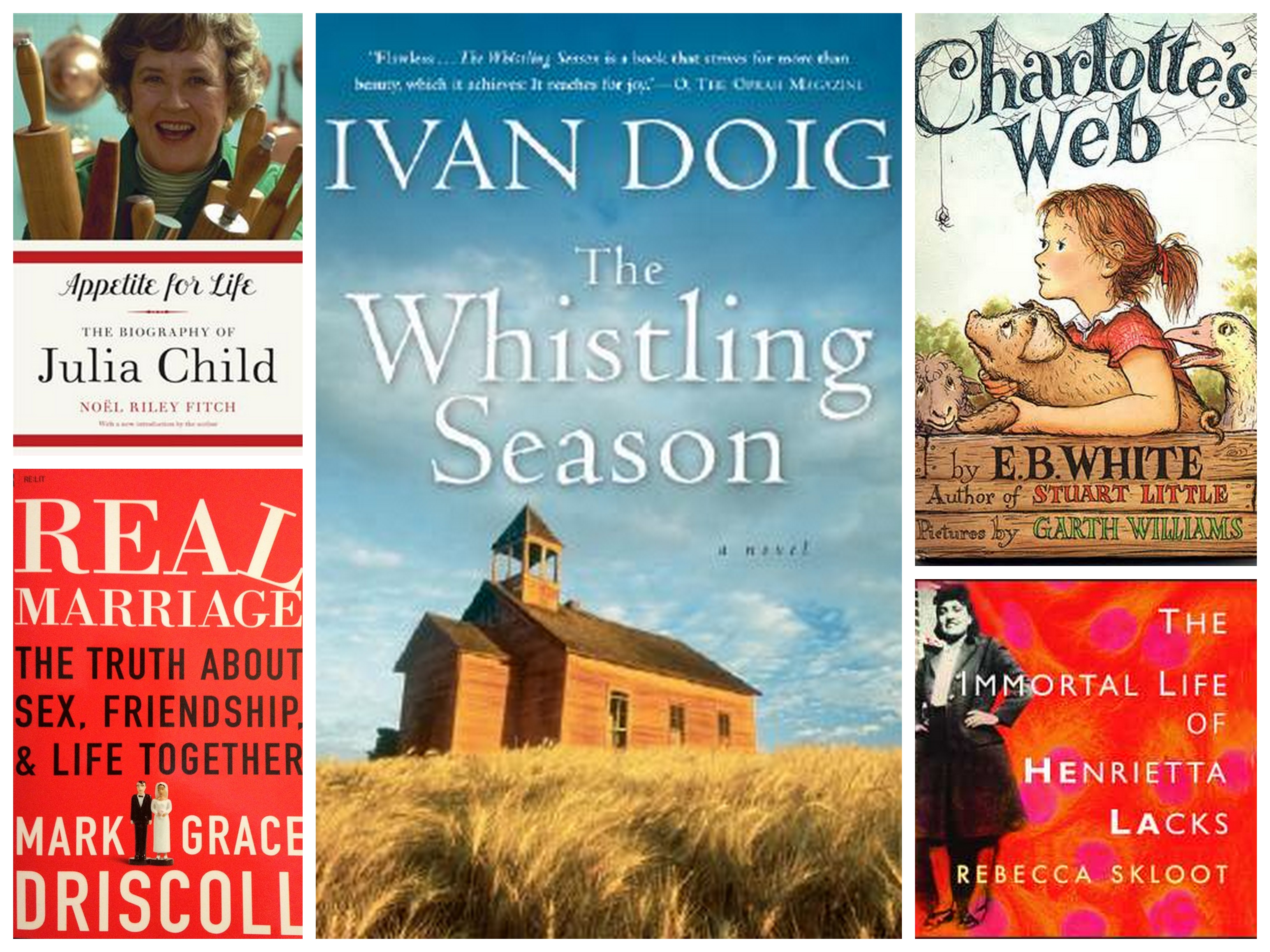
My nose is in Ivan Doig’s The Whistling Season, which I liken to a bowl of home-made ice cream on a hot day. I haven’t finished it, and I’ve already ordered a second copy to share with others. I am new to Ivan Doig, but his prose has me promising myself that I will seek out more.  My sister-in-law recommended this, calling Doig “the Wendell Berry of Montana”. Classroom dynamics in a one-room school house will snag anyone interested in education. The private Latin lessons give Doig a chance to explain word origins to the reader in a winsome manner. Yes, yes, and yes.

When I’m doing chores around the house, I’m listening to Noel Riley Fitch’s Appetite for Life: The Biography of Julia Child. I’ve gone on a Julia jag since I saw Julie and Julia. It’s not as good as My Life in France, but it’s a companionable boost to my bi-monthly ironing orgy, but I think the print version wouldn’t keep my interest enough.

Downloads2

My husband and I commute two hours/week, splitting our car time between talking through our schedule, airing our gripes, listening to music, audio magazines or audio books. We started The Immortal Life of Henrietta Lacks, bowled over by the first CD. Soon, I drove 12 hours, finished it, betraying our tacit agreement to share the book. This audio version is dynamic, in my list of ten best audio book performances. Skloot mixes scientific explanation with human interest, a compelling combination.

At the end of the day I was reading aloud to my husband Mark and Grace Driscoll’s book, Real Marriage, but we’ve had a lot of company lately, and have stayed up late talking, falling into bed with no thought of reading. I’ll comment more about it when we’ve finished.

Reading Charlotte’s Web aloud to my 4½ year old grandson in four days reminded me of the C.S. Lewis’ quote:

No book is really worth reading at the age of ten which is not equally – and often far more – worth reading at the age of fifty and beyond.

It was so fun to “get” some of the nuggets E.B. White dropped into the story line. It was a stretch for Noah, his first chapter book. Illustrations on every page would have helped. This classic is definitely worth reading again, whether you have a child by your side or not.

Lark Rise to Candleford

Image

Lark Rise to Candleford is a charming BBC series depicting life in late nineteenth century England. It offers a nostalgic view of a life uncluttered by modern technology and conveniences. It plays the ancient contrast of the agricultural hamlet of Lark Rise versus the merchant town life of Candleford. Visually rich and well written, it is cozy entertainment.

Lark Rise to Candleford is a trilogy written by Flora Thomson, (loosely) the basis of the BBC series. Without a narrative arch, it is a portrait of a culture. Not a novel, it is a memoir written in the third person. The overwhelming motif is change, how current life (1930’s) is so different from the ‘eighties (1880’s).

Watch the series first (how seldom I say that) and let the characters (Laura, ‘Par’, ‘Mar’, Alf, Queenie, Dorcas Lane) and countryside seep into your bones. If your curiosity isn’t piqued by the films you may not stick with the books. Enjoy the trilogy for its own merits. Par and Mar are winsome in the fictionalized movies; it was disappointing to read Flora’s realistic characterizations in the book.

After working in the pure cold air of the fields all day, the men found it comforting to be met by, and wrapped round in, an atmosphere of chimney-smoke and bacon and cabbage cooking; to sink into ‘feyther’s chair’ by the hearth, draw off heavy, mud-caked boots, take the latest baby on their knee and sip strong, sweet tea while ‘our Mum’ dished up the tea-supper.

You will enjoy reading about:
— Victorian privies with a wall hanging ‘Thou God seest me’
— how poor kids moisten mud pies
— outdoor singing during work being the norm
— wisps of mist floating over the ploughed fields
— England’s women all gave a penny for Queen Victoria’s Jubilee
— Laura’s need to read (Waverly, Cranford, Dickens, Trollope, Austen)
— superstitious remedies (black slug for warts, fried mice for bedwetting)
— origin of ‘a pretty kettle of fish’ and ‘journeyman’
— the all-conquering song of the ‘nineties: Ta-ra-ra-BOOM-de-ay!

Books can enliven unfamiliar times and places. Honestly, the end of the nineteenth century seems so far back.

Or is it? Lark Rise is a few years later than Little House in the Big Woods. There are still some living who are only one or two generations removed from pre-WWI times. My grandpa was born in 1889.

If you read through the first book, Lark Rise, you will get to experience one of the best last sentences of a book. The final paragraph is a masterpiece. The magnificent restraint, the absence of foreshadowing until the final word—a gut puncher—makes this book well worth reading. Its potency is in surprise: please don’t peek!