Listen
Image
1


Wow. The audio edition read by Maggie Hoffman enshrouded me, made this not merely listening to a book, but an experience. I listened while driving, but when I was home, I found it difficult to do anything beyond listening. Setting the iron upright, drying my hands, leaving clean clothes in the basket, I basked in the cadences.
The writing is spare, the words short. This is a story of abandonment, of survival, of transience. Provision and grace make spattered appearances, but they are layered and torn and patched. Lila finds herself alone but she steadfastly refuses to consider herself needy. The story pivots when she steps into a church on a rainstorm.
Quotes that captured me:
I got shame like a habit, the only thing I feel except when I’m alone.
There was no way to abandon guilt, no decent way to disown it. All the tangles and knots of bitterness and desperation and fear had to be pitied. No, better, grace had to fall over them.
Most of the time she thought she understood things better when she didn’t try. Things happen the way they do. Why was a foolish question. In a song a note follows the one before because it is that song and not another one.
If I were leading a discussion of this book, we would talk about the knife; geraniums; gardens; charity; baptism; adoption; King James language; Psalm 22. And Ezekiel.
I was unmoved when I first read Gilead. What changed my response was hearing the audio. I can still remember what I was doing when I listened perhaps five years ago, it made so deep an impression. Now I want to return to the print book and read it with Lila still fresh in my mind.
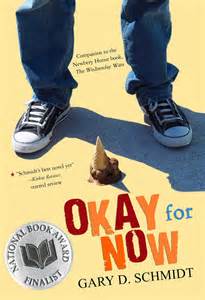
I enjoy persuading adult readers to read well-written young adult books. Gary Schmidt’s book is one I recommend, perhaps even more for older readers than for a middle schooler. It made me snort with laughter and it turned me into a sobbing, sniffing mess.
Doug Swieteck has a lying, blustering, bullying, abusive father. His mom tries to compensate, neutralizing her husband’s venom to the best of her ability within the strictures of 1960’s mores. Doug’s older brothers are plain mean.
I tried to talk to my father about it. But it was a wrong day. Most days are wrong days.
So convincing is Doug’s voice that I could hear it. “Terrific.” “I hate stupid Marysville.” “You know how that felt?” and Doug’s trademark phrase, “I’m not lying.”
Perhaps we’ve all grown up with someone like Doug, a mixture of bravado and vulnerable. Someone outside the family takes an interest and tries to pull that kid up above his/her circumstances. Doug had his share of tormentors, but also four mentors who invested in him.
There are some things in this world that we cannot fix, and they happen, and it is not our fault, though we still might have to deal with them. There are other things that happen in this world that we can fix. And that is what good teachers like me are for. — Miss Cowper, English teacher
A few things seduced me. One brother is only identified as “my jerk brother.” He is changed by a horrific situation — converted (not religious) — and Doug begins calling him by his name. It is a subtle but significant clue. The smile motif captured me. Pay attention to the smiles.
I listened to the audio version (5 stars for Lincoln Hoppe’s narration–except he mispronounced Cowper— it’s Cooper), but was compelled to read the words.
And see the pictures. Doug Swieteck’s doorway to a better life comes through John James Audubon’s bird pictures. (The hefty Birds of America was the first gift I gave my husband after we married.) Each chapter is named after an Audubon bird; the audio experienced is diminished without seeing the prints.
There is a broad ranged of interests represented in this book: Audubon, Apollo 11, the Vietnam War, Jane Eyre, Periodic Table, baseball, and Aaron Copland. There is drama, devastation, and unexpected grace. I loved the book. Would a young teen love it?

Chives growing in my garden, February 12, 2016
Awake, Thou Wintry Earth is almost a life anthem. I came to Thomas Blackburn’s poem by way of Bach’s Cantata 129. When I heard it, I came to understand in a new way that spring is an annual demonstration of resurrection. Listening to this still gives me shivers. Singing it means I end up whispering to tell that dead is dead over a voice that is breaking.
I took a walk around my backyard this morning and was delighted to hear garlic and chives laughing at winter, death, decay.

Here is a link to Margo’s service: http://tinyurl.com/jl3g6yj
If you copy the link and paste it into your browser, it should work. I hope so! I don’t know why this link seems to open the service twice. Just “X” out of one.
“It isn’t Narnia, you know,” sobbed Lucy. “It’s you. We shan’t meet you there. And how can we live, never meeting you?”
“But you shall meet me, dear one,” said Aslan.
“Are -are you there too, Sir?” said Edmund.
“I am,” said Aslan. “But there I have another name. You must learn to know me by that name. This was the very reason why you were brought to Narnia, that by knowing me here for a little, you may know me better there.”
:: :: :: :: :: :: ::
“Oh, Aslan,” said Lucy. “Will you tell us how to get into your country from our world?”
“I shall be telling you all the time,” said Aslan. “But I will not tell you how long or short the way will be; only that it lies across a river. But do not fear that, for I am the great Bridge Builder.”
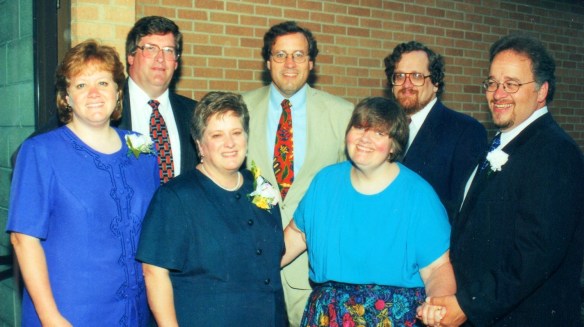
By Jim Harper
So, as you all— I am Jim, by the way, the middle brother —as you all probably know, music is very important in the Harper family.
When we were growing up, we were each either assigned or picked an instrument to play… some of us went further with this than others. (laughter) And I always sort of thought of it in my mind as the Bach Family Orchestra. I sort of thought that maybe Dad had so many kids to fill the gaps in the orchestra. But, that never panned out.
So, Margaret played the cello. That was her division, her instrument. And she also played the piano, just like Carol and Dorothy. But she also loved to sing.
She got together with Judy Petke and Rosalyn Hines at Bair Lake Bible Camp — we spent most of our summers at Bair Lake Bible Camp — and they formed a trio: The Bair Lake Lovelies. And they had wonderful harmonies. And I think they even sang out here, in Lombard, under a different name: The Lombard Lovelies.
But I came across this quote by Garrison Keillor, who I think Margaret enjoyed listening to, from a piece he wrote, Singing with the Lutherans. And I presume by that, he meant Singing with Sanctified Brethren, because that’s who he grew up singing with.
“Lutherans are bred from childhood to sing in four-part harmony. It’s a talent that comes from sitting on the lap of someone singing alto or tenor or bass and hearing the harmonic intervals by putting your little head against that person’s rib cage. It’s natural for Lutherans to sing in harmony. We’re too modest to be soloists, too worldly to sing in unison. When you’re singing in the key of C and you slide into the A7th and D7th chords, all two hundred of you, it’s an emotionally fulfilling moment. I once sang the bass line of Children of the Heavenly Father in a room with about three thousand Lutherans in it; and when we finished, we all had tears in our eyes, partly from the promise that God will not forsake us, partly from the proximity of all those lovely voices. By our joining in harmony, we somehow promise that we will not forsake each other.”
So, when we turned off life-support for Margaret, we sang her into heaven. She lasted two songs, and her heart stopped.
:: :: :: :: :: :: ::
Here is my playlist for the prelude with some choice lyrics. One of my favorite piano quotes is from my sister Dorothy: Play the words.
Sweet, Sweet Spirit — Without a doubt we’ll know that we have been revived when we shall leave this place.
King Jesus — For He opens doors for me, doors I’m not able to see, That’s why I say King Jesus will roll my burdens away.
He’s Able — I know my Lord is able to carry me through.
Softly and Tenderly — You who are weary, come home.
There Is a Fountain — Redeeming love has been my theme and shall be till I die.
I Will Sing of My Redeemer — How the victory He giveth over sin and death and hell.
I Heard the Voice of Jesus Say — I came to Jesus as I was, so weary, worn, and sad. I found in Him a resting place and He has made me glad.
Wayfaring Stranger — I’m only going over Jordan; I’m only going over home.
Come Thou Fount — Tune my heart to sing Thy grace.
Abide with Me — Heaven’s morning breaks, and earth’s vain shadows flee; in life, in death, O Lord, abide with me.
My God Is Real — [written by Mahalia!!] His love for me is just like pure gold, My God is real, for I can feel Him in my soul.
Come, Ye Disconsolate — Earth has no sorrow that heaven cannot heal.
Precious Lord, Take My Hand — At the river I stand, guide my feet, hold my hand, take my hand, precious Lord, lead me home.
Blessed Assurance — Angels, descending, bring from above echoes of mercy, whispers of love.
It is a good rule, after reading a new book, never to allow yourself another new one till you have read an old one in between. If that is too much for you, you should at least read one old one to every three new ones. — C.S. Lewis
The rewards of deep reading (reading several books on the same subject or by the same author) are plentiful: synthesis, comprehension, analysis. Or just the possibility of remembering the main point. Reading widely pays well, too. The stab of joy, the searing beauty of synchronicity! When I read Book G and it revisits something I read in Book B with no obvious connection between the two? Oh, man. It gets my voice in the high treble range and sets my fingers aflutter.
I thought it would be fun to classify my reading list for 2015 chronologically by publication date. I like old books, yes. But I also have been guilty of reverse-snobbery, where I lift my nose a few centimeters and declare that I’m not all that interested in modern writing. Blech! (autocorrect wanted to change that to belch; that works, too!) As you can see, I’ve overcome that weakness, haha!
2011-2015 (30 books)
Reclaiming Conversation Sherry Turkle
Come Rain or Come Shine Jan Karon
Bread and Wine Shauna Niequist
Earthen Vessels Matthew Lee Anderson
Being Mortal Atul Gawande
Fierce Convictions Karen Swallow Prior
As Chimney Sweepers Come to Dust Alan Bradley
Landfalls Naomi Williams
The Wright Brothers David McCullough
All the Light We Cannot See Anthony Doerr
Gutenberg’s Apprentice Alix Christie
Nigellissima Nigella Lawson
Among the Janeites Deborah Yaffe
Wheat Belly William Davis
Every Good Endeavor Timothy Keller
Coolidge Amity Shlaes
The Book of Strange New Things Michel Faber
The Green Ember S.D. Smith
Food: A Love Story Jim Gaffigan
Dad Is Fat Jim Gaffigan
God Made All of Me Justin Holcomb
No Higher Honour Condoleezza Rice
The Forgotten Founding Father Joshua Kendall
Delancey Molly Wizenberg
Lit! The Christian Guide to Reading Books Tony Reinke
The Curious Case of the Copper Corpse Alan Bradley
The Every-Other-Day-Diet Krista Varady
Tsura Heather Anastasiu
House of Stone Heather Anastasiu
One Good Dish David Tanis
Naturally, since I myself am a writer, I do not wish the ordinary reader to read no modern books. — C.S. Lewis
2000-2010 (24 books)
In the Midst of Life Jennifer Worth
The Midwife Jennifer Worth
Waiting for Snow in Havana Carlos Eire
The River of Doubt Candice Millard
Mudhouse Sabbath Lauren Winner
Complications Atul Gawande
Unless It Moves the Human Heart Roger Rosenblatt
The Importance of Being Seven Alexander McCall Smith
The Best Day, The Worst Day Donald Hall
A Personal Odyssey Thomas Sowell
The Shoebox Bible Alan Bradley
Sonata for Miriam Linda Olsson
Better: A Surgeon’s Notes on Performance Atul Gawande
Shadows of the Workhouse Jennifer Worth
Inkheart Cornelia Funke
The Unbearable Lightness of Scones Alexander McCall Smith
Old Filth Jane Gardam
The Man in the Wooden Hat Jane Gardam
How to Read Shakespeare Nicholas Royle
In Thy Dark Streets Shineth David McCullough
The House at Riverton Kate Morton
Not Quite What I Was Planning: Six Word Memoirs Larry Smith
Widow of the South Robert Hicks
A Separate Country Robert Hicks
1990-1999 (7 books)
A Pianist’s Landscape Carol Montparker
Down the Common Ann Baer
Poems New and Collected Wistawa Szymborska
Melodious Accord Alice Parker
One Year Off David Elliot Cohen
Girl in Hyacinth Blue Susan Vreeland
Jeremy: The Tale of An Honest Bunny Jan Karon
1980-1988 (2 books)
Godric Frederick Buechner
To School Through the Fields Alice Taylor
1970-1979 (1 book)
The Brendan Voyage Tim Severin
1950-1969 (4 books)
A Grief Observed C.S. Lewis
How Does a Poem Mean? John Ciardi
On the Beach Nevil Shute
The Schoolmasters Leonard Everett Fisher
1900-1949 (7 books)
Orthodoxy G.K. Chesterton
The Adventures of Sally P.G. Wodehouse
Pied Piper Nevil Shute
Anna and the King of Siam Margaret Landon
I Capture the Castle Dodie Smith
Mont-Saint-Michel and Chartres Henry Adams
Jimmy at Gettysburg Margaret Bigham Beitler
The only palliative is to keep the clean sea breeze of the centuries blowing through our minds, and this can be done only by reading old books. — C.S. Lewis
1800-1899 (4 books)
Doctor Wortle’s School Anthony Trollope
Sir Henry Hotspur Anthony Trollope
Henry Heathcote of Gangoil Anthony Trollope
Luck of the Roaring Camp Bret Harte
1500-1599 (2 books)
Henry IV, Part I William Shakespeare
Henry IV, Part 2 William Shakespeare
0- 500 AD (2 books)
On the Incarnation Athanasius
Marcus Aurelius and his Times Marcus Aurelius
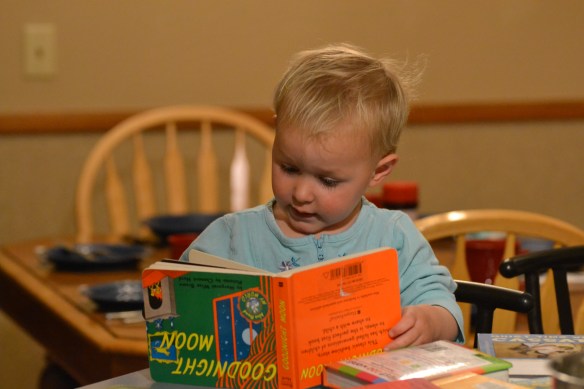
Photograph is my granddaughter, reading Goodnight Moon to me.
Sherry Turkle’s Reclaiming Conversation
This is our paradox.
When we are apart: hypervigilance.
When we are together: inattention.
I believe it. Sherry’d make a point and I was a one-woman gospel choir, swaying and amening. “Solitude is important,” she calls and my response is Yes, sister. “Support unitasking and deep reading.” Deeeeeep reading, I sing. “Continuous partial attention is the new normal.” Say it isn’t so, I moan. “Make sacred spaces where no devices intrude.” Not in the kitchen, not in the bedroom, not even in the car, I harmonize.
What Ms. Turkle did not say, however, has reverberated through my brain. She never framed it this way, but I think we are simply selfish. We have zero tolerance for boredom, for discomfort, for anything unpleasant. We now have devices that we can take refuge in rather than discipline ourselves to wait through the boring bits.
Last May, my niece graduated from a large university in California. I’ve been to a handful of college graduations recently, but I’ve never seen the rudeness that I witnessed that morning. Rudeness I participated in.
A thousand names were called and a thousand graduates walked across the stage to shake the Dean’s hand. People pulled out their phones; some teachers graded papers. I, cough cough, tried to get my seating on Southwest Airlines, even while part of me looked upon myself in astonishment. My husband assumed the tilted coffin pose and took a nap. This wouldn’t have happened ten years ago.
Conversations take work. Conversations take energy. Conversation require me to reveal myself to my friend.
Some of the wealthiest moments of my life have been three recent reunions with childhood girlfriends. We spend a weekend practically device-free. We don’t watch movies. We talk. We listen. We experience deep, focused conversation. (Once, a friend apologized for keeping her phone nearby. She hadn’t heard from her daughter who was living across the world in a country buffeted by a typhoon!) The time and attention is a treasure, all the more so because of its rarity.
Turkle has two time-honored commands to help us out of this murky mess.
Use your words. (what she told her young daughter)
Look at me when you speak to me. (what Grandma always said)


 A Living Pencil