Figaro, John and Abigail

marriage-of-figaro-program Mental Multivitamin calls it synthesis / serendipity / synchronicity. It’s that glorious connection between what you just read/saw/heard and—in an unexpected way—what you are currently reading/seeing/hearing.

The practice of reading (deep and wide) is in effect laying down a swath of Velcro loops. And along comes something that enhances, expands, expatiates on what you already know: those are the Velcro hooks.

That aha! moment brings me great joy. My husband wishes he had written down every hunting experience he’s had since he was seven…for the pleasure of reliving them. I wish I had noted each experience of synthesis / serendipity / synchronicity in my reading life; for there have been many and, alas, my mind grows dim.

::today’s synthesis::

For a year I have been plowing through Jacques Barzun’s From Dawn to Decadence: 500 Years of Western Cultural Life 1500 to the Present. It is demanding and daunting. Twenty years ago I wouldn’t have had the fortitude and background knowledge to pull through. But it is rewarding in the same way that losing thirty pounds is rewarding.

Barzun writes several pages about Beaumarchais, the author of The Marriage of Figaro, artisan, wit, pamphleteer, and secret agent. Have you heard of him? Me, neither. Barzun calls him “the most effective helper of the [American] colonists in their war.” Do you find that an arresting description?

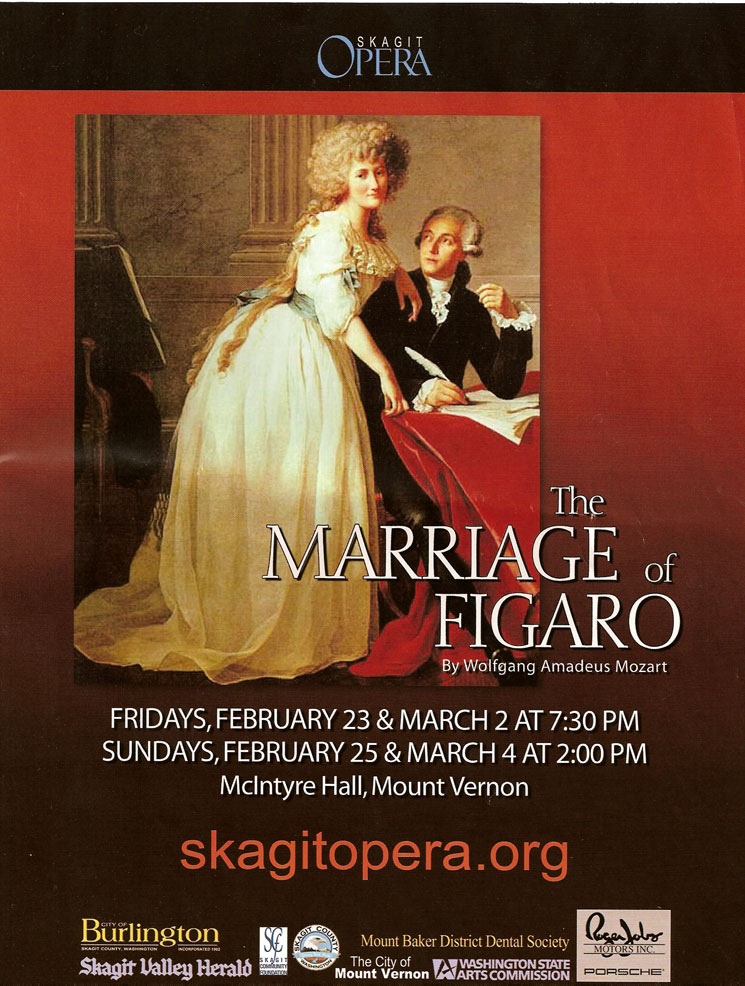
Mozart wrote an opera based on Beaumarchais’ story which challenged the French aristocracy, making Figaro, a valet (or barber), more noble than his master.

:: Pause, Barzun. ::

When I’ve been home alone this week, I have listened to Joseph J. Ellis’ history, First Family: Abigail and John Adams. After a five year separation, Abigail and her daughter Nabby joined John and John Quincy in Paris. The Adams family “attended an early performance of The Marriage of Figaro.”  Hello! I just read about significance of Figaro!! I reveled in the realization that for a time John and Abigail Adams and Mozart were both living and breathing in relative proximity.

::Pause, Abigail and John::

Three weeks ago I visited my friend Lisa in North Carolina. She had been culling books from her shelves and gave me a quaint 1913 book called Opera Synopses. In it I found more information on The Marriage of Figaro ; I learned the story is a direct continuation of Rossini’s opera The Barber of Seville (created by Beaumarchais).

::return to Barzun::

Fascinating! I went back to Barzun’s tome and there it all was: “the man who wrote The Barber of Seville and The Marriage of Figaro before the librettists of Rossini and Mozart gave the two plays another meaning for the musical state.”

I had previously read that sentence, but because I didn’t have any Velcro loops of interest or connection, that fact just bounced off my brain. The synthesis, the recognition, made those words adhere.

So what? Although I am familiar with the overture and several arias, I have never seen the opera. I started to watch it on YouTube this morning, while I wrapped Christmas presents, but quickly realized that three hours of opera wasn’t on the agenda today. And if I’m going to be thorough (cough, cough) I should start by watching The Barber of Seville first.

So little time…

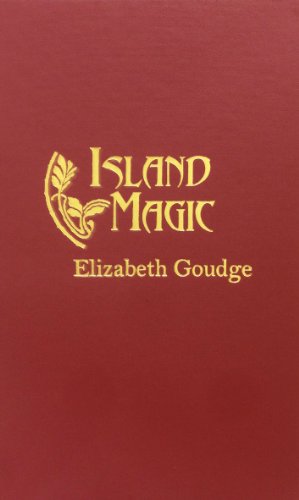
E. Goudge’s Island Magic

0848813421When Hope at Worthwhile Books reviewed Elizabeth Goudge’s first novel, I wanted to read it.  The setting is St. Pierre, the capital of Guernsey, a channel island between England and France. Island Magic quenches two of my current fascinations: island culture and late 19th century rural life.

André and Rachell du Frocq are barely eeking out a living on a farm called Bon Repos (“Good Rest” or, as I like to translate it, “Sweet Tranquility”), a place that comes with a benediction written on stone outside the farmhouse:

Harbour and good rest to those who enter here,
courage to those who go forth.
Let those who go and those who stay forget not God.

The characters of André, Rachell, their five children, Grandpapa, and the stranger Ranulph— who is taken in after a shipwreck—, are vivid and unique; they linger in my thoughts days after I finished the book. Among the five siblings are a humanitarian, a poet, a failed academic, an adventurer, and a joyspring.

The story is sad and yet not without hope. The children have individual minor tragedies, they also have the confidence and security of being part of a bustling family. The tension resides between husband and wife as they begin to think about conceding failure at farming. The stranger’s assistance is helping the bottom line, but brings more marital conflict.

Typical of Goudge, there is a fairy element in the story. Themes of faith, bitterness, the value of beauty, hard work, service, gratitude, grief and sacrifice make the story shimmer. One point of the plot beggars belief. Of course I can’t identify it without giving away part of the story.

Rarely—and happily— I come across a sentence, with which I can fully relate, and about something I’ve never before seen in literature. Island Magic delivered! This is used to be me!!

How thankful she was for her one great gift—the gift of making her nose bleed at will.

Here is a great Christmas quote:

Christmas Day at Bon Repos was something terrific. The du Frocqs took the whole of December preparing for it and the whole of January recovering from it.

Goudge’s mother was a native of Guernsey; summer visits to the grandparents were part of Goudge’s childhood. Her final thoughts on island living in this book are a bit idealistic, but they reflect some of the necessities of interpersonal relationships in a closed society.

You can’t be an individualist on our Island. There’s so much magic packed into so small a space. With the sea flung round us and holding us so tightly we are all thrown into each other’s arms—souls and seasons and birds and flowers and running water. People understand unity who live on an island. And peace. Unity is such peace.


Alan Bradley and Bill Bryson

Alan Bradley and Bill Bryson

Alan Bradley, left; Bill Bryson, right.

It would have made a great story. If only the facts would cooperate.

Last night I finished listening to Bill Bryson’s book about Australia, In a Sunburned Country. I listened with joy to his elegantly turned phrases, self-deprecatory humor, and characterizations of the people and landscape. His dismay at the treatment of aborigines provoked me to care, too. At times Bryson’s tone veers to the suburbs of crass, and he inserts a few liberal rants, but overall I liked it very much.

As it happens, I also finished Alan Bradley’s latest Flavia de Luce mystery, Speaking from Among the Bones.  Because it’s how I’m wired, I read through the acknowledgments, and there two thirds down the page were these sentences: Family, too, have been there to wave flags and shout encouragement at every way station, and I’d like to especially acknowledge …Bill and Barbara Bryson

What? Bill Bryson in Alan Bradley’s family section? Crazy!  I skipped out of bed to explore this connection. Alas, Bill Bryson, the author, is married to a Cynthia. Bill’s father, William, is married to an Agnes Mary. I can’t detect anything other than coincidence in the names.

My favorite excerpt from Bryson’s book is his description of how he sleeps:

I am not, I regret to say, a discreet and fetching sleeper. Most people when they nod off look as if they could do with a blanket; I look as if I could do with medical attention. I sleep as if injected with a powerful experimental muscle relaxant. My legs fall open in a grotesque come-hither manner; my knuckles brush the floor. Whatever is inside—tongue, uvula, moist bubbles of intestinal air—decides to leak out. From time to time, like one of those nodding-duck toys, my head tips forward to empty a quart or so of viscous drool onto my lap, then falls back to begin loading again with a noise like a toilet cistern filling.

And I snore, hugely and helplessly, like a cartoon character with rubbery flapping lips and prolonged steam-valve-exhalations. For long periods I grow unnaturally still, in a a way that inclines onlookers to exchange glances and lean forward in concern, then dramatically I stiffen and, after a tantalizing pause, begin to bounce and jostle in a series of whole-body spasms of the sort that bring to mind an electric chair when the switch is thrown.. Then I shriek once or twice in a piercing and effeminate manner and wake up to find that all motion within five hundred feet has stopped and all children under the age of eight are clutching their mothers’ hems.

Flavia’s humor is dry, more inclined to make me smile in appreciation than to laugh out loud. And tucked in unexpected places the whiz kid chemist wonders about life.

How odd, I thought: Here were these four great grievers, Father, Dogger, the vicar, and Cynthia Richardson, each locked in his or her own past, unwilling to share a morsel of their anguish, not even with one another.

Was sorrow, in the end, a private thing? A closed container? Something that, like a bucket of water, could be borne only on a single pair of shoulders?


Edit: I received a gracious and funny email from Mr. Bradley confirming that his Bill Bryson is not the American author Bill Bryson.

Comparing L.M. Montgomery

DSC_1607(Katie, another Anne-girl model)

A distinct joy of the reading life is in making connections. Ah, we say, this is like that! This is true of unfamiliar words: we meet and greet; then that new friend appears at someone else’s party. Hey! we exclaim. I know you! It is true also of authors. We chortle—at least I do—when an author is referenced and, instead of shrugging in ignorance, we know that name. Oh joy! Montgomery writes of Dan King in The Story Girl “he had a new Henty book he wanted to finish.” Twenty years ago you wouldn’t’ve known Henty, I remind myself, smiling.

This summer as I’ve read through most of L.M. Montgomery’s fiction, I’ve been thinking about connections.

L.M. Montgomery writes much about the landscape: trees, orchards, the ocean, the light, the color. Two other authors write great descriptions of vastly different geographies. Gene Stratton Porter and Willa Cather.

Rainbow Valley, full of adventures of the Blythe kids and the Meredith kids reminds me of other books revolving around siblings: The Lion, the Witch and the Wardrobe, The Railway Children, and  Meet the Austins.

I’ve been reading books set before the Great War (aka WWI); though I find it hard to articulate, there is something different in the flavor of daily life. A clear-eyed view of rustic simplicity is portrayed both in Maud’s books and in Lark Rise to Candleford.

Emily Starr, in Emily of New Moon, a young writer coming of age—with a supreme desire to be published— reminds me of Jo March in Little Women.

Though Prince Edward Island is almost a character itself in Montgomery’s books, there is a Scotch Presbyterian element that makes me think of Scottish books, particularly O. Douglas’ Penny Plain.

Orphans? Oh, man. There are times, particularly with the Emily books, where the adults were so brutal they were positively Dickensian.

I don’t want to get too obscure (e.g. books set on islands: Anne of Green Gables was like Robinson Crusoe! — wink) but it has been fun to retrieve a few of the random thoughts that wandered around my head while I read through L.M. Montgomery’s books.

Reading Lucy Maud, Part 2

DSC_5238 (We do not lack for red-headed beauties in these parts.)

This was my summer of Lucy Maud Montgomery. I want to share thoughts and a few choice quotes from each of the Anne books in this post..

Anne of Green Gables The themes of imagination, wonder, friendship, drama and belonging come together in the person of Anne Shirley. Anne has eyes to see and the heart to be stopped by the beauty around her. All that exuberance is counter balanced by the clear-eyed, practical Marilla Cuthbert. And who doesn’t love Matthew Cuthbert, the buyer of puffed sleeves?

“Oh, Marilla,” she exclaimed one Saturday morning, coming dancing in with her arms full of gorgeous boughs, “I’m so glad I live in a world where there are Octobers. it would be terrible if we just skipped from September to November, wouldn’t it?”

All things great are wound up with all things little.

Anne of Avonlea Anne begins teaching at the Avonlea school. Can you imagine our schools today hiring sixteen-year-olds to teach? The cranky neighbor, Mr. Harrison, plays the curmudgeon, adding spice to the story. Marilla adopts the Keith twins, Davy and Dora, but their characters didn’t capture my interest.

I believe the nicest and sweetest days are not those on which anything very splendid or wonderful or exciting happens but just those that bring simple little pleasures, following one another softly, like pearls slipping off a string.

Anne of the Island Anne leaves PEI for Redmond College in Nova Scotia. Anne is coming of age; she is going away, Diana is staying—their friendship will change. The book is framed by Anne and Gilbert’s relationship: from comfortable comrades at the beginning through the awkwardness of rejected romance eventually to true love.

Humor is the spiciest condiment in the feast of existence. Laugh at your mistakes but learn from them, joke over your troubles but gather strength from them, make a jest of your difficulties but overcome them.

There is so much in the world for us all if we only have eyes to see it, and the heart to love it, and the hand to gather it to ourselves—so much in men and women, so much in art and literature, so much everywhere in which to delight, and for which to be thankful.

Anne of Windy Poplars Anne is teacher/principal at a school in Summerside, back on PEI. Every Anne book needs a crank: Katherine Brooke fills the role, a woman who made being disagreeable into a fine art. Katherine is transformed by Anne’s patient and pursuing friendship.

Anne had a horror of being petty.

Even the commonplaces had been made lovely. Every bit of wire fencing was a wonder of crystal lace.

Anne’s House of Dreams The book begins with Gilbert and Anne’s wedding, a small quiet event in the apple orchard at Green Gables. They move to Glen St. Mary where Gilbert begins medical practice and Anne gets involved in the stories of the people around her. Instead of a crank, one of the main characters, Leslie Moore, is tragic. And Miss Cornelia Bryant, who has strong opinions about Methodists and Presbyterians, provides comic relief. The spinster maid, Susan Baker—one of my favorites—is introduced.

They had a sort of talent for happiness, them two.

I LIKE to be alone now and then, just to think over things and TASTE them. But I love friendship—and nice, jolly little times with people.

Anne of Ingleside Five Blythe children have joined Gilbert, Anne and the maid, Susan, at Ingleside. It is their stories we read: Jem disappears, Di learns about false friends, sensitive Walter has a long dark night; Nan cheats God.  Grouchy Aunt Mary Maria Blythe plays the part of the crank. She so resembled one of my long-departed relatives that I snorted a few times in sympathy with Anne.

Susan’s mince pies are poems, just as her apple pies are lyrics.

Only sneaks, Jem had said once, tried to get out of bargains.

Rainbow Valley This book is dear to my heart. The Reverend John Knox Meredith, the new minister, is a widower with four children. The Meredith kids get all the good stories in this book. I bonded with Rainbow Valley, of course, because my mom died when I—the youngest of seven—was ten and my dad was the same kind of absent minded minister as the Rev..

Every LMM book needs a cranky reprobate: enter Norman Douglas. Spunky Faith Meredith challenges old Norman Douglas and the sparks fly. it’s a jolly good time.

Where can folks get better acquainted than over a meal table?

The more we love the richer life is—even if it is only some little furry or feathery pet.

Rilla of InglesideLucy Maud’s final Anne book comes up to the level of Anne of Green Gables, and may even surpass it. Bertha Marilla, aka Rilla, aka Rilla-my-Rilla, is one of Montgomery’s most well-rounded, multidimensional characters. Like the Dowager in Downton Abbey, Susan Baker—the maid who is a part of the family—has the best quotes.

So much that is satisfying can be found in this book: the growth of Rilla; her fostering of the infant Jims, a war-baby; the understanding and affection between Rilla and her brother Walter; the long vigil of Dog Monday waiting for his master to return.

Rilla, published in 1921, offers a clear view of life in Canada during the war. This title belongs on more WWI lists.

When we have to do a thing, Mr. Dr. dear, we can do it.

I am not, proceeded Susan firmly, going to lament or whine or question the wisdom of the Almighty any more as I have been doing lately. Whining and shirking and blaming Providence do not get us anywhere. We have just got to grapple with whatever we have to do whether it is weeding the onion patch or running the Government. I shall grapple.

Reading Lucy Maud, Part 1

5 Great Endings, 3 That Didn’t Satisfy

I loved Ivan Doig’s The Whistling Season until I got to the last chapter. The day I finished the book was a grief-stacking day. One grief added to others; and then another. By dinner I was a throat-lumpy, care-worn woman in need of a good gully-washing downpour.

Sitting on the terrace, I explained entire plot structure of Doig’s book and why I was indignant with the ending. My husband is used to these book-spoutings. Curt cocked an eyebrow, and said, “So you wanted it to end in heaven, and instead it ended on earth?”

“But [character x] was flawed and there was no foreshadowing of that. I found it inconsistent. I felt betrayed.” Seriously? Now I’m grieving over a fictional character who misbehaved?

What makes a good ending good? Satisfying? Must every story have a happy ending? Is a fitting resolution believable? How wearisome would be a library filled with happy books, devoid of pain. There is the tyranny of perfect heroes. Often it is the response to the crisis that satisfies or disappoints.

Much to mull over…

Here are some books whose endings satisfied me:

1. Charlotte’s WebAs a child I was appalled that Charlotte died. And I turned my back on the book for decades. I now admire the way E.B. White acknowledges Wilbur’s loss while maintaining his joy. The last paragraph:

Wilbur never forgot Charlotte. Although he loved her children and grandchildren dearly, none of the new spiders ever quite took her place in his heart. She was in a class by herself. It is not often that someone comes along who is a true friend and a good writer. Charlotte was both.

2. Light from HeavenJan Karon concludes the ninth title in the Mitford books. There was a diaspora, a scattering, and each book reattaches one section. I wasn’t sure if Jan Karon would withhold the last piece of the puzzle out or snap it into place. At the end there is an unexpected knock at the door.

His hand trembled as he reached out to grasp the hand that reached for his. There was a kind of spark, something electric, as their palms met, flesh to flesh. “We’ve been expecting you.”

3. Little Britches and Man of the FamilyRalph Moody’s endings are velcroed on my mind, twenty years after I read these books aloud to my boys. The family has come through a crisis; the response of the characters ends the books.

4. Lark Rise to CandlefordFlora Thompson’s Lark Rise does not end happily. So powerful, so unexpected, so taut is the final paragraph. It doesn’t have to be happy. But it is fitting.

5. To Kill a MockingbirdThe books ends on the far side of a catastrophe with Atticus on watch being as decent and dependable as every father should be.

And some not-so-satisfying conclusions. These are not books I disliked; it was the ending that disappointed. It would be easy to fill of list of poorly written books, trite and facile fiction. But I could only think of three books which I liked…until they ended.

1. The Whistling Season Someone said about this one, they “were waiting for the shoe to drop.” It ends with a thirteen year old boy confronting adults and then covering up their past. I didn’t like the boy put in the position of a judge and keeping secrets from his father.

2. The Elegance of the Hedgehog The ending seemed very abrupt. It sideswiped me. I couldn’t get over it. This? Is over, like this? It’s hard to explain without explaining.

3. The Count of Monte CristoI never liked that the the Count sails into the horizon at the end. More abruptness.

What endings have bothered you? Which ones were a masterpiece, and why?

Eisenhower

I am midway through a journey begun in 2008 to understand the 20th century.  The Great War took a year (of my time!); WWII about 15 months. Life circumstances slowed me down, but I’m cheerfully working through the post-war period and the Korean War.  One approach to history that I appreciate is studying the lives of key people. Voila, la bibliographie! [That is a private joke that only I understand: the first sentence I ever learned in French was “Chttt! Voila, la biblioteque!” translated: Be QUIET! There is the librarian! It was on a filmstrip (with accompanying vinyl album that had a bell signal to go to the next slide) we watched in French I.]

I wanted to know Eisenhower better. Stephen Ambrose admires his subject.  He begins, “Dwight Eisenhower was a great and a good man. He was one of the outstanding leaders of the Western World in this century.”  This is the first volume of a two-volume biography of Eisenhower. Anyone interested in leadership would benefit from reading Ike’s story.

Everyone brings a personal “grid” to their reading.  I was very interested in Eisenhower’s religious background. Much has been made of the fact that one of the world’s greatest generals was raised in a pacifist home. David and Ida Eisenhower were devout members of Brethren in Christ.  David’s nighttime reading was the Bible in Greek; Ida memorized 1325 Bible verses. And yet…

Nightly Bible reads, Milton said, were “a good way to get us to read the Bible mechanically.” They never discussed what they had read, never asked “Why?,” never explored the deep subtlety or rich symbolism of the Bible. It was the word of God, sufficient unto itself. The duty of mortals was not to explore it, investigate it, question it, think about it, but rather to accept it. 24

Two traits, ever helpful in his life, were manifest in young Ike’s life: intense curiosity and a remarkable ability to concentrate.  As an adult he had another remarkable ability: to shake a depression. Ambrose writes about his vitality:

That quality showed in his speech, in his mannerisms, his physical movements, most of all in his eyes. They were astonishingly expressive. As he listened to his deputies discuss future operations, his eyes moved quickly and inquisitively from face to face. His concentration was intense, almost a physical embrace. His eyes always showed his mood—they were icy blue when he was angry, warmly blue what he was pleased, sharp and demanding when he was concerned, glazed when he was bored. 272

As a general, Ike comprehended the sacrifice that both the soldiers and their families made.

Eisenhower wanted to let as many men as possible see him. He made certain that every soldier who was to go ashore on D-Day had the opportunity to at least look at the man who was sending him into battle. 294

He was the man who had to total up all the casualties. 293

…only Eisenhower had such a keen sense of family, of the way in which each casualty meant a grieving family back home. Eisenhower’s concern was of such depth and so genuine that it never left him. 293

It wasn’t until he was in his fifties, that Eisenhower received acclaim and notoriety, primarily as the Supreme Commander of Operation Overlord.  Eisenhower was also the NATO commander, president of Columbia University and president of the United States.  This volume ends with Eisenhower as President-Elect of the United States.

I found Ambrose’s book engaging and helpful. At no time did my interest lag. I was inspired by Eisenhower’s discipline, organizational skills and perception.

A fun coda: I have a habit of immersing myself in books on (relatively) obscure topics. I find myself wanting to discuss the ideas and events I have read about, but coming up short on conversation partners. Honestly, what would dampen a dinner party faster than, “I know, let’s talk about Truman and Eisenhower!”?  I discovered recently that among my acquaintances are a couple who were friends with Ike and Mamie Eisenhower during their retirement years in Gettysburg.  They were full of stories about the Eisenhowers. I lent them this book; Ray read it through in three days.  I’m looking forward to some great discussions.  An unexpected gift!

SatReviewbutton

Swooning Over This Book, I Am


Safe Passage has shanghaied me.  The minute I finished, I was ready for a second reading.  I want to send it to friends who live life with ferocious passion.  Or passionate ferocity.  The ones who dream, who wonder, who say, “what if?”  Visionaries who can execute a plan.  Friends for whom zest is more than a lemon.

Forget Thelma and Louise.  Ida and Louise will bowl you over.

The book covers three periods in the life of British spinster sisters.  Each one, alone, would make a dazzling book. The first period (1923-1936) paints their love of opera and initial friendships with opera celebrities.  The second season (1937-1939) narrates their travels to Germany almost every weekend under the guise of going to the opera in order to facilitate emigration for desperate refugees.  The third act (1939 -1950) gives a remarkable account of life in London during the Blitz and post-war operatic adventures.

Listen to me.

You don’t have to know, understand or even like opera to enjoy this book. Because the remarkable thing is how two typical office workers making £2 – £3 a week saved £100 each to travel to New York to see an opera.

It never occurred to Louise and me to suppose we might get someone
else to provide us with what we wanted, or to waste time envying
those who…could do with ease what we must accomplish with difficulty
and sacrifice. All our thoughts were concentrated on how we could do it.

First Louise bought a gramophone and ten records. When Amelita Galli-Curci made her English debut, Ida and Louise skipped lunches, scrimped to buy tickets.  They discovered opera.  Galli-Curci, their favorite soprano, only sang opera in America.  It was simple: if they wanted to hear her in an opera, they must travel to New York.  (I get this: I flew to Chicago to hear Yo-Yo Ma play the cello; our family and friends drove six hours through an epic snowstorm to hear blues singer-songwriter Eric Bibb.) Without telling anyone, the Cook sisters sketched a budget and systematically saved £1/week.    They continued to attend operas, queuing on camp stools for up to 24 hours in order to get cheap seats in the gallery. Rarely are such exacting frugality and such exuberant extravagance found in one personality.

But let no one suppose we were not happy. Going without things is
neither enjoyable nor necessarily uplifting in itself. But the things you
achieve by your own effort and your own sacrifice do have a special flavour.

They did something wonderfully naive: they told Galli-Curci their plan.  She was delighted, offered tickets and asked them to look her up in New York.  Thus began the first of many close friendships with the celebrities of the day. The Sisters Cook were commoners, plain British women (think Susan Boyle…before).  Yet their enthusiasm, their untrammeled joy must have been attractive, as evidenced by their host of friends.

Ida began writing romance novels to finance their opera habit.  A trip to Verona followed a trip to Florence; they traveled to Salzburg then to Amsterdam to see Strauss conduct.  Through their friendship with opera stars they became acquainted with Jews looking for an escape from the Nuremberg Laws.

And so, at the very moment when I was making big money for the first
time in my life, we were presented with this terrible need. It practically never
happens that way. It was much the most romantic thing that ever happened
to us. Usually one either has the money and doesn’t see the need, or one sees
the need and has not the money. If we had always had the money we might
not have thought we had anything to spare.
For an German adult to emigrate to the safety of England, a British citizen had to guarantee financial responsibility for life for the emigrant.  After Ida and Louise exhausted their resources, Ida took any public speaking invitation to inform people of the urgent need for sponsors.  Ida bought a flat in London for transitional housing for the refugees; the sisters continued to live with at home with their parents.  The sisters’ efforts secured safety for twenty-nine people.

When September 1939 arrived, their refugee work was over.  What follows is an extraordinary account of life during the Blitz.  An entire city worked during the day and slept in underground shelters at night.

One of my most vivid memories of that first night was the five minutes before
“Lights
Out.” There were prayers for those who cared to join in, but no
compulsion on those
who did not. Only a courteous request for quiet
for a few minutes. In the crowded,
rather dimly lit shelter,
there was the murmur of a couple of hundred voices repeating
the
ageless words of the Lord’s Prayer. And the not very distant crash
of a bomb lent a terrible
point to the earnest petition, Deliver us from evil,
breathed from the farthest, shadowy corner.

Though Ida and Louise didn’t have the faith of Corrie ten Boom, there is a quote my husband has already used in a Sunday School class.  [When polio struck Marjorie Lawrence she had to give up opera and sing from a wheelchair.]

“What was it, Marjorie,” I asked at last, “that keeps you bright and courageous
in spite of
everything? You must have some very clear and remarkable
philosophy to support you.” She
smiled a little mischievously,
but replied without hesitation, “Well, you see, many people
believe
in God and make themselves miserable.
We believe in God and have lots of fun. That’s all.”

Safe Passage is part Julia Child (if she took to opera like she did to cooking), part Oskar Schindler.
(Thanks to Frankie, reconnected friend from long ago and co-bibliophile; she lived through the war in London. I will always read the books you recommend.)