
Celebrating sixty years of ‘I do’.

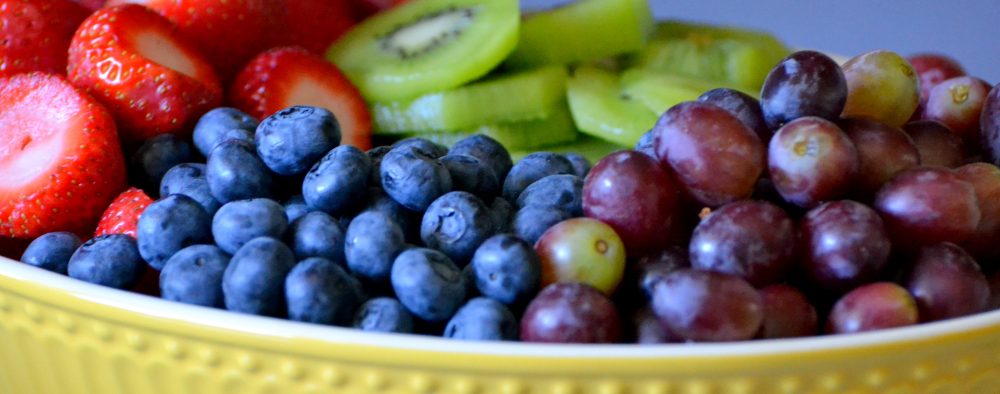
Celebrating sixty years of ‘I do’.
 It is hard to be brief.
I finished Jan Karon’s newest book last night. It undid me. Seriously. I started crying on page 32 and sniffed and sobbed my way through the rest of the book. I loved it. But that is another blog post.
The first thing I wanted to write (in that other post) was how helpful it is to listen to the song Come Rain or Come Shine. Ten years ago I made a slide show for Curt’s Dad and Mom’s 50th anniversary, using Eric Clapton and B.B. King’s version as heard on Riding With the King


So. In the slide show I matched photos to the lyrics: a picture of Mom and Dad with a mountain in the background when B.B. sings ♪♫♪ high as a mountain ♪♫♪ and Dad in the boat on the Snake River when the King sings ♫♪♫ deep as a river ♫♪♫. I own this song.
Before I could write you must listen to this song and make sure you listen to the B.B. King/Eric Clapton version, I would need to evaluate other covers. You, too, can listen to this song over and over (I stopped counting at 142): just type ‘come rain or come shine’ on the search engine in Spotify.
This song clearly demonstrates the difference between orchestra and band, how the style varies with the instruments, stringed, brass, or woodwinds.
 My conclusion: listen to B.B. King and Eric Clapton.
My favorites
— B.B. King and Eric Clapton, Riding with the King (perfection)
— Barbara Streisand and John Mayer, Partners. (same arrangement as BB/EC, I liked the male/female take, a big production, a big YES)
— Willie Nelson, American Classic (Willie brings it! His voice is well-suited for this song. The arrangement is inspired. It’s on repeat.)
Female vocals
— Natalie Cole, Still Unforgettable (clean, upbeat, pure notes, normally I prefer a slower tempo, but gracious, girl’s got pipes, fun cover)
— Etta James, Love Songs, (classic EJ, she sings “unhappy” with conviction)
— Norah Jones, Wynton Marsalis, Here We Go Again (breathy, good blend)
— Robin McKelle (sultry, lots of muted trumpet, brass background, her voice holds up with some sweet high notes)
— Monica Zetterlund, Waltz for Debby (unconvinced until 0:55, then YES)
— Sarah Vaughan, Sarah Vaughan in Hi-Fi (unadorned vocals, vibrato much, weird end)
— Rosemary Clooney, Jazz Singer (too fast, no nuance)
— Billie Holiday, Love Songs (too nasal, it’s all Billie, but Billie didn’t excel, sigh)
Male vocals
— Frank Sinatra, Ultimate Sinatra (he breathes life into the words, wonder-full)
— Ray Charles, The Genius of Ray Charles (Ray was great; background oohs were uninspired, not of fan of this slow tempo)
— Jamie Cullum, Interlude (methinks he’s trying too hard)
Instrumental
— David Hazeltine, The New Classic Trio (jazz trio, wandering, quiet, understated)
— Bill Evans Trio, Portrait in Jazz (piano-centric,
— Beegie Adair, Jazz Romance (elevator music, easy listening station)
— Art Blakey, Moanin’ (upbeat, loud, punchy, and maybe bumpy)
Most hideous:
— Judy Garland, The Essential Capital Collection (the tempo, the pitch, the everything…all. wrong.)
— Chet Baker, Embraceable You (flat, insipid, vacant, absent)

Weddings are my thing. Joyful solemnity, giving, sharing, joining, celebrating, laughing, crying, hugging, singing, dancing, rejoicing, thanksgiving. I love a good wedding and I’ve been to a few profoundly remarkable ones.
There was joy in the air; you could sniff it as plain as new-cut hay.
The focus of Come Rain or Come Shine
 The main character is Lace Harper. Her journals reveal her heart, her hopes, her fears, her loves. She wants to find a wedding dress for under $100; she is thankful for the callouses which document her hard work. She wants to get it—this whole starting a new family—right. I appreciated the ways Dooley and Lace honor the memory of Sadie Baxter (benefactor) and Russell Jacks (Dooley’s grandpa) in their wedding. Fun stuff: there is a Pinterest page for Lace Harper’s wedding!
Jan Karon and Wendell Berry are both skilled at portraying a community where giving, helping, and reciprocating are the norm. In their novels they don’t cover up the hurts, the anger, the tensions, the troubles. Weddings can be awkward with family drama. Karon handles the presence of Dooley’s birth mom, Pauline Leeper, in the same room as his siblings with utmost care. There is no easy resolution, no instant reconciliation, just baby steps, tiny beginnings towards the on-ramp to healing.
I connected with this book in many ways. This summer we went to a small, simple country wedding (see picture above) in a pasture. My son and daughter-in-law have a wind storm and fallen trees in their wedding story, too. I know what it is to be gob-smacked by blessings, reduced to silent tears of joy. Live music is the best for dancing the night away. I love the song in the title.
‘Why can’t life always be lived under the stars,’ she said, ‘with great music and family and friends?’
♪♫♪ Come Rain or Come Shine ♪♫♪ is a standard (music by Harold Arlen, lyrics Johnny Mercer) that has been covered by scores of recording artists. I used it ten years ago when I made a PowerPoint slideshow for Curt’s folks’ 50th wedding anniversary. In the course of my work, I listened to B.B. King and Eric Clapton on endless repetition. And I can honestly say, I never tired of it. But there are so many recordings of this song, that I put my listening of them in this post.
This book.
I finished it last night. I started it again this morning.
 Sherry at Semicolon posted this fun meme this morning. Here are my answers (today).
1. What propelled your love affair with books — any particular title or a moment?
I grew up in a book-saturated home: books in every room, books in front of every face; never a day without books. Books were not allowed at the dinner table, but most of us tried at one time to hold a compelling book in our lap, under the table, and keep reading. It was inconceivable to grew up a Harper and not love books.
2. Which fictional character would you like to be friends with and why?
Laura Ingalls Wilder was my first fixation and she remains with me, especially at this time of the year. Yesterday, I was making a year’s supply of fire starters (dryer lint stuffed into egg cartons with melted wax poured over it) and thought of Pa and Ma’s preparations for winter. (OK, I missed the word fictional…give me a pass, please?)
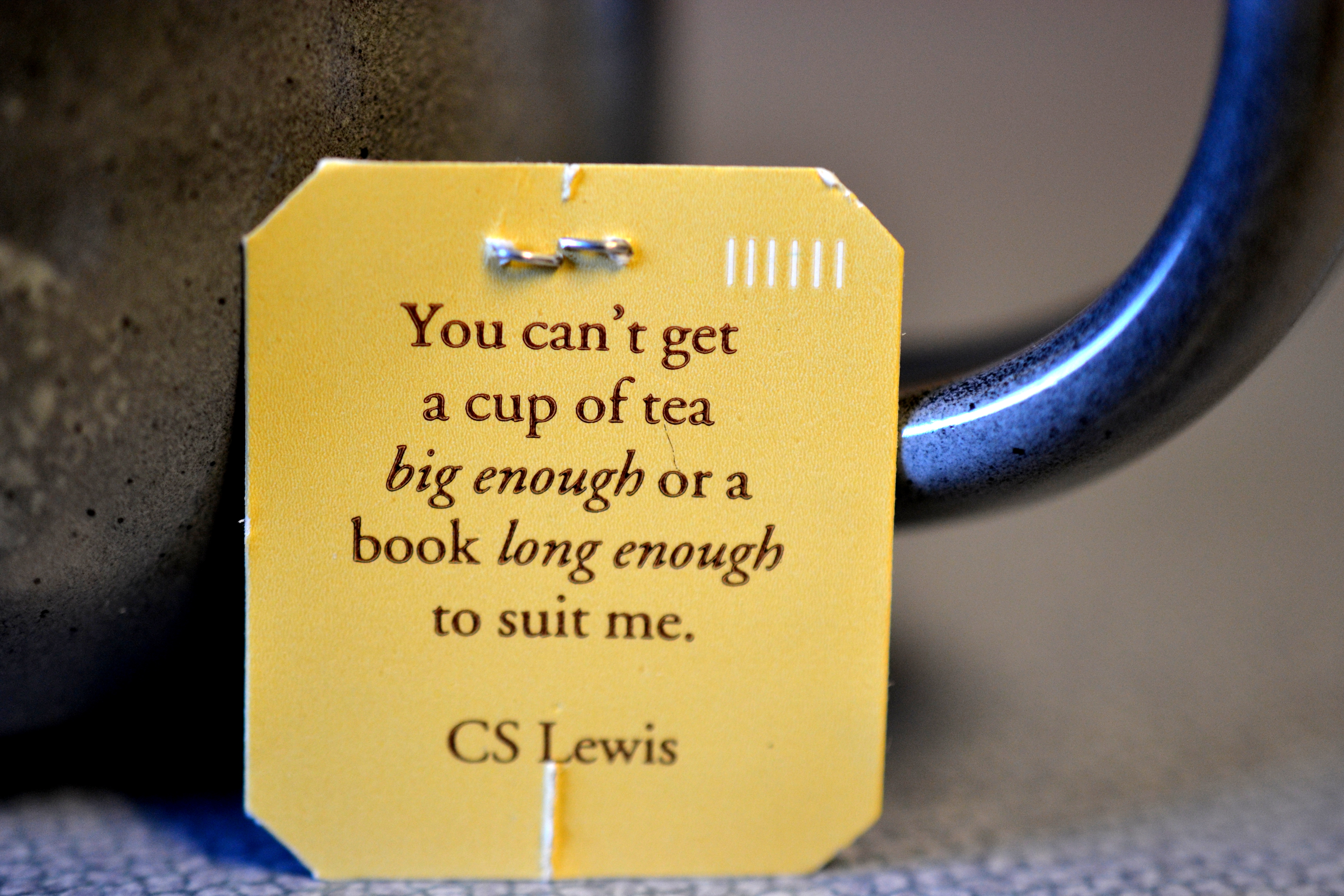 3. Do you write your name on your books or use bookplates?
All but the best books I read are on a rotation: in the house, read, out of the house. When I write my name I always write it in pencil. I’ve found that the book I love today and think I’ll keep forever might get the boot in ten years.
4. What was your favourite book read this year?

5. If you could read in another language, which language would you choose?
Not just one. I’m starting to twitch from the demands of decisions. I’d love to read my father’s Greek New Testament with the cranberry cover. I’d love to read the Latin books on my shelf. I’d swoon if I could read a French book aloud with exquisite pronunciation. And why not Russian? Or Arabic? Or Portuguese?
6. Name a book that made you both laugh and cry.

7. Share with us your favourite poem.
That f word is making me crazy, even with the charming British spelling. Gerard Manley Hopkins Pied Beauty. Billy Collins The Lanyard . To snort with laughter at his Litany….And you are certainly not the pine-scented air. There is just no way that you are the pine-scented air. There is Wendell Berry’s Manifesto with those last two words: Practice resurrection.
But in this moment, my mind goes to Michelangelo’s LXXIII.
Well-nigh the voyage now is overpast,
And my frail bark, through troubled seas and rude,
Draws near that common haven where at last
Of every action, be it evil or good,
Must due account be rendered. Well I know
How vain will then appear that favoured art,
Sole Idol long and Monarch of my heart,
For all is vain that man desires below.
And now remorseful thoughts the past upbraid,
And fear of twofold death my soul alarms,
That which must come, and that beyond the grave:
Picture and Sculpture lose their feeble charms,
And to that Love Divine I turn for aid,
Who from the Cross extends his arms to save.
I love that old translation, but I have a newer one tucked into the page. Which one do you prefer?
Unburdened by the body’s fierce demands,
And now at last released from my frail boat,
Dear God, I put myself into your hands;Smooth the rough waves on which my ship must float.
The thorns, the nails, the wounds in both your palms,
The gentleness, the pity on your face—
For great repentance, these have promised grace.
My soul will find salvation in your arms.And let not justice only fill your eyes,
But mercy too. Oh temper your severe
Judgment with tenderness, relieve my burden.Let your own blood remove my faults and clear
My guilt, and let your grace so strongly rise
That I am granted an entire pardon.
Please join me and link to your answers (or just write them there) in the comments. If your time is limited, take just one question.
 Our home is the kind where nail holes in the wall are sacred. I normally change a picture—or even a paint color—about once a score. Score, you’ll recall, is the second word in the Gettysburg address.
And now, in the space of one month, I have three new views. This shocks me…and confuses friends for whom a total room makeover occurs with every new season. The kind of interior decorators who develop a facial twitch if everything in their house is the same for six months.
The Courage, dear heart is eye level next to the mirror in the bathroom. Befitting, eh? I love looking at this while I prepare for the day ahead. My husband uses this phrase to gently tease me. As in, (me–>) “I can’t figure out how to get the gray scuff marks out of the sink.” (him–>) “Courage, dear heart.”
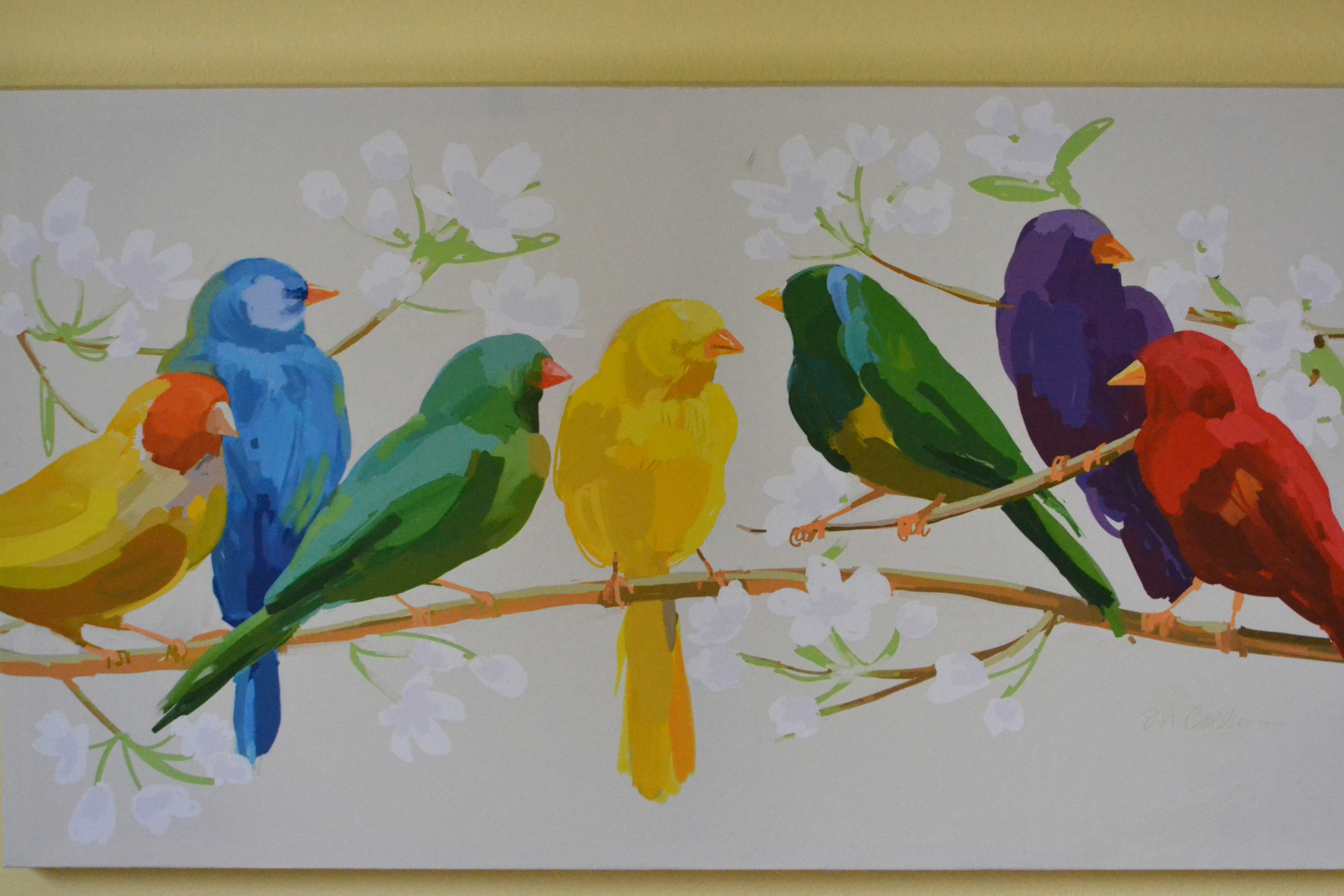 I saw these colorful creatures at The Potter’s House, a local store that sells hand-thrown bowls and plates and mugs. A store perched on the other end of the spectrum from WalMart. My go-to store for gifts. I couldn’t resist the whimsy. Curt calls it, “Till We Have Faces.” I wake up with the birds every morning; they make me sing.
 My friend Faith gave me Bind my wandering heart to thee knowing the phrase came from my favorite hymn, Come Thou Fount of Every Blessing. I propped this on top of my piano, testing the location before I pounded a (sacred) nail in the wall. This week I was in the midst of a talkfest in the aisle of a store when Tune my heart leaned into my peripheral vision. And now they both sing to me in my kitchen while I make dinners or type on the computer. I love the pairing.
Beauty and serendipity washed and rinsed me again. ♫♪♫ Strength for today and bright hope for tomorrow ♫♪♫.
I’ve no background. I’ve been peeled off my background.
I’ve been attached to another background like a cut-out.
I had never heard of Operation Pedro Pan — 14,000 unaccompanied minors were flown out of Cuba to Miami in 1960-62, dispatched by their parents in order to escape life under a dictator, creating a Cuban Diaspora. Carlos Eire, one of the children, writes about it in his memoir, quoted above, Waiting for Snow in Havana
I had never heard the phrase “Raj Orphan” — English children born in the outer edges of the British Empire and shipped to England for education around the age of five years—before I read Old Filth
The displaced orphan, a stock character in literature. One boy raised in Cuba until he was exiled in American at eleven; the other fictional boy, Eddie Feathers (FILTH = Failed in London Try Hong Kong), was born in Malaya—his mother died at his birth—, raised by an native family until he was five, then sent to North Wales to a couple who fostered on the cheap.
Both are compelling stories that snagged me like barbed wire. Both are a lamentation of abandonment. This will sound strange, but negligence of one’s children in order to serve a higher cause is a theme that holds my attention.
 Midway through the second chapter of Waiting for Snow
I have always inhaled with abandon. The world is so full of wonderful smells. Roasted peanuts. Olives. Popcorn. Bus exhaust. Turpentine. Kerosene. Talcum powder. Gasoline. New tires. Glue. Shoe polish. Bubblegum wrappers. Gunpowder. Thinly sliced potatoes and hot dogs frying in olive oil. When I matured, the strangest things began to emit pleasing fumes too. Freshly baked bread. Single-malt Scotch whiskey. Cigars. Roses. Bordeaux wines. New wallets. New cars. The back of a woman’s knee after a hot bath. Fumes are the fifth dimension, I’m convinced.
He tells the story of going to a boy’s birthday party. The parents, owners of a sugar plantation, put on a lavish extravaganza. Carlos brought a last-minute birthday gift, something taken from the house and quickly wrapped.
A foretaste, I hope, of The Final Judgment, the ultimate party, when we show up bearing crappy gifts and, instead of being tossed out on our ear, to wail and gnash our teeth, are instead overwhelmed with superabundant largesse, with eternal gifts beyond our wildest dreams.
I’ve never been to a Catholic confession, but I confess the same pride:
What a neat little list of sins I had. But I don’t think pride was anywhere on that list, not even in disguise. Just the opposite, in fact: I was so, so proud of the list.
Carlos Eire became my focus. I ordered the second memoir he wrote, Learning to Die in Miami: Confessions of a Refugee Boy
Old Filth
“Take this. It was your mother’s.”
“Does Ada [the native girl that raised him] say I can?”
“I say you can. I am your father.”
“You can’t be,” said Edward.
Silence fell and Auntie May’s hands began to shake.
The servants were listening.
“And why not?”
“Because you’ve been here all the time without me.”
Eddie spends his holidays with Jack, a boarding school friend, and is considered a member of Jack’s family; but when they face a crisis their circle closes and Eddie is again excluded.
It turns out that Rudyard Kipling was a Raj Orphan. Now I want to read a RY biography with that perspective in mind. I may or may not read the other two books of Jane Gardam’s Old Filth trilogy.
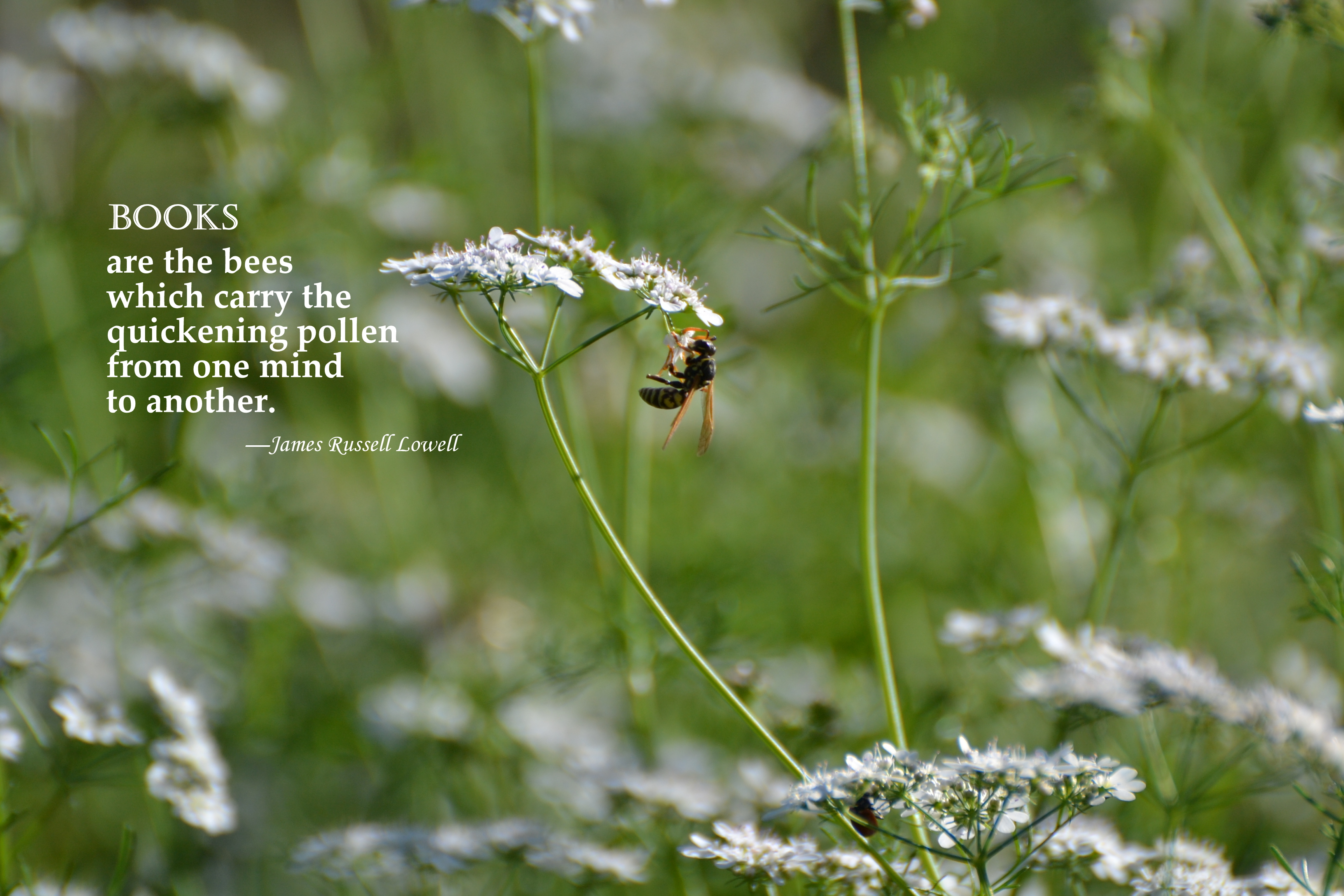 Thanks to Sherry at Semicolon.
 Nothing motivates me to read a book more than deciding to give/sell/swap it and someone else wanting it. The mailing deadline puts me into a panic and the book that has been sitting, unread, on my shelf for decades suddenly must. be. read. Stat!
Such is the story of Marcus Aurelius and His Times. I remember the moment it came into my life. I was at the annual book sale at the local university and my friend/former boss — a skeptic who loved to spar with me over existential stuff, until we had to limit those rambling discussions to Thursday, because we did Theology on Thursday — walked up to me and put this book in my hand. Bakker, he said, you need to read this. And since he had very high literary standards, I clicked my heels and bought the book. That was in the vicinity of 1993.
This book excerpts three authors: Marcus Aurelius, 161-180 AD, Stoic // Lucian of Samosata, Skeptic // Justin Martyr, Christian
As is universally the case, I am astonished at how easy it is to read words from so far back in history. Words that make me giggle aloud:
“Are you irritated with one whose armpits smell? Are you angry with one whose mouth has a foul odor? What good will your anger do you? He has this mouth, he has these armpits. Such emanations must come from these things.”
— M. Aurelius V. 28.
Aurelius advocates a humble approach to life, laced with thanksgiving. I see myself, alas, in the second man of this meditation:
“One man, when he has done a service to another, is ready to set it down on his account as a favor conferred. Another is not apt to do this, but still in his own mind he thinks of the other man as his debtor, and knows what he has done. A third hardly knows what he has done, but is like a vine which has produced grapes, and asks nothing more once it has produced its proper fruit.
As a horse when it has run its race, a dog when it has tracked its game, a bee when it has made its honey, so a man when he has done a good act does not call out for others to come and see, but goes on to another act, as a vine goes on to produce again the grapes in season.”
— M. Aurelius, V.6.
I skimmed the Lucian section but stopped long enough to be enraptured by the phrase “travelers must bedew it [the path] with sweat.”
I was most eager to read Justin Martyr. I’ve read a few early Church Fathers and I declare I find Justin the most accessible. His description of the cross as fundamental to life on earth surprised and delighted me.
The final bonus excerpt from Walter Pater’s ‘Marius the Epicurean’ gave me the most satisfying quote:
“Those august hymns, he thought, must thereafter ever remain by him as among the well-tested powers in things to soothe and fortify the soul. One could never grow tired of them!”
From Alexander, the grammarian, [I learned] to refrain from faultfinding, and not in a reproachful way to chide those who uttered any barbarous or incorrect or strange-sounding expression; but tactfully to introduce the very expression which they ought to have used, in the course of an answer or assent or inquiry about the thing, not about the word; or by some other suitable suggestion.
— Marcus Aurelius
The timeline of my grammar life could be summed up in a few words: apathetic → indifferent → learned-through-teaching → pompous donkey → repellant sheriff → quieter → still learning manners.
There was a time in my life, alas, when I would not hesitate to correct your grammar, nay, when I would swoop down and pounce upon your words as an eagle dives for a fish. There was a time when I approved of scoldfests written by grammar purists.
There was a time, cough cough, when I publicly corrected my son in the middle of a toast at a wedding reception. Indeed, it’s true! But here’s the deal. He said, speaking to his brother-in-law (groom) and sister-in-law (bride), that “my mom should probably get a finder’s fee since two marriages happened because of her Grammar Class: First me and Jessie got married and now you two.” I could only stand up and say, “JESSIE AND I” … and the crowd roared with laughter. If it had been a art class or a science class I would never have said a peep!
I pray those times are behind me. I hope I’ve learned that people are more precious than words. There is a time to refrain from faultfinding.





 A Living Pencil