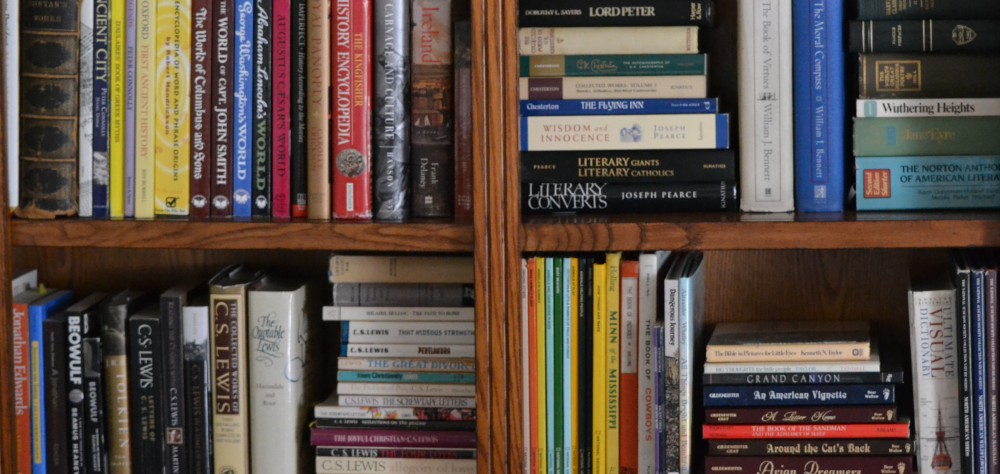
in which you live
and I will tell you who you are.
~ José Ortega y Gasset
One of the first and finest lessons I learned from blogging (thank you, Janie) was to read with a plan. It’s not that I needed a Reading Challenge to read more, but it kept my reading focused, gave it form.
For years my reading choices have been oriented to time, cataloged by chronology. As I homeschooled, I read about the Greeks, the Romans, Medieval times, the Renaissance, colonization, etc. Literature was linked with history.
But, now I’m ready for a different focus. Wendell Berry has made me think more about place. I would like to orient my reading for 2010 (& ’11?) to geography, land, cultures. I explored my bookshelves and, ladies and gentlemen, we have a plan: to read around the world from my home. All the titles on this list reside in our house. A few I have begun, but not completed; none are re-reads. And because I like to read across time as well as across continents, I’ve included the year of publication. The short descriptions are the publisher’s blurbs found on back covers and dust jackets or notes from the author’s introductions.
I don’t promise to read every book on this list in 2010. Undoubtedly I will discover some not worth reading. I don’t promise to read only books on this list. But this will be my core curriculum this year (and next?).
These aren’t the *best* books to read on each country. They are just the ones that happen to be on my shelf. I want to read them, release the one-time-through-is-enough books and keep and love the others. If you have recommendations on other titles, I’d love to hear them. Just know that it’s close to giving a drunkard a bottle of wine.
This post is ridiculously long. I have librarian DNA in me; formatting this was fun! Connections (like a quote from Thubron on Fisher’s book…immediately after posting Thubron’s book) abound. I’m really revved up.
If you scroll to the bottom, there are two books to be given away.
 An Unexpected Light: Travels in Afghanistan
 Jason Elliot (1999) In his skillful illumination of an ancient and noble history long obscured by war, Elliot has done service to a country rarely written about. But it’s his lyrical culling of beauty from despair that will resonate long after the last page has been turned.
Africa
 Facing the Congo: A Modern-Day Journey into the Heart of Darkness
 , Jeffrey Tayler (2000) Faced with an identity crisis in his work and his life, seasoned traveler and journalist Jeffrey Tayler made a bold decision. He would leave behind his mundane existence in Moscow to re-create the legendary British explorer Henry Stanley’s trip down the Congo in a dugout canoe, stocked with food, medicine, and even a gun-toting guide.
 Out of Africa and Shadows on the Grass
 Isak Dinesen (1937, 1960) At the age of twenty-seven, Isak Dinesen (née Karen Blixen) left Denmark and sailed for East Africa to marry her Swedish cousin, Baron Bror Blixen. Together they bought a four-thousand-acre coffee plantation in Kenya. From 1914 to 1931 she managed the plantation, even after she and her husband separated. Her account of those years is transformed by the magic of her prose and her supreme gift as a storyteller into a vibrant re-creation of Africa, filled with her affection for and understanding of the land and its people.
 Out of My Life and Thought
 Albert Schweitzer (1933) A brilliant organist, musicologist, theologian and philosopher, Albert Schweitzer, at the age of thirty, turned his back on the dazzling rewards the world offered him in order to serve his fellow men as a medical missionary in Africa. It is a thrilling account of a monumental personal quest, enormous self-sacrifice and extraordinary achievement, told with simplicity, modesty, and humor.
 The Heart of the Hunter: Customs and Myths of the African Bushman
 Laurens van der Post (1961) Traveling out of the Kalahari’s Central Desert, van der Post traverses the splendid terrain of southwestern Africa and finally encounters the Bushmen. It is only at the end of this physical trek that the real journey can begin; once van der Post has found the tribe, he looks deep into the Bushmen’s customs and mythological life. The true odyssey of The Heart of the Hunter is into the mind and culture of a legendary people.
 Arrow of God
 The Reader’s Companion to South Africa
 Skeletons on the Zahara
 Too Late The Phalarope Alan Paton (1953) After violating his country’s ironclad law governing relationships between the races, a young white South African police lieutenant must struggle alone against the censure of an inflexible society, his family, and himself. / A great and enduring novel, written in exquisitely balanced prose.
 West with the Night
Alaska
 The Reader’s Companion to Alaska
 Edited Alan Ryan (1997) Inspiring and unforgiving, Alaska is vividly revealed in this collection of twenty-eight eyewitness reports from intrepid travelers to America’s last great frontier. An enraptured John Muir first glimpses Glacier Bay in 1879. John McPhee encounters kamikaze bush pilots, and Anne Morrow Lindbergh is amazed simply at the sight of a road after a long flight over the trackless wastes of the North Slope. / Covers the majesty and terror of the great frontier.
American Midwest
 Giants in the Earth: A Saga of the Prairie
 O.E. Rölvaag (1925) A classic story of a Norwegian pioneer family’s struggle with the land and the elements of the Dakota territory as they try to make a new life in America. / A fiercely woven tapestry of harsh texture wrought by a master sure in his choice of strong fiber and of color, telling with heroic gesture and intricate design its legend of simple people struggling in the eternal coil of unwitting life.
American South
 A Wake for the Living
 Andrew Nelson Lytle (1975) “Now that I have come to live in the sense of eternity” are the words with which Tennessean Andrew Lytle opens his lively family chronicle, A Wake for the Living, and it is perhaps the author’s detachment from time that allows him to invest these stories with such freshness and immediacy. With his own often boisterous family as the focus, Lytle turns the narrative into a meditation on the meaning of American history, “the carnal serach for Eden.”
 Penhally
 Stomping The Blues
American West
 A Lady’s Life in the Rocky Mountains
 Isabella L. Bird (1873) Women were scarce enough in the West of the late nineteenth century, and a middle-aged English lady traveling alone, by horseback, was a real phenomenon. It was during the autumn and early winter of 1873 that Isabella Bird made this extended tour of the Rocky Mountain area of Colorado, when she was on her way back to England from the Sandwich Islands. / Delightful letters by an English spinster who recorded a considerable portion of the real West.
 Hole in the Sky
 William Kittredge (1992) This is the story of a grandfather whose single-minded hunger for property won him a ranch the size of Delaware but estranged him from his family; of a father who farmed with tractors and drainage ditches but consorted with movie stars; and of Kittredge himself, who was raised by cowboys and saw them become obsolete, who floundered through three marriages, hard drinking, and madness before becoming a writer.

 It Happened in Oregon
 and It Happened in Washington
 James A. Crutchfield (1994, 1999) Here you’ll read about the volcanic eruption that formed Crater Lake, the haphazard deal that led to the founding of Portland, and the reckless decision that resulted in the Great Tillamook Burn. / You will uncover the avalanche at Ozette, follow a massive manhunt from Tacoma to the wheat fields of eastern WA, and witness the 1980 eruption of Mount St. Helens.
 Journals of Lewis and Clark
 (1809) From 1804 to 1806 Captain Lewis and Captain Clark led their intrepid expeditionary crew on an 8,000-mile trek–from the mouth of the Missouri to the Pacific outlet of the Columbia River. Paddling in canoes and riding on Indian horses, the “Corps of Discovery” confronted breathtaking mountains, white-water rapids, charging buffalo…a natural world never before seen by white men: Edenic landscapes, mysterious native peoples, and the first descriptions of hundreds of plants and animals (coyotes, bighorns, prairie dogs, jackrabbits, kit foxes, and Ursus horribilis, the grizzly bear).
Mountain Man Vardis Fisher (1965) Strange, that people can find so strong and fascinating a charm in this rude, nomadic, and hazardous mode of life, as to be estranged themselves from home, country, friends, and all the comforts, elegances, and privileges of civilization; but so it is, the toil, the danger, the loneliness, the deprivation of this condition of being, fraught with all its disadvantages, and replete with peril, is, they think, more than compensated by the lawless freedom, and the stirring excitement, incident to their situation and pursuits.

 The Mountains of California

My Oregon
 Of Men and Mountains
 William O. Douglas (1950) In 1949, after a fall from a horse broke all but one of his ribs, the busy 51-year-old Douglas had time to write about the profound influence nature had on his life. “These pages contain what I, as a boy, saw, felt, smelled, tasted, and heard in the mountains,” he begins. What follows are evocative, compelling tales of the grandeur of the mountains and the solitude of the individual. “I learned that the richness of life is found in adventure,” Douglas writes. “It develops self-reliance and independence. Life teems with excitement. This book may help others to use the mountains to prepare for adventure.”
 Rising From The Plains
 John McPhee (1986) If you like to read about geology, you will find good reading here. If, on the other hand, you are not much engaged by the spatial complexities of the science, you could miss a richness of human history that has its place among the strata described. This is the story of an isolated ranch, soon after the turn of the century, and of the geologist who grew up there, at home with the composition of the high country in the way that someone growing up in a coastal harbor would be at home with the vagaries of the sea.
 Tough Trip Through Paradise, 1878-1879
 Andrew Garcia Throughout the long nights, by lantern light, on this little mountain ranch, Garcia wrote a story that took place in a land so vast and varied that it is almost impossible to comprehend. / Tough Trip Through Paradise grew out of a manuscript left by Andrew Garcia on his death in 1942 after a long and colorful life in Montana. It tells Garcia’s story of the 1877 war between the U.S. government and the Nez Perce people, the end of the buffalo herds, and other historic events in Western life.
Appalachia
 A Walk in the Woods
 Bill Bryson (1998) Back in America after twenty years in Britain, Bill Bryson decided to reacquaint himself with his native country by walking the 2,100-mile Appalachian Trail, which stretches from Georgia to Maine. The AT offers an astonishing landscape of silent forests and sparkling lakes–and to a writer with the comic genius of Bill Bryson, it also provides endless opportunities to witness the majestic silliness of his fellow human beings.
Australia
 In a Sunburned Country
 Bill Bryson (2000) Australia is a country that exists on a vast scale. It is the only island that is also a continent and the only continent that is also a country. Despite being the most desiccated, infertile, and climatically aggressive of all inhabited continents, it teems with life. In fact, Australia has more things that can kill you in extremely nasty ways than anywhere else: sharks, crocodiles, the ten most deadly poisonous snakes on the planet, seashells that actually attack you, and the unbelievable box jellyfish. It’s one tough country
Bosnia
 The Bridge on the Drina
 Ivo Andric (1945) A great stone bridge built three centuries ago in the heart of the Balkans by a Grand Vezir of the Ottoman Empire dominates the setting of Ivo Andric’s novel. Spanning generations, nationalities, and creeds, the bridge stands witness to the countless lives played out upon it…War finally destroys the span, and with it the last descendant of that family to which the Grand Vezir confided the care of his pious bequest–the bridge.
Canada
 Roughing it in the Bush
 Susanna Moodie (1852) When Roughing It in the Bush was published in 1852, it created an international sensation, not only for Susanna Moodie’s glowing narrative of personal incident, but also for her firm determination to puncture the illusions European land-agents were circulating about life in Canada. This frank and fascinating chronicle details her harsh–and humorous–experiences in homesteading with her family in the woods of Upper Canada.
Croatia
 Dubrovnick (2004) The town of a perfect harmony reveals itself. The man is the measure of living in the town which changes its face every day, sings, keeps silent, grieves, which is melancholy and mysterious, but permanent in its beauty. It is built in stone in which it inscribed the motto of its existence: Non bene pro toto libertas venditur auro (You do not sell freedom for all the gold!).
Cuba
 The Reader’s Companion to Cuba
 Edited by Alan Ryan (1859-1992) The Reader’s Companion to Cuba offers nearly two dozen captivating eye-witness “reports” from visitors to Cuba’s shores, among them Anais Nin’s introduction to the “Fairyland” of Havana, Langston Hughes’s surprising rumba party, an excursion around town with Fidel behind the wheel, Tommy Lasorda’s baseball interview with pistol presiding, and Thomas Merton’s pilgrimage to Our Lady of Cobre–a trip “nine-tenths vacation and one-tenth pilgrimage.”
 Country Bunch: A Collection by ‘Miss Read’ (1963) Drawn from diaries, memoirs, poems, novels, recipes, spells and even curses, Country Bunch is a rich anthology that evokes all these things and more. In it Miss Read shares her astonishing breadth of reading with us, taking us on a wonderful journey through the countryside with the help of, among others, Dorothy Wordsworth, Laurie Lee, Flora Thompson, Chaucer and Shakespeare. The writings included range from Anglo-Saxon times to the present day and cannot fail to delight all who read them, even the most jaded city-dweller.
 In Search of England
 Small Island
 Andrea Levy (2004) Hortense Joseph arrives in London from Jamaica in 1948 with her life in her suitcase, her heart broken, her resolve intact. Her husband, Gilbert Joseph, returns from the war expecting to be received as a hero, but finds his status as a black man in Britain to be second class. His white landlady, Queenie, raised as a farmer’s daughter, befriends Gilbert, and later Hortense, with innocence and courage, until the unexpected arrival of her husband, Bernard, who returns from combat with issues of his own to resolve.
Everywhere
 1,000 Places to See Before You Die: A Traveler’s Life List
 Patricia Schultz (2003) Around the world, continent by continent, here is the best the world has to offer: 1,000 places guaranteed to give travelers the shivers. Sacred ruins, grand hotels, wildlife preserves, hilltop villages, snack shacks, castles, festivals, reefs, restaurants, cathedrals, hidden islands, opera houses, museums, and more. Each entry tells exactly why it’s essential to visit. Stop dreaming and get going.
 A Year in the World: Journeys of A Passionate Traveller
Locations

My World of Islands
Places
France

 Christine de Pizan (1405) Written in 1405, The Book of the City of Ladies is a history of Western civilization from the point of view of women. Christine de Pizan, the author of this remarkable volume, is considered France’s first woman of letters. She wrote more than twenty distinguished works, nearly all concerned with two themes: the political life of her country and the defense of her sex.
  France the Beautiful Cookbook
 Scotto Sisters (1989) France, the Beautiful Cookbook gives a rare insight into the less-publicized side of French cooking: a cuisine which, for centuries, has been passed down through families by word of mouth. It explains the vital link between each region’s history, geography and culinary traditions, and the people who make the food so unique. Without the abundance of oysters, without cassoulet, without hochepot, without bourride, without the wines and beers that go with them, France would not be France.
 The Piano Shop on the Left Bank
 Thad Carhart (2000) Walking his two young children to school every morning, Thad Carhart passes an unassuming little storefront in his Paris neighborhood. Intrigued by its simple sign–Desforges Pianos–he enters, only to have his way barred by the shop’s imperious owner. Intertwined with the story of a musical friendship are reflections on how pianos work, their glorious history, and stories of people who care for them, from amateur pianists to the craftsmen who make the mechanism sing.
 The Story of San Michele Axel Munthe (1929) This is the story of a remarkable life filled with fabulous experiences and ambitions. Axel Munthe was a fashionable physician in Paris who built one of the best-loved houses in the world–San Michele–on the Isle of Capri, on the site of the villa of Tiberius.
 Two Towns in Provence
 M.F.K. Fisher (1964) Here she not only celebrates, in her uniquely perceptive, evocative fashion, Aix-en-Provence and Marseille, but also gives us ‘my picture, my map, of a place and therefore of myself’. Weaving together topography, history, folklore and personal memoirs with the looks, the sounds, the smells and the tastes of her chosen cities, M.F.K. Fisher provides the traveler, the gourmet and the lover of France and fine writing with unforgettable portraits of two remarkable and highly individual towns.
Germany
 Evening in the Palace of Reason: Bach Meets Frederick the Great in the Age of Enlightenment
 James R. Gaines (2005) [Frederick] worked hard and long to draw “old Bach” into his celebrity menagerie. The king had prepared a cruel practical joke for his honored guest, asking him to improvise a six-figure fugue on a theme so fiendishly difficult some believe only Bach’s son could have devised it. In a fever of composition, [Bach] used the coded, alchemical language of counterpoint to write A Musical Offering in response. A stirring declaration of everything Bach had stood for all his life, it represented “as stark a rebuke of his beliefs and worldview as an absolute monarch has ever received.” It is also one of the great works of art in the history of music.
Guernsey
 The Book of Ebenezer Le Page
 G.B. Edwards (1981) Ebenezer Le Page, a man of the Channel Islands tells his story, and from the moment we meet him, in mid-sentence, we are spellbound: he is funny and contrary with a furious loving attachment to the past and an old man’s querulousness towards the new. / Imagine a weekend spent in deep conversation with a superb old man, a crusty, intelligent, passionate and individualistic character at the peak of his powers as a raconteur, and you will have a very good idea of the impact of The Book of Ebenezer Le Page…Extraordinary.
India
 A Passage to India
 E. M. Forster (1924) Ranked among the greatest novels of the twentieth century, A Passage to India is the classic account of the clash of cultures in British India after the turn of the century. With careful crafting, exquisite prose, and a well-developed sense of irony, Forster reveals the menace lurking just beneath the surface of ordinary life, as a common misunderstanding erupts into a devastating affair. Mr. Forster possesses the secret of all poets, which is intensity of perception.
 Clear Light of Day Anita Desai (1980) A wonderful novel about silence and music, about the partition of a family as well as a nation. / Set in India’s Old Delhi, Clear Light of Day is Anita Desai’s tender, warm, and compassionate novel about family scars, the ability to forgive and forget, and the trials and tribulations of familial love. / This is a wonderful book, a book where passages must be read and reread so that you savor their imagery, their language, and their wisdom.
 Climbing the Mango Trees: A Memoir of a Childhood in India
Ireland
 Ireland: A Novel
 Frank Delaney (2005) Ireland travels through the centuries, interweaving Ronan’s quest for the Storyteller with a richly evocative unfolding of the great moments of Irish history, ranging from the savage grip of the Ice Age to the green and troubled land of tourist brochures and political unrest. Along the way, we meet foolish kings and innocent monks, fabled saints and great works of art, shrewd Norman raiders, strong tribal leaders, poets, politicians, and lovers. Each illuminates the magic of Ireland and the eternal connection of its people to the land.
 Twenty Years A-Growing
 Maurice O’Sullivan (1933) Maurice O’Sullivan was born in 1904 on a remote island off the Atlantic coast of Ireland–the Great Blasket. In this classic book he tells the story of his youth, and of a way of life which belongs to the past.
 If the reader laughs at the schoolmistress and the matrons, and is moved by the dream of a butterfly inside the horse’s skull–then he is assured of amusement and emotion to come. He is ready to go to Ventry Races, and to make the great journey from Dingle East…This book is unique…for here is the egg of the sea-bird–lovely, perfect, and laid this very morning.
 Warrenpoint
 Denis Donoghue (1990) Warrenpoint takes its title from the seaside town in Northern Ireland whose police barracks served as the residence for the Catholic Donoghue family…a love story bearing on the severe relations between Donoghue and his policeman father–“not,” by the master critic’s own admission, “a well-rounded character,” but instead one who might seem “partial and brittle.”…Here is that rarest of books, a necessary book–for everyone concerned with the life of the mind and with the hard business of living with the family romance.
Italy
 Italy – The Beautiful Cookbook
 Lorenza De’ Medici (1996) For those who imagine Italian food to consist of pizza, pasta and tomato sauce, this book will be a revelation. It encompasses the culinary traditions of the whole of Italy – a country diverse in landscape, climate and traditions, but blessed with a wonderful array of ingredients and a people imaginative enough to make the most of them. The food is uncontrived but delicious, fresh and full-flavored.
 Lavinia
 The Path to Rome
 Playing for Pizza
New York City
 How the Other Half Lives
 Jacob A. Riis (1890) In 1890, when the book was published, the Lower East Side was a landscape of teeming streets and filthy tenements crowded with immigrants living in dreadful conditions. How the Other Half Lives brings them to life–the Italians, Jews, Bohemians (Czechs and Slovaks), Blacks, and Chinese–in precise descriptions of their habits and traditions, jobs and wages, rents paid and meals eaten, and explores the effects of crime, poverty, alchohol, and lack of education and opportunity on adults and children.
North Pole
 Arctic Dreams: Imagination and Desire in a Northern Landscape
 Barry Lopez (1986) It is a celebration of the artic landscape and of the animals that live there…of the Eskimo…a story of movement…a story of light–solar and lunar rings, halos, and coronas; the pale green and soft rose of the aurora borealis; the distant mountain that is actually a looming, and entirely convincing, mirage. Unique in its vision, it is a book that asks what it means to live well. In the integrity of that land one finds an answer.
 My Attainment of the Pole
 Frederick A. Cook (1913) Cook, allegedly the first man to reach the North Pole, recounts his adventures at the top of the world, his meetings with Eskimos and his hunting of musk ox, plus his subsequent debates with Robert Peary after he had returned to his homeland. / Cook must be considered an extraordinary personality in Polar history…he was a Bonaparte on the ice to his rival…
Nowhere
 The Geography of Nowhere: The Rise and Decline of America’s Man-Made Landscape
 James Howard Kunstler (1993) In elegant and often hilarious prose, Kunstler depicts our nation’s evolution from the Pilgrim settlements to the modern auto suburb in all its ghastliness. The Geography of Nowhere tallies up the huge economic, social, and spiritual costs that America is paying for its car-crazed lifestyle. It is also a wake-up call for citizens to reinvent the places where we live and work, to build communities that are once again worthy of our affection.
  Kon-Tiki: Across the Pacific in a Raft
 Thor Heyerdahl (1950) Kon-Tiki is the record of an astonishing adventure — a journey of 4,300 nautical miles across the Pacific Ocean by raft. Intrigued by Polynesian folklore, biologist Thor Heyerdahl suspected that the South Sea Islands had been settled by an ancient race from thousands of miles to the east, led by a mythical hero, Kon-Tiki. He decided to prove his theory by duplicating the legendary voyage.
 Racing Through Paradise: A Pacific Passage
Russia
 One Day in the Life of Ivan Denisovich
 Aleksandr Solzhenitsyn (1962) First published in 1962, it is considered one of the most significant works ever to emerge from Soviet Russia. Illuminating a dark chapter in Russian history, One Day in the Life of Ivan Denisovich is at once a graphic picture of work camp life and a moving tribute to man’s will to prevail over relentless dehumanization, told by “a literary genius whose talent matches that of Dostoyevsky, Turgenev, Tolstoy [and] Gorky.”
 Tevye the Dairyman and The Railroad Stories
Where Nights Are Longest: Travels by Car Through Western Russia
 In Search of Scotland
 H.V. Morton (1929) There is, I think, something to be said for books written by an explorer who admits frankly, as I do, that he knew nothing about Scotland when he set out, because then commonplace knowledge comes freshly with an air of discovery, and those readers who are also ignorant are possibly stimulated to go forth and perform the same trick of progressive absorption.
 Men of the Covenant
Utah
 The Gathering of Zion: The Story of the Mormon Trail
 Wallace Stegner (1964) Wallace Stegner has written the best single volume to appear on the Mormon migration westward…His sensitivity to human beings and his ability to understand the spirit motivating the oft-persecuted Latter Day Saints allow him insights missed by earlier writers. Stegner draws on scores of printed and unprinted diaries kept by the Saints, and has used these very personal documents to pinpoint events that take on new meaning when viewed through the eyes of commonplace mortals.
 The Burning : Sheridan’s Devastation of the Shenandoah Valley
 John Heatwole (1998) The Burning captures the tragedy of two weeks in the Shenandoah Valley in the autumn of 1864. It is the story that…reminds modern readers how the Civil War visited with man-made flame and fury the granery of the Confederacy. Rich in detail, incidents, and drama, The Burning is a gripping story and a fine book.
 Wild Wales: Its People, Language and Scenery
 George Borrow (1901) Wales signifies a land of mountains, of vales, of dingles, chasms, and springs. It is connected with the Cumbric bal, a protuberance, a springing forth; with the Celtic beul or beal, a mouth; with the old English welle, a fountain; with the original name of Italy, still called by the Germans Welshland; with Balkan and Vulcan, both of which signify a casting out, an eruption…
I have a copy of 1,000 Places To See Before You Die
and an ex-library (but charming if you like old textbooks)
1929 edition of How the Other Half Lives by Jacob Riis.
Riis was a photojournalist; his photos are compelling.
[Leave a comment either here or on Facebook.
Please mark your preference. Thanks!]
I will draw names on January 12th.


 . At the beginning of March it was the best DVD we had seen in 2009, and at the end of December I can still say it was the best.
  documents the independence of Estonia through the power of singing. It’s simply incredible! Please! Take two minutes, click on the link and watch the trailer. I had the same response to this film that I had to a much different movie,
 from Netflix and decided we needed to own this series. We gave the set to our sons for Christmas. Extraordinary footage. If you have kids in your life, it is worth owning this.
  is an eye-opening look at what we eat. Sounds appetizing, eh? If you enjoyed Michael Pollan’s book
 . It took us a while to find a friend willing to lend it to us. Curt had co-workers who owned this set, but it was too precious to them to lend it out. Gritty, war-violence, it is not for the faint of heart. If you can stomach the intensity of combat scenes, it is highly excellent. Our son was very happy to get this from his brother for Christmas. On a side note, the theme music is the most compelling, haunting, soul-grabbing collection of notes.
  with my daughter-in-law and her sister. They said it was the best war movie they’d seen. Apart from the opening, there are no gunfights or battle scenes. It is all spy and mystery and thriller. Even though you
  when it came out in 2000, but I did. I love Dickens and I loved David C. We’ve enjoyed
  but it is gripping. This is, I believe, Emma Thompson’s best role….ever. John Donne, the metaphysical poet, is worth exploring. My review
  under films that demonstrate the power of music. A composer/teacher takes a job at a boy’s reform school after WWII. The headmaster is a typical two-dimensioned cruel man, a foolish tyrant. Singing in a chorus brings beauty into the students’ lives. A few gritty parts, and a little heavy on sentimentalism, but I liked it.
 to us. It’s the first foodie show we’ve raved about. Jamie Oliver is a guy’s guy who loves to cook. Unpretentious. With a British accent. What’s not to love?
 this Christmas. Since Curt and I watched it in the theater, we rented a disc of Julia Child’s cooking shows. Having seen them underscored how brilliant Meryl Streep really is. Perfectly delightful.
  . I was dipping into Michael Ruhlman’s
  . The tree twinkled, the fire crackled; the only other sounds were barely audible breathing.


 A Living Pencil