Sister Bernadette’s Barking Dog

DSC_8942My husband, home sick from work, was fixing to fascinate me with stories about locks at the hospital. My responses cycled between “Hmmm” “Oh?” “yeah” and “wow.” He shook his head in exasperation and complained, “I’m trying to impress you and you aren’t responding!”

“Babe,” I lifted my head and made eye contact. “I have three pages left of this book.”

“Oh?” he said. “What are you reading?”

“Sister Bernadette’s Barking Dog … a book about diagramming sentences.”

We dissolved into laughter at the absurdity of diagramming edging out locksmithing.

When I was a student, I was not gripped by grammar. Caron, my camp friend, used to amuse herself by counting the spelling and grammar mistakes in my letters. The fun flattened when the error count declined to three or four. I still stumble over less and fewer, lay and lie, hopefully and I hope.

Kitty Burns Florey is a fun look back. Moderately fun. To those who suffered through grammar, it has about the same nostalgic power as a teeter-totter has to two chunksters in their fifties. (Have you noticed that teeter-totters disappeared from playgrounds? Hmmm?)

Relax! Florey’s acerbic tone spices up this bland subject. She calls Eats, Shoots & Leavesa “popular scold-fest.” I enjoyed her prose and reveled in her side notes.

The fact is that a lot of people don’t need diagramming or anything else: they pick up grammar and syntax effortlessly through their reading—which, in the case of most competent users of words, ranges from extensive to fanatical. The language sticks to them like cat hair to black trousers, and they do things correctly without knowing why.

I learned details about words, a bonus she couldn’t resist throwing in. (When Kitty isn’t writing books, she is a copy editor.) I learned that enormity means a very great wickedness, not a very large hugeness. Likewise, infinitesimal means endless, not very, very small. She explained that a Lion’s share is 100%, not a majority. Ain’t, don’t you know, exists because we don’t have a contraction for “am not.” So ain’t used with the first person singular (the pronoun I) is technically correct.

My opinion is that English grammar can be taught with more ease and more adhesion through the ear rather than the eye, with vocal chants/songs such as those used in The Shurley Method or Grammar Songs. But, I enjoyed the refresher course on sentence diagramming.

The visual delight of the book are the diagrams of unwieldy sentences by James, Hemingway (whose sentences are normally spare), Fenimore Cooper, Twain, Proust, Oates, Updike, Kerouac, Fitzgerald, Faulkner, Welty and Powell.

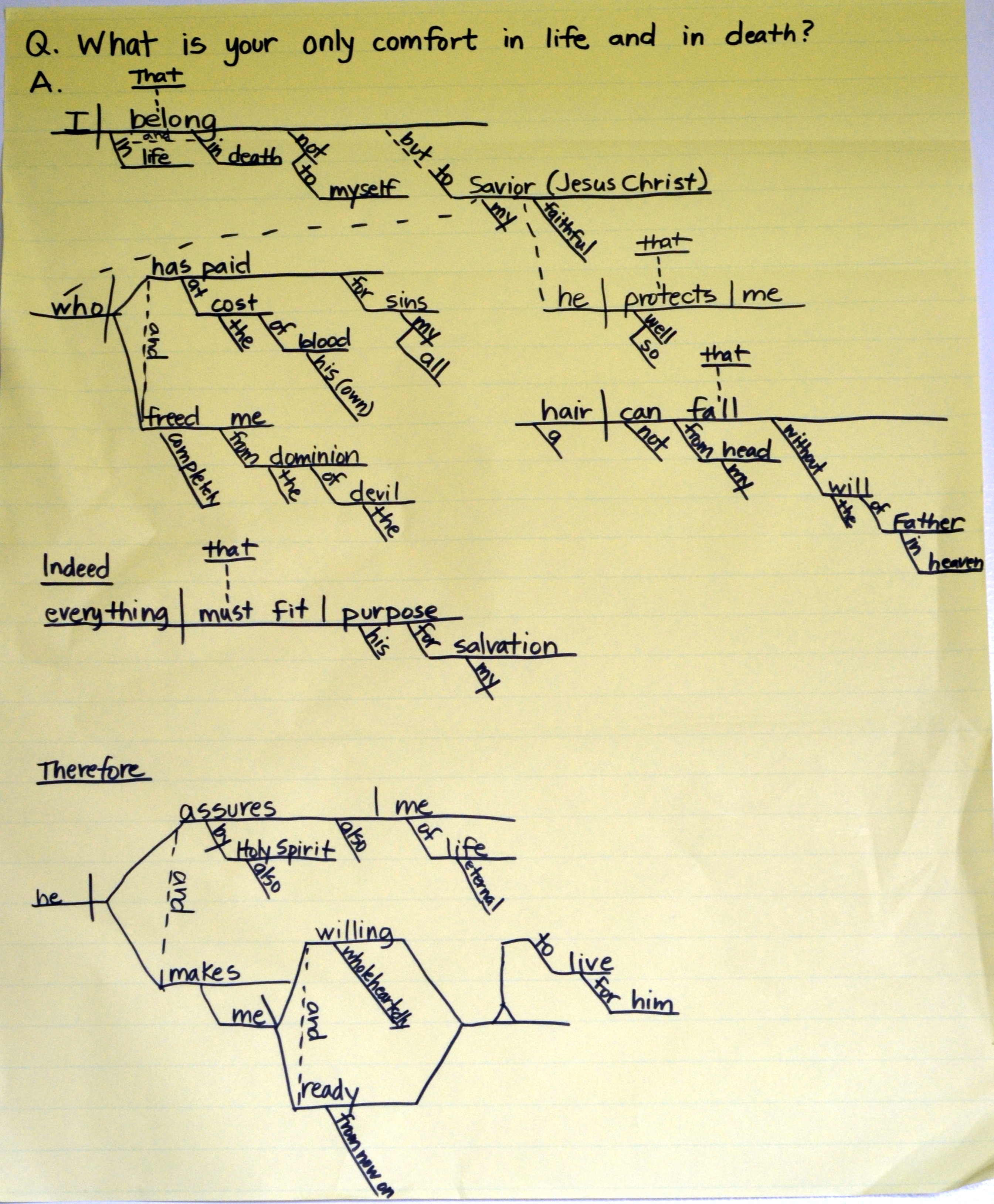
I couldn’t resist trying a long sentence myself. Above is the answer to the first question of the Heidelberg Catechism. Corrections are welcome.

England, Goudge, the Eliots

101_4570Elizabeth Goudge’s Eliot Family Trilogy?

First, it is English: paragraphs of appreciative comments on the comfort of tea; gallons of hot tea consumed; nine variations of rain—slanting, gentle, white, solid, gloomy, light, windy, misty, sparkly; logs added to warming fires; imaginative children; a country vicar; the pronoun ‘one’ put to good use (Eustace—dreadful name! One thinks at once of a parson’s dog-collar); ditto for the adverb ‘rather’ and the adjective ‘dreadful’ (Ben says it’s dreadful. They’re trying to do a telescoped version of ‘The Wind in the Willows’, and it won’t telescope.)

Then, it is Elizabeth Goudge. I find Goudge in a category of her own. She is spiritual, at times mystical, fantastical (Faerie, but just in cameo appearances), romantic in the sense of the woods being infused with symbolism, almost medieval.

But her characters deal with modern problems that most authors of her genre would avoid. One man falls in love (inexcusably, I’d say: one must recognize boundaries) with the wife of one of his relatives. This complex relationship is the focus of her first book, but isn’t completely resolved until the third. Goudge’s parents have favorite children. Some of the marriages lack love. One character’s violent past is haunting.

There is a strong sense of place. Damerosehay, a large eighteenth century house purchased by the Grandmother, home base for the Eliot family, is the focus of book one. The Herb of Grace—a Pilgrim’s Inn, where sojourners stay on pilgrimage to a sacred place—is more ancient, with deep history in its walls. George and Nadine’s restoration of this Inn is the focus of the second book. The third book adds Lavender Cottage, a small place where Margaret and Lucilla can retire.

Her themes resonate with me: determined contentedness; work as a sacramental offering; the mystery of small joys; beauty indoors and outdoors, interior and exterior; the inscrutable connection between twins; aging, grandparenting, and above all else, relinquishment.

“Relinquish.” It was a good word. It suggested not the tearing away of treasures but the willing and graceful sacrifice of them.     The Bird in the Tree

The twins mimic a blend of The Wind in the Willows, medieval crusaders, and pirates:

“Scrooge, scrabble and scratch.” repeated Jerry. “For the glory of God, my hearties. For the glory of God.” Pilgrim’s Inn

Hilary, wounded in the first world war, is stable, sensible, lovable.

Nevertheless, the tea was what he wanted. Heat, he thought, there’s nothing like it. All the best symbols have to do with light and fire and warmth. The Heart of the Family

Hendrickson has recently reissued the trilogy.
            

I took the top photograph at Shere, a picturesque English village. While I was in England, I darted into used bookshops looking for treasures. It is thence I found a first edition of The Herb of Grace (the English title for Pilgrim’s Inn), my favorite of the three books. I’d like to give away this book that has given me much pleasure. (It’s the first time I’ve used this widget. I hope it works.)

a Rafflecopter giveaway Congratulations, Di! You won the Herb of Grace book.

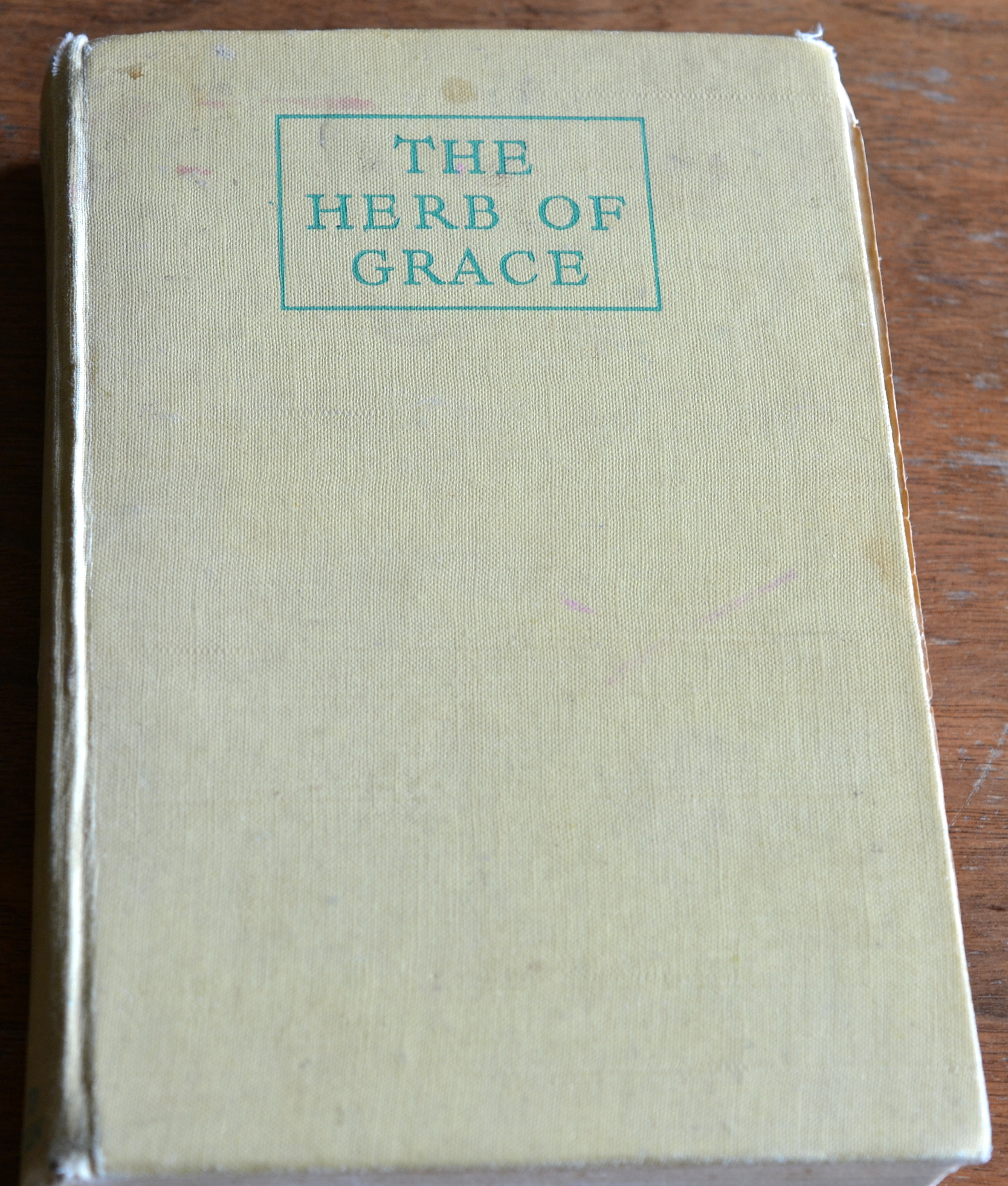
*It occurred to me that my definition of ‘treasure’ might not jive with yours. Here is a picture of the book. It is not a pretty book, but I love the inscription in the front “Jeanette Pound 1950” and I like old hardbacks.

DSC_8686

Winter Watch

I’m a fan of cozy mysteries. Miss Marple, Brother Cadfael, Mma Ramotswe, Alan Grant, and Flavia de Luce are guaranteed to bring pleasure. Especially if they are read with a steaming pot of tea while sitting on a leather couch with a fire snapping close by.

In Winter Watch, Anita Klumpers has written what I call a cozy-eccentric book. Barley, Wisconsin, is a isolated northern burg where the Justice of the Peace is also the dog catcher and where a few crazies reside. Bernice, a miscreant referred to as the resident killer, is the battiest of them all. After a family member dies, Bernice gets meals and kindness and concerns. And wouldn’t you know, she likes the perks of grief. More relatives mysteriously die. Sympathy can be mighty addicting.

Like Alexander McCall Smith, Klumper weaves humor into the warp and woof of her prose. Blizzards are snowstorms with enthusiasm. A woman was proud to give her son a Biblical name—Tubal—until the nurse told her it sounded like a female medical procedure.

DSC_7902There is comfort—I like a woman who knows her way around an egg—and a passage about joy that is flat out lyrical.

Joy arrived unbidden and unpredicted to pour from heart to fingertips to toes. She held her breath, everytime, to preserve and examine it but it forever danced just out of her grasp and slipped away. Claudia stayed still, focusing, her heart ready to burst. At the last crucial second joy seeped through cracks and crevices of her being until her every extremity and pore rejoiced before the evaporation worked backwards and she sat in the afterglow.

The focal point of the narrative centers on an old watch. The prologue and epilogue added more layers of history regarding the watch. The story line had me eagerly turning the page, and a bit annoyed with life’s beckoning demands when I needed to put the book down.

In short, this is a satisfying and entertaining read.

Loveliness Showing Through the Rubble

The job of the soldiers who served with the Monuments, Fine Arts, and Archives section of the Allied Forces in WWII was to “mitigate combat damage, primarily to structures—churches, museums, and other important monuments.”
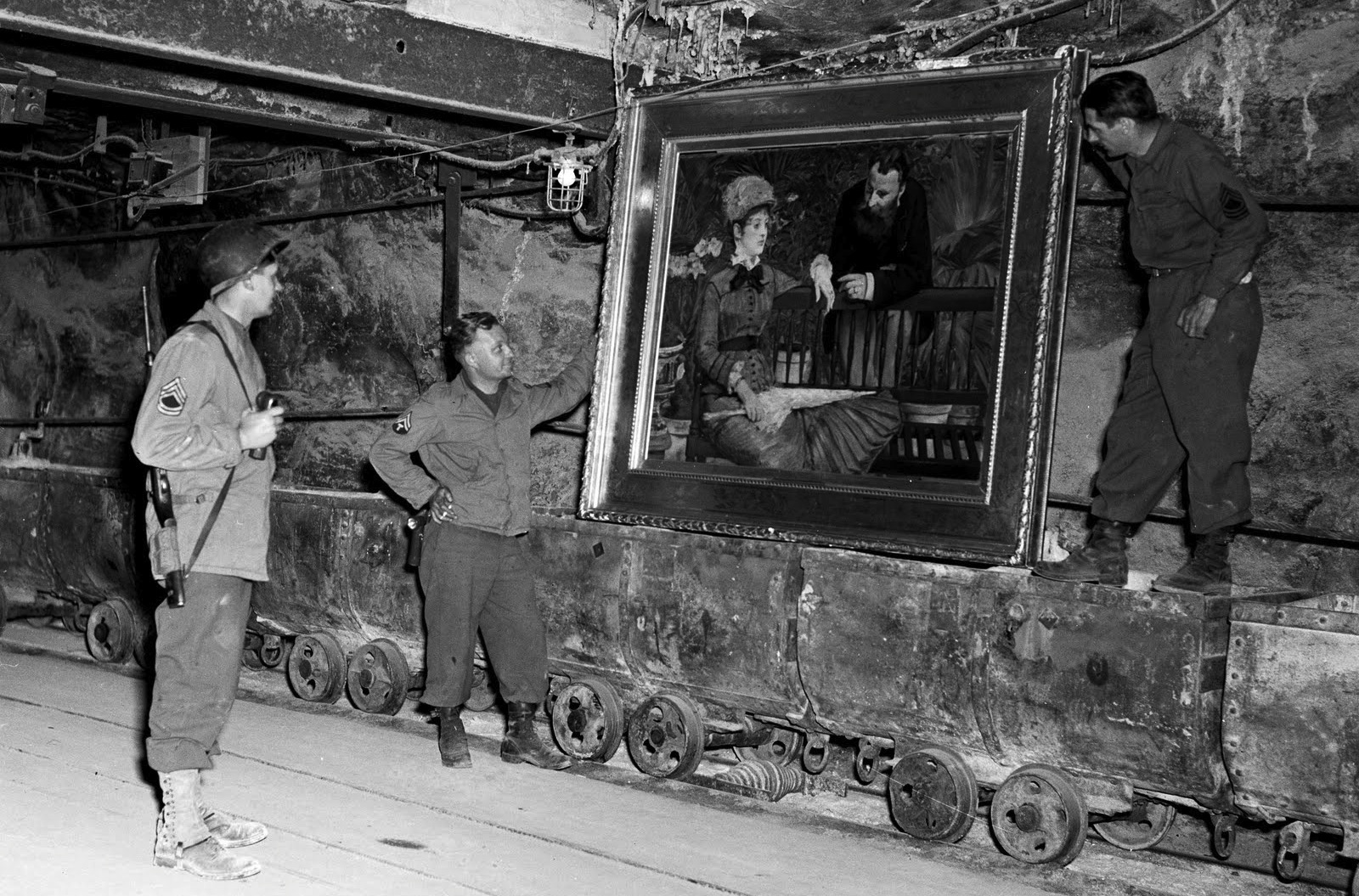
Because Adolf Hitler and Hermann Göring were obsessed with collecting (read: stealing) fine art, the primary job of the MFAA became rooting out hidden caches of art before the Nazis destroyed them in the event of a Nazi defeat.

I found it difficult to engage with the first third of the book, background stories of a large roster. Because they were all working independently— their stories seldom converged—there was too many bits to sift through. It wasn’t until Paris, and the entry of the great heroine Rose Valland, that I found myself gripped by the narrative. From that point, the book is perfectly paced, and the thrill of the chase raised my pulse. It is a cracking good story!

monuments-men^^ can you imagine? ^^

Tucked into the story was a gem—the only one like it— from Capt Walker Hancock.

The eyes have one continual feast. It is late in the spring. Flowering trees are everywhere and the charm of the romantic little towns and the fairy tale castled countryside is enhanced by all this freshness. And in the midst of it all—thousands of homeless foreigners wandering about in pathetic droves, Germans in uniform …. Children who are friendly, older ones who hate you, crimes continually in the foreground of life. Plenty, misery, recriminations, sympathy. All such an exaggerated picture of the man-made way of life in a God-made world. If it all doesn’t prove the necessity of Heaven, I don’t know what it means. I believe that all this loveliness showing through rubble and wreck are just foreshadowings of the joys we were made for.

For fun, the magnificent George Stout, after receiving a package three months late:

It is amazing how the world can change during the life span of a fruitcake.

Because one curious door opens many others, I’m now interested in reading:

Flannery in Janu’ry

Flannery child.Flannery O’Connor, from her childhood home (picture by K. Harper)

I committed myself to reading Flannery O’Connor’s The Complete Stories as part of Books and Movie’s “I’ve Always Meant to Read That” challenge. In the past few years, I’ve acquired everything published by Flannery (except for A Prayer Journal, just released in November). The Challenge gave me a needed push to dive in.

It was more a belly flop than a dive. I collared my young friend Matthew, who counts FOC as one of his favorite authors, and asked him why I should be reading this depressing stuff. His answer:

“Every Christian needs to read O’Connor, to get the pettiness and self-absorption out of their systems.”

And, you know, Flannery grew on me. The later stories made more sense, were more accessible. “More mature,” a lit major would murmur, cigarette dangling between his knuckles.

It has been a baptism by immersion. Two things helped me immensely: I read Brad Gooch’s Flannery: A Life of Flannery O’Connor, which made me sympathetic to her and helped me to see her vision. I borrowed two audio books, A Good Man Is Hard to Find, and Every Thing That Rises Must Converge, which included many of the stories in The Complete Stories. I took 4 mile walks, listening and concentrating. When I had the time, I listened and read along.

No question, the girl was brilliant. I felt kinship with the reviews of her first novel. “They all recognized her power but missed her point.” Here’s an example: In one story, a grandfather is confronted with a woman who claims his grandson ran into her and broke her ankle. He replies, “I don’t know him. I’ve never seen him before.” A clear allusion to Peter denying Christ the night before the crucifixion. Sooooo. What does it mean?

Flannery herself described her stories as odd, disturbing, unconventional. And the irony? With Flannery, irony is a contact sport. Wickedly funny. But it seems her goal was to smack us in the face so we would see ourselves correctly. These stories have much more than entertainment in mind.

Now that I’ve read through The Complete Stories, I’m ready to read through Mystery and Manners: Occasional Prose and The Letters of Flannery O’Connor: The Habit of Being.

I hoped that O’Connor was filmed giving one of her lectures. I didn’t find that, but I found an audio track of her reading one of her most famous stories, “A Good Man Is Hard to Find.” This would give someone a taste of Flannery.

I found it interesting that Flannery substitutes “colored” for the n-word in this reading.

The Bookshelf Project

DSC_1834I blame the movie Julie & Julia. Do you know how many times I’ve thought about cooking through every recipe in one of my 46 cookbooks? It messes with my all-or-nothing propensities. So many times, I’m browsing among the books and think: wouldn’t it be fun to read exclusively from this shelf until I’ve read everything?

The all-or-nothing system hasn’t been good to me. Because, you know, the nothing side hits the playground pavement with a bang and the all side is swaying, suspended in the air above the teeter-totter.

So I made a bargain. I eyed the shelves and did the math. What if? I whispered to myself. Stop! the other me warned. No, this is reasonable, I countered. What if I committed to reading one book from every shelf on the big white bookshelf? There are 30 shelves in total. Subtract three that hold CDs, Audio books, and DVDs. Subtract the one narrow shelf about which I can say, “I’ve read them all.”

26 books from my own shelves. That’s about half of the number of books I read in a year, so it allows room for the books in other rooms in my house, on my Kindle, or yet to be published.

I’m not going to decide which title on each shelf right now. I’m a bit schizophrenic in my reading. When I am mindful of how little time I have left on the earth, I determine to only read the best books. When I think about making room on the shelves, I read the book I want to read, but don’t think I’ll want to keep. And when I don’t want to work, I go for easy reading.

And I won’t shelve a new book, so I can say I read it off my shelves. Dirty pool!

So here’s a glance at my options:

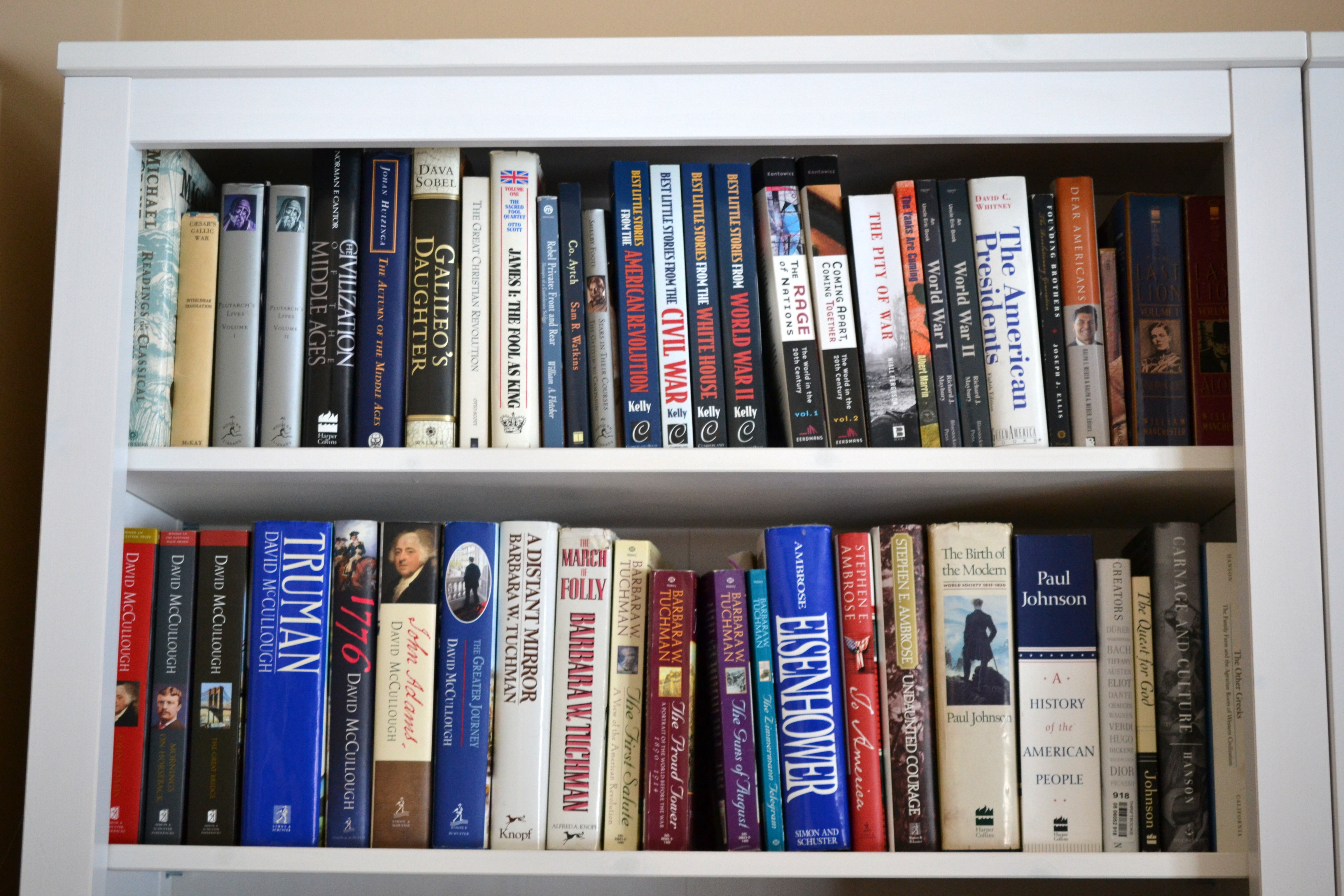
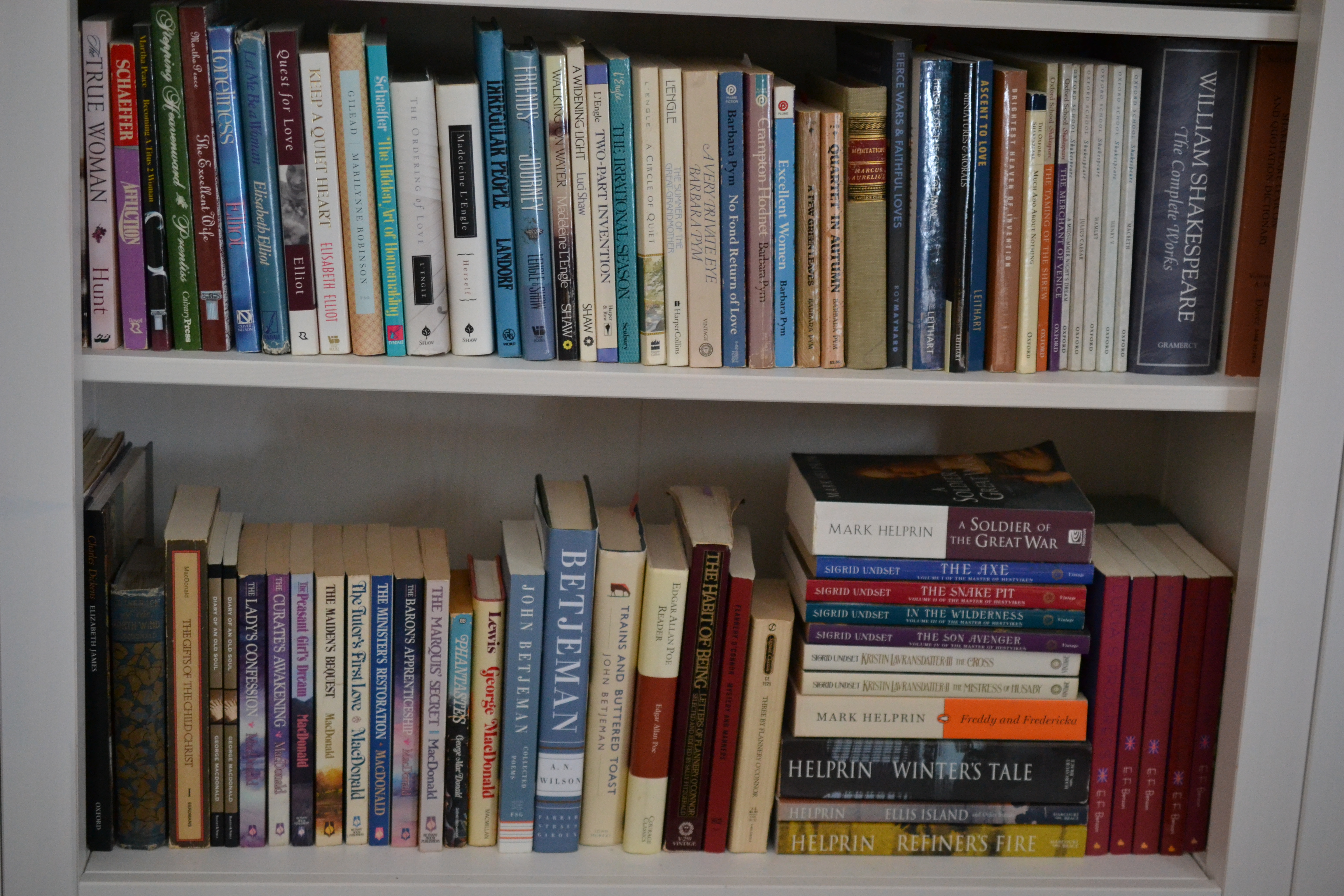
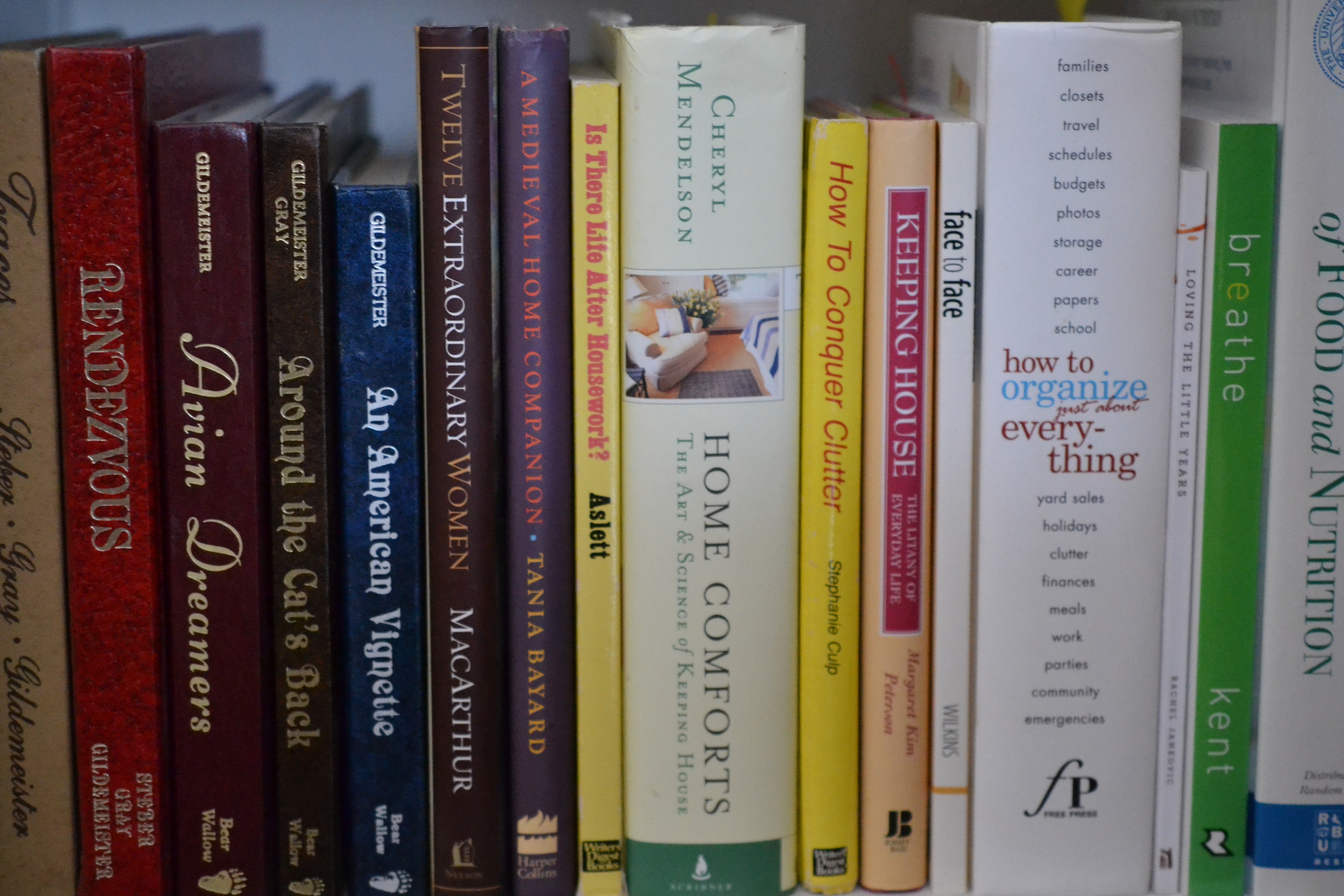
DSC_8173There are two shelves of history. On the top shelf I’m inclined toward The Pity Of War: Explaining World War Ior The Last Lion: Winston Spencer Churchill.

On the lower shelf, it’s an excruciating decision. McCullough’s book on the Brooklyn Bridge, Barbara Tuchman, Stephen Ambrose or Paul Johnson?

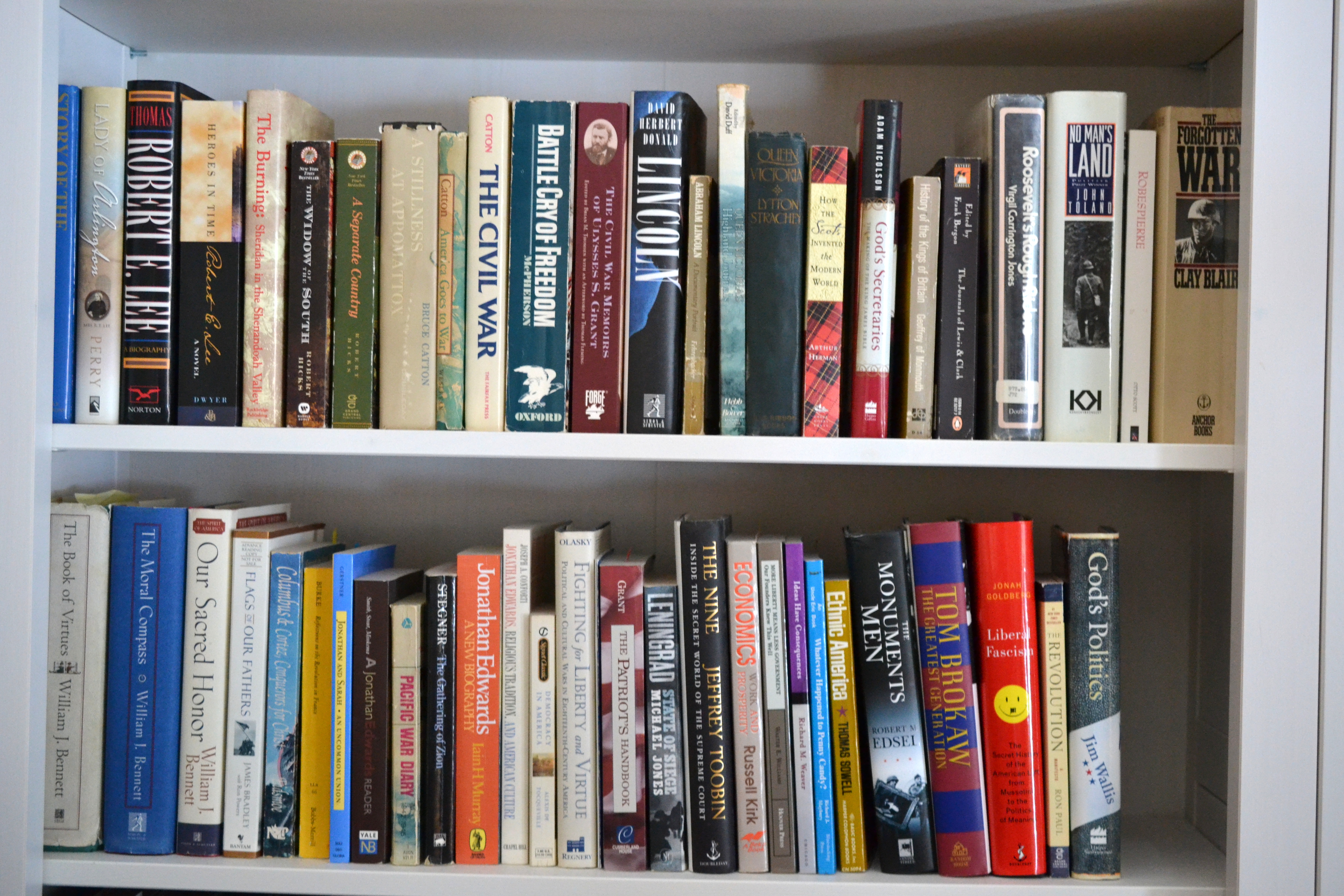
DSC_8174Oh, man. Several titles on these two shelves come highly recommended. The Widow of the Southis set in Franklin, TN. I want to read The Monuments Men before the movie comes out this year.

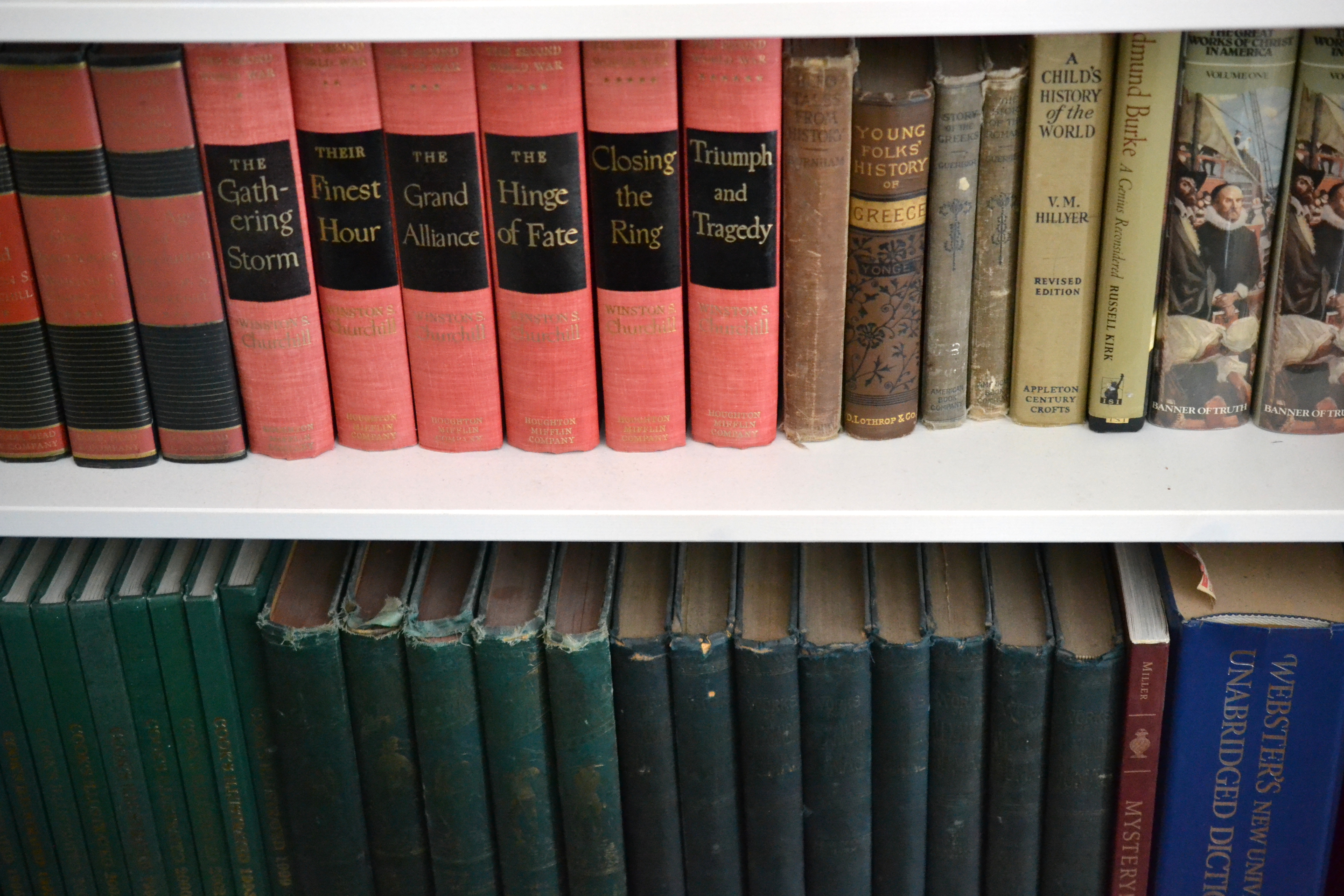
DSC_8175Two sets of Churchill to choose from: I’ve read A History of the English-Speaking Peoples and would like to re-read them. But Edmund Burke  beguiles me.  Three sets sit on the bottom shelf: 13 years of Cook’s Illustrated, a set of Dumas and a set of Dickens.
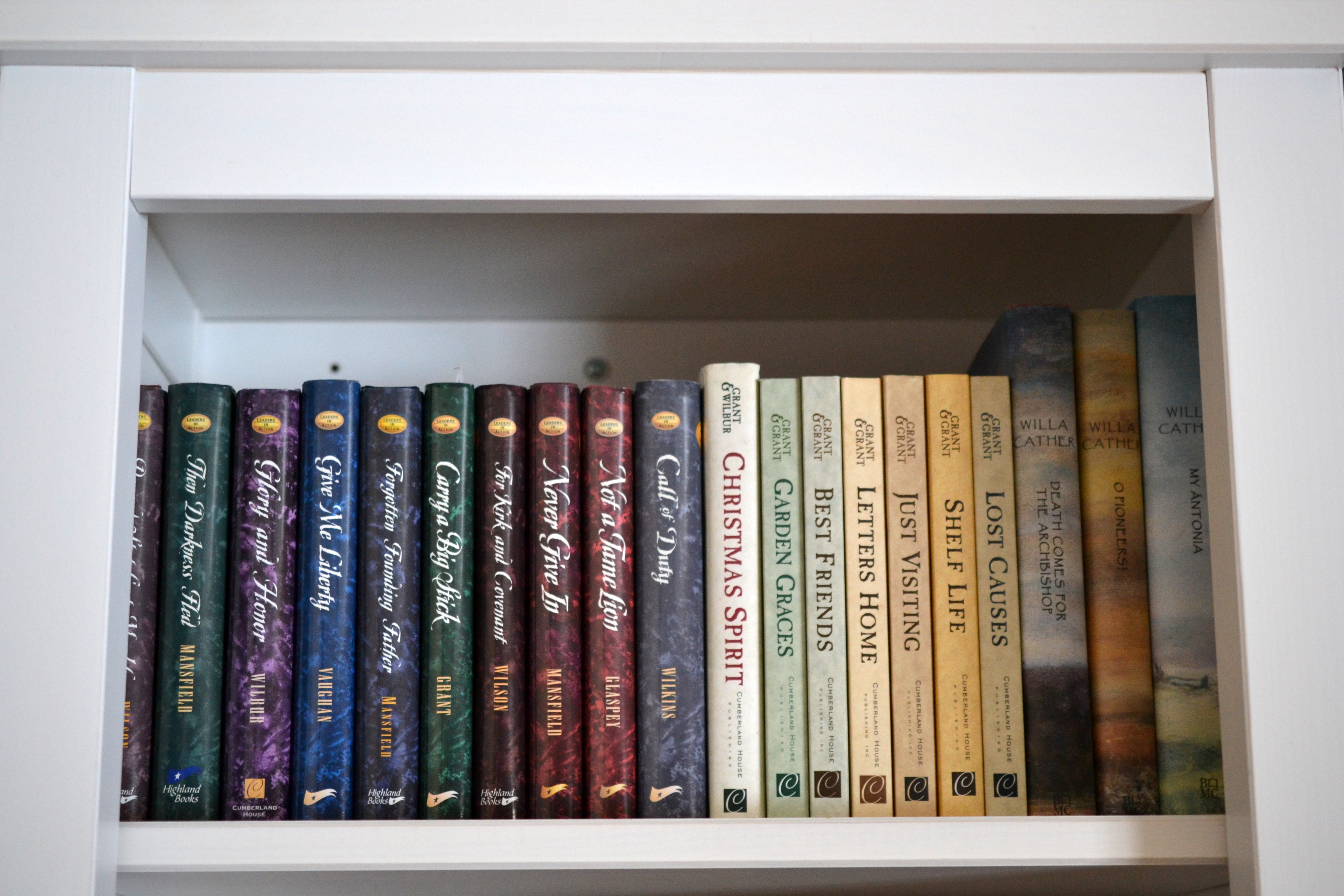
DSC_8176Short biographies, a collection of collections, and Willa Cather.

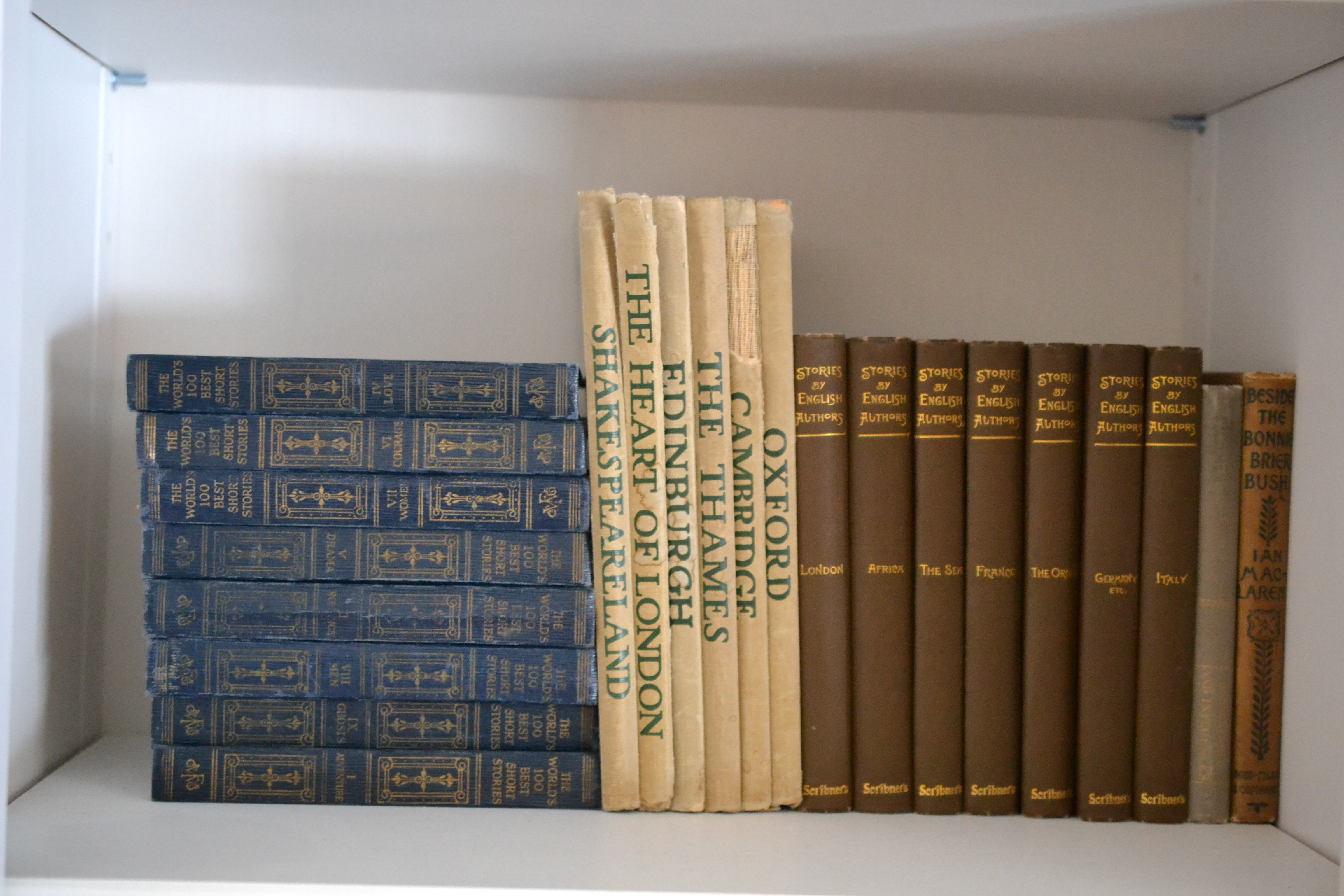
DSC_8177Small books with short stories and gorgeous books about Britain with watercolor plates.

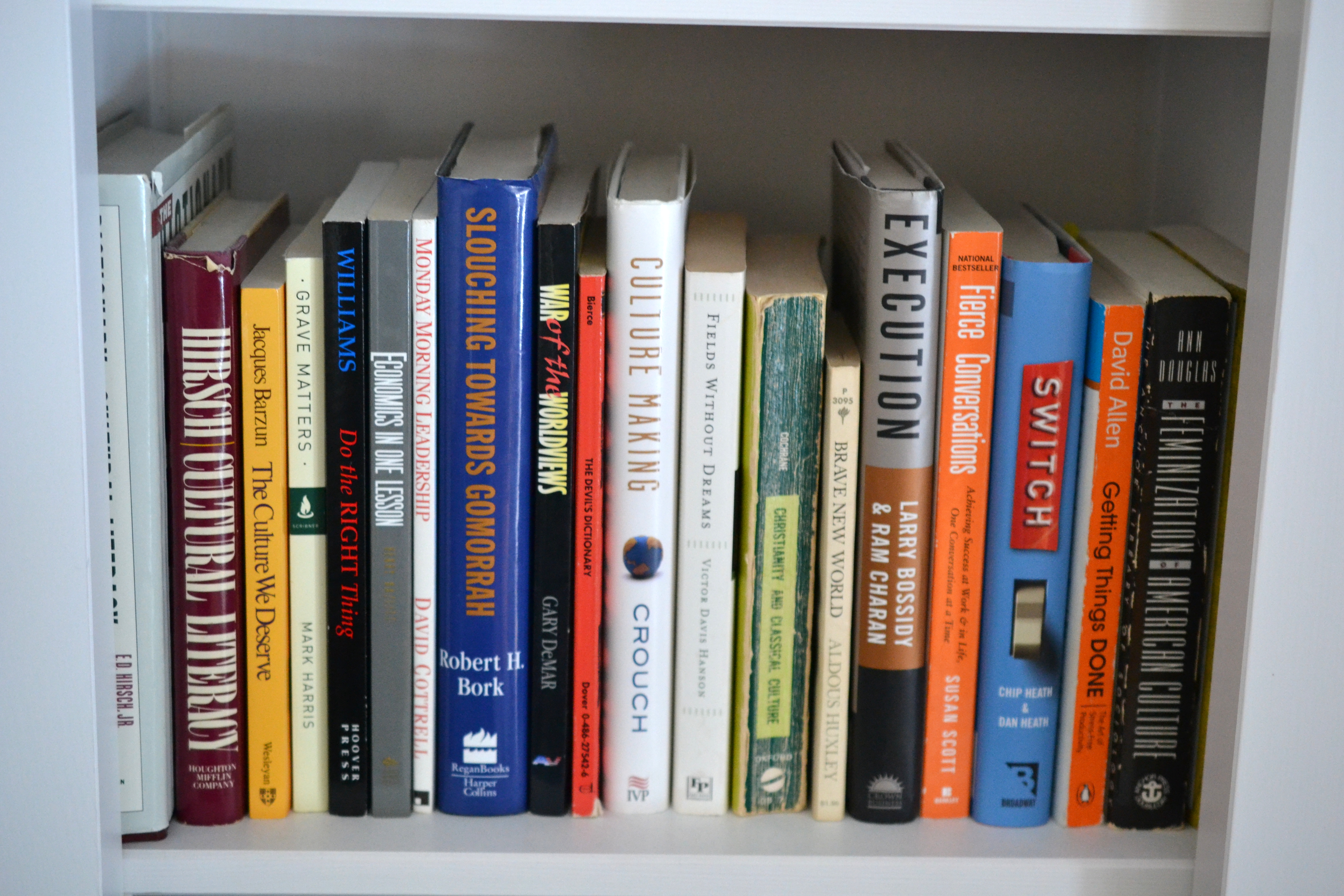
DSC_8178Business and culture.

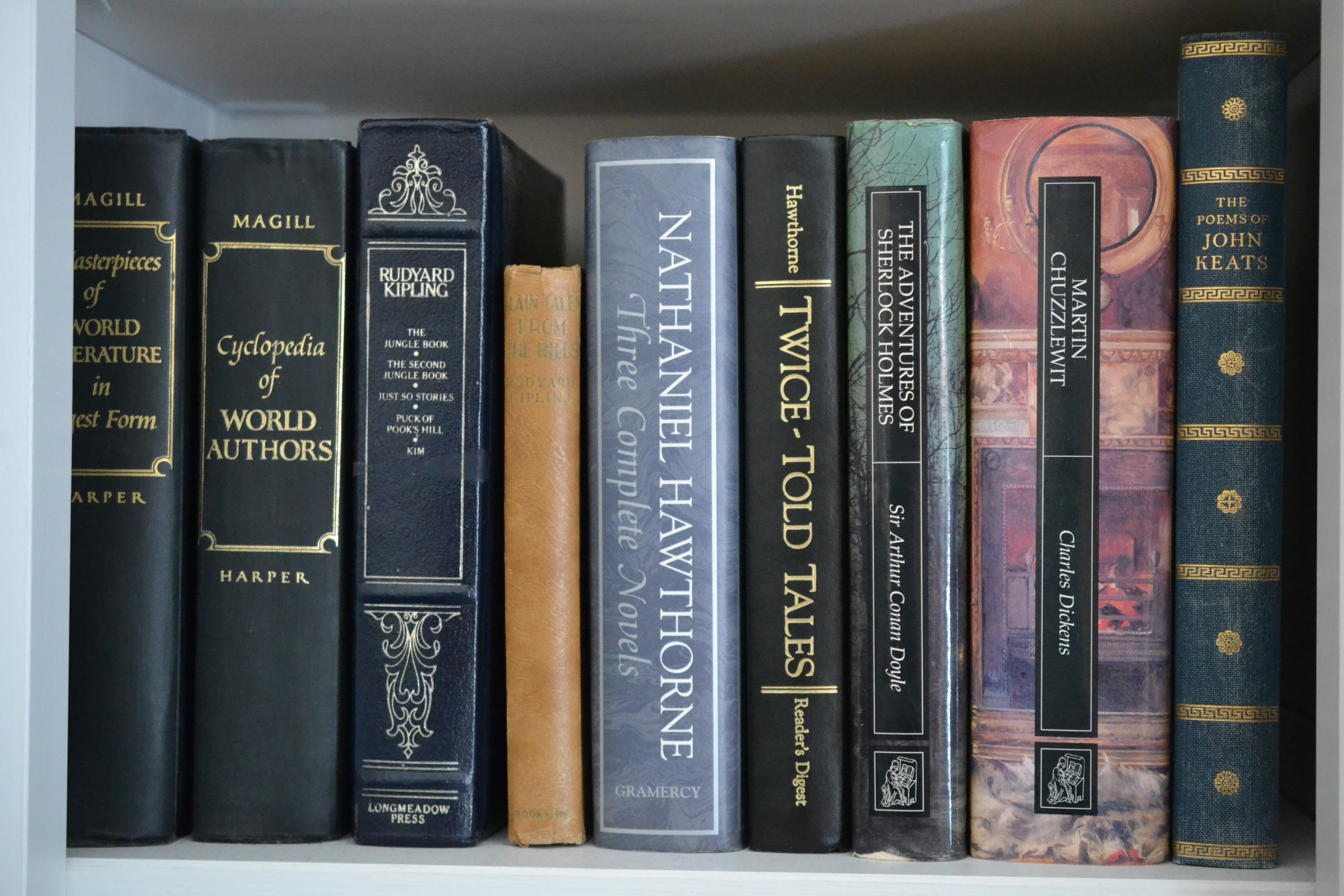
DSC_8201Classics. My husband and I are enjoying A Study in Scarlet, so we may well continue with more Conan Doyle. But I’ve never read Kimso I may choose Kipling.

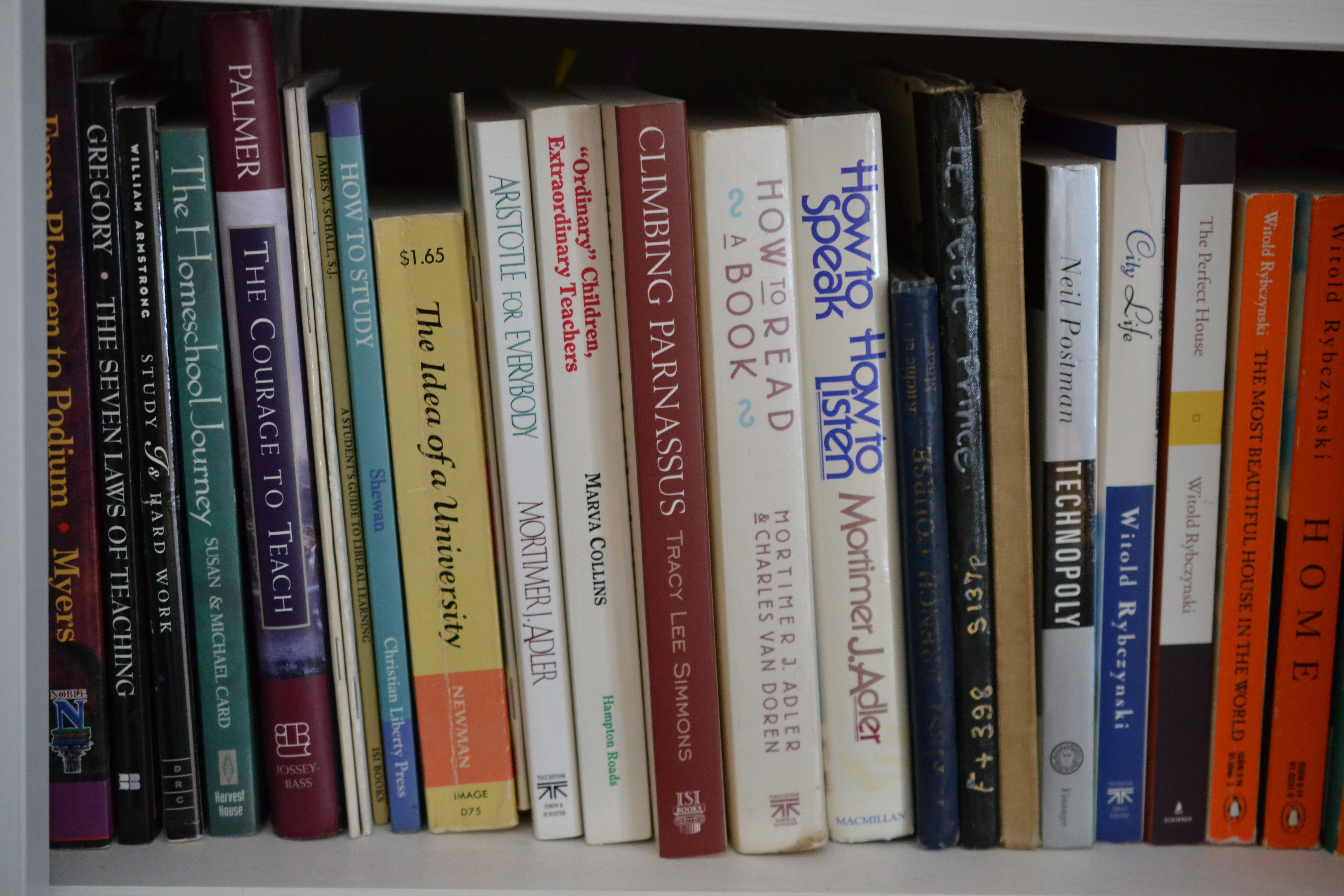
DSC_8180Education and Witold Rybczynski.

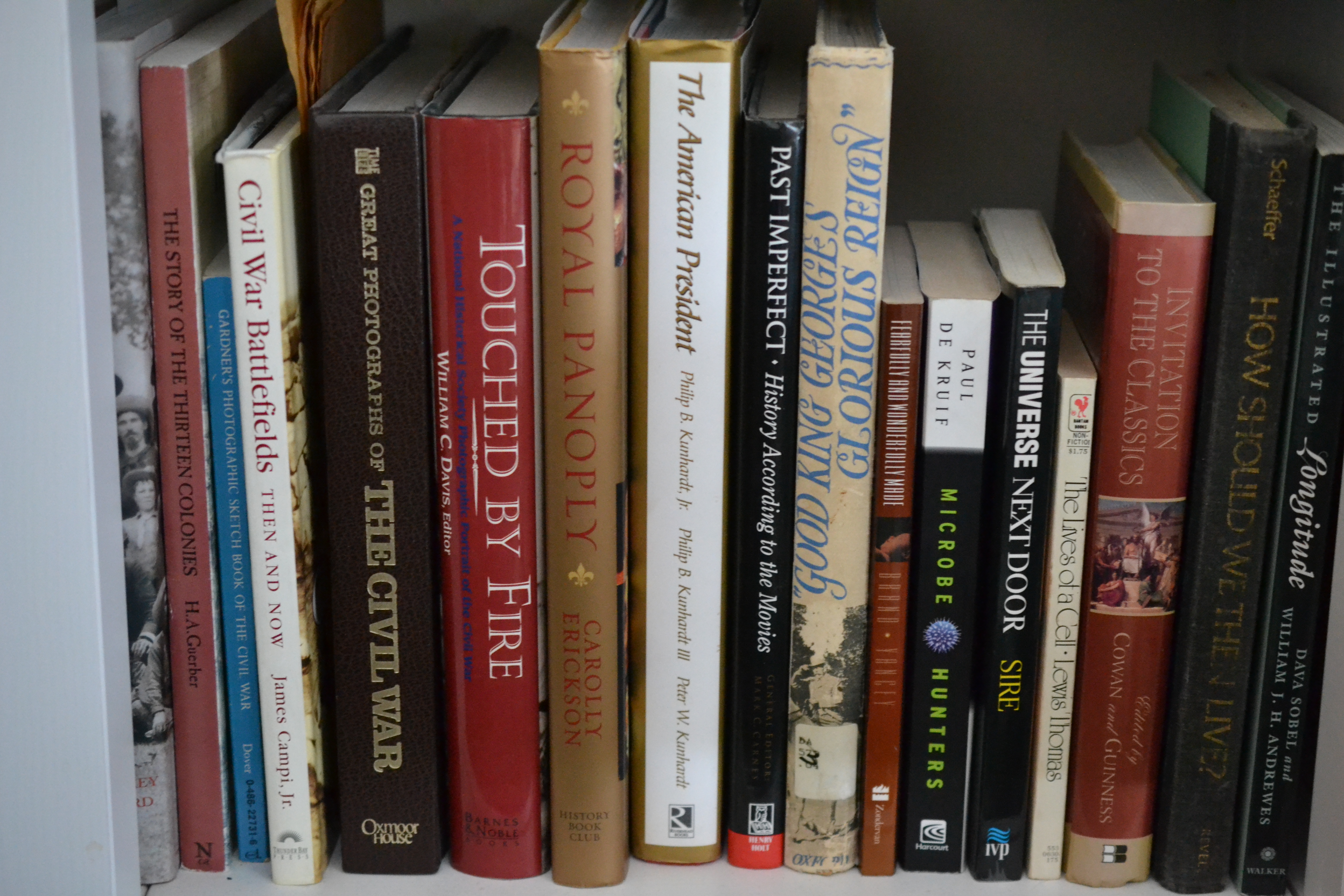
DSC_8181I insist on reading one science book a year, weak as I am in science. I highly recommend Microbe Huntersand Longitudeif you need your science in narrative form. I think Lives of a Cellis calling my name.

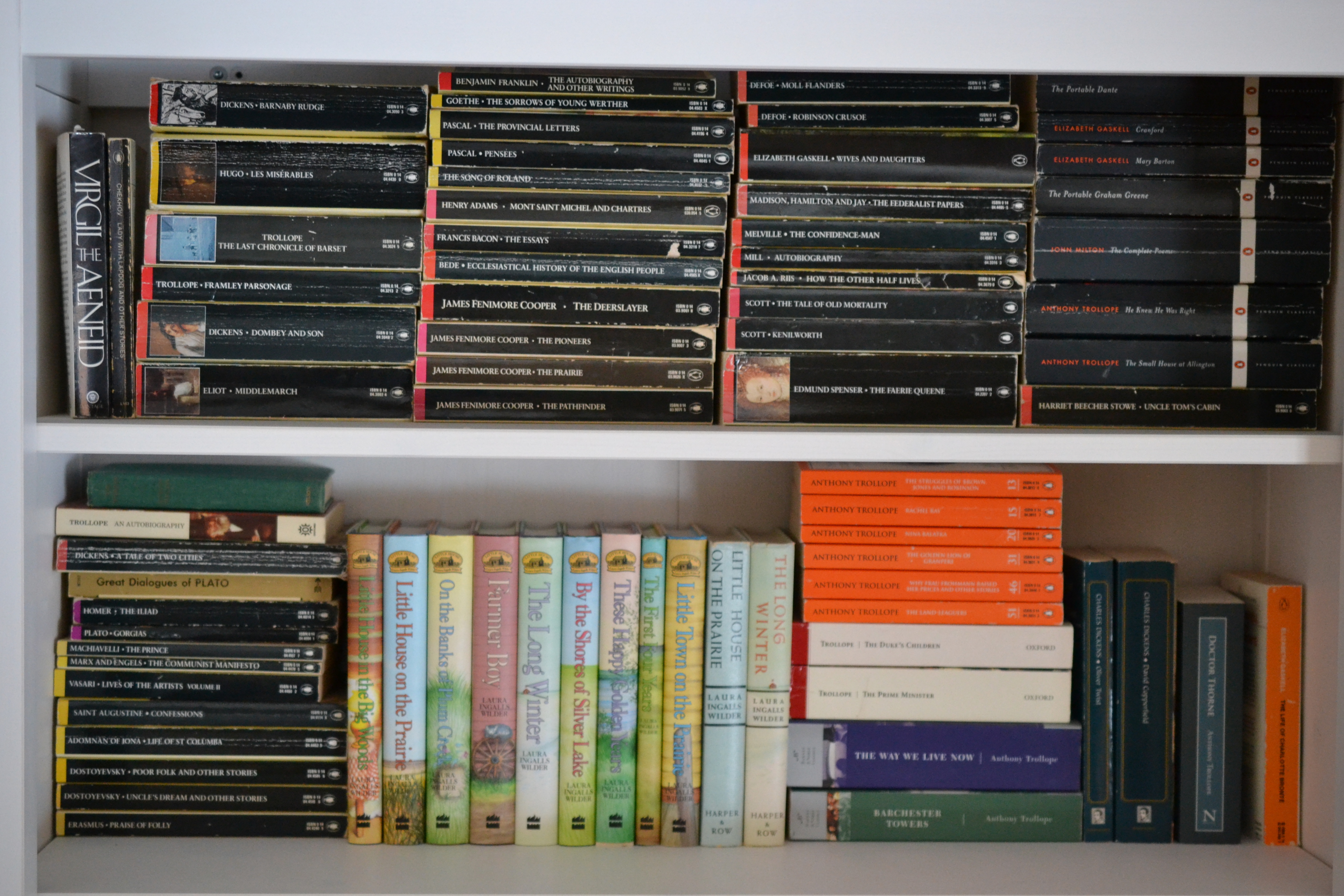
DSC_8182Oh to have room to store my beloved Penguin collection upright! Whoever invented orange covers ought to be shot. I would love to read all those orange Trollopes so I can be done with them.

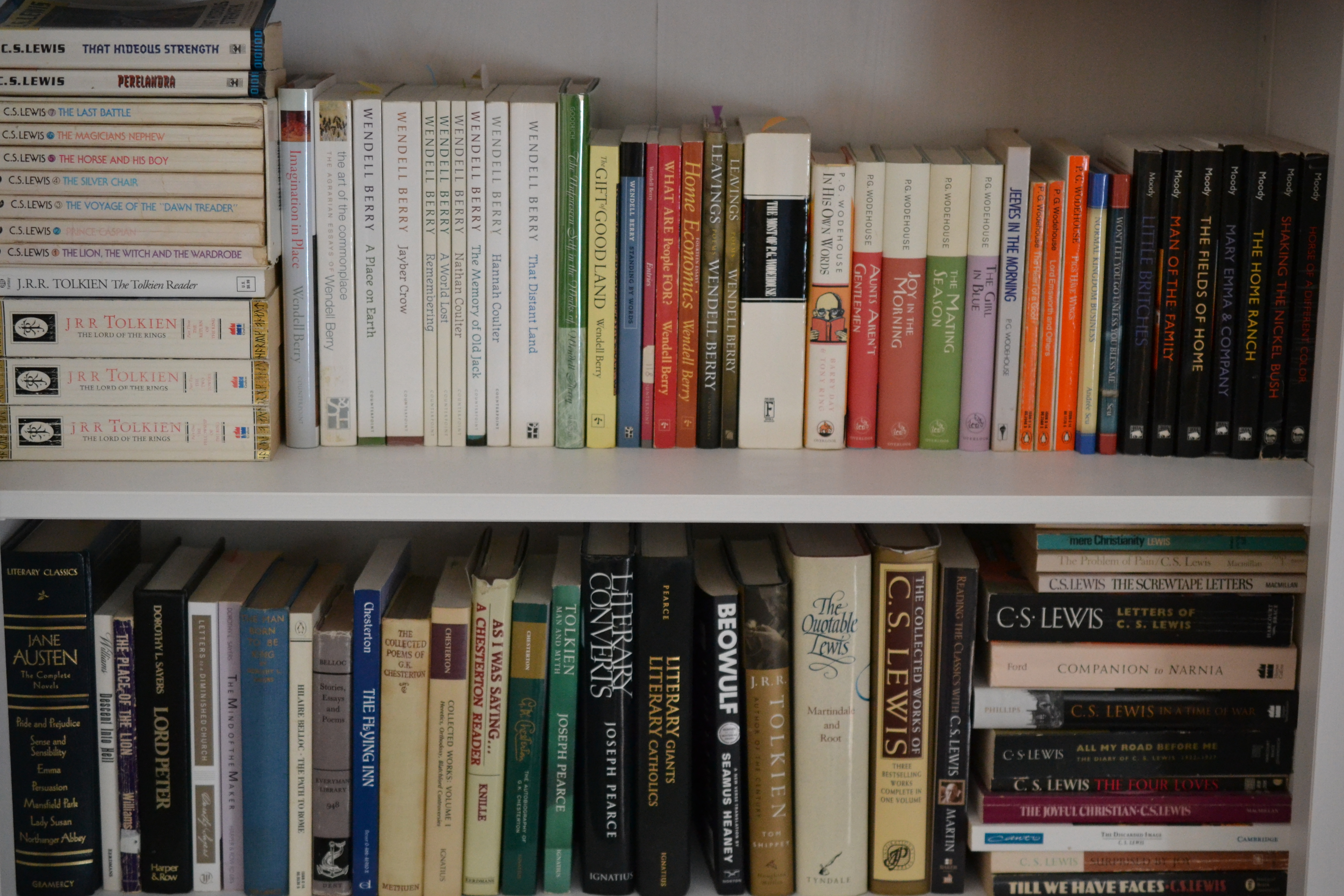
DSC_8183These two shelves are at the center of my collection. Deep. love.

DSC_8184More groups of authors that I love.

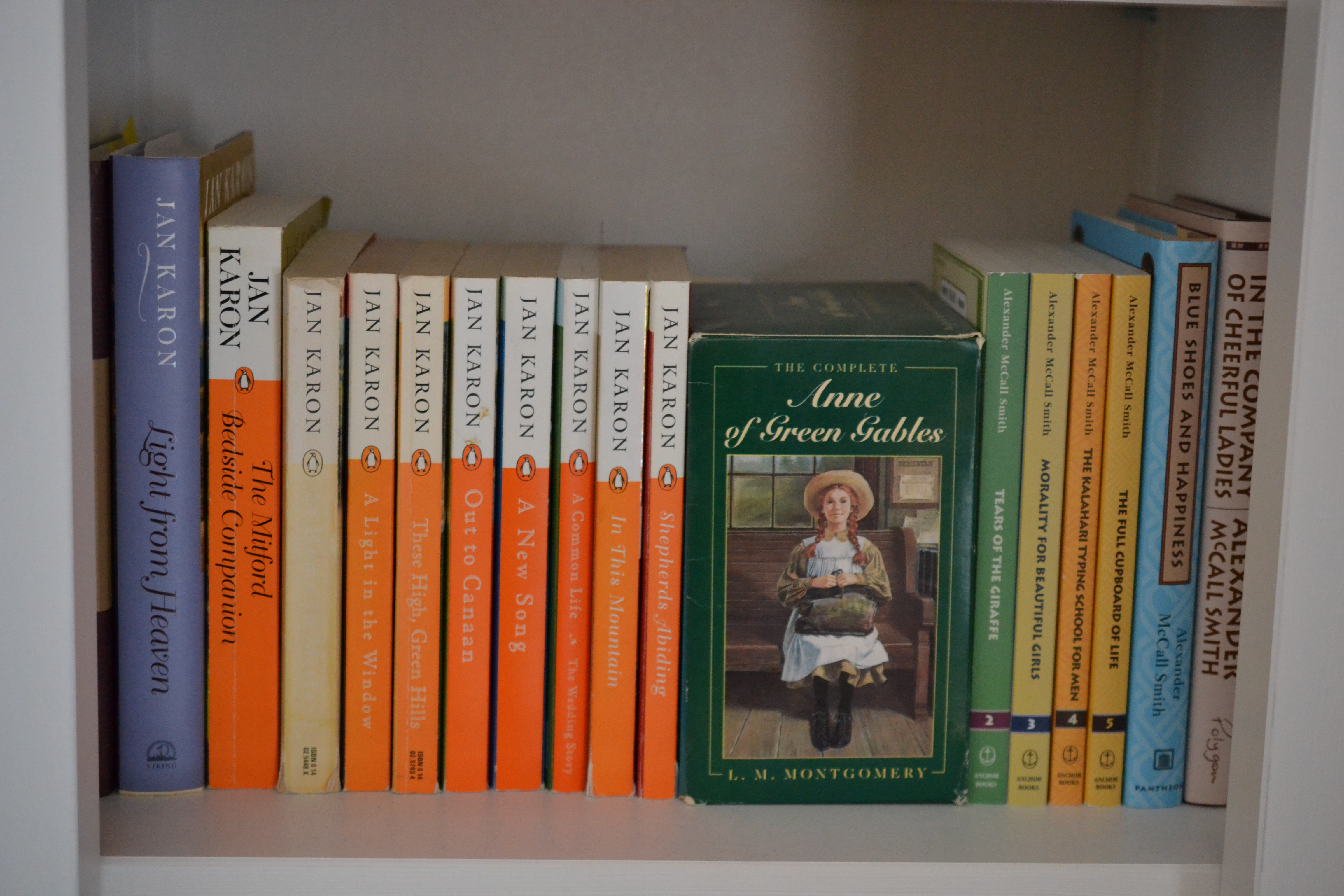
DSC_8185This shelf is a pass on my read-from-my-shelves project. Jan, Anne, and Mma.

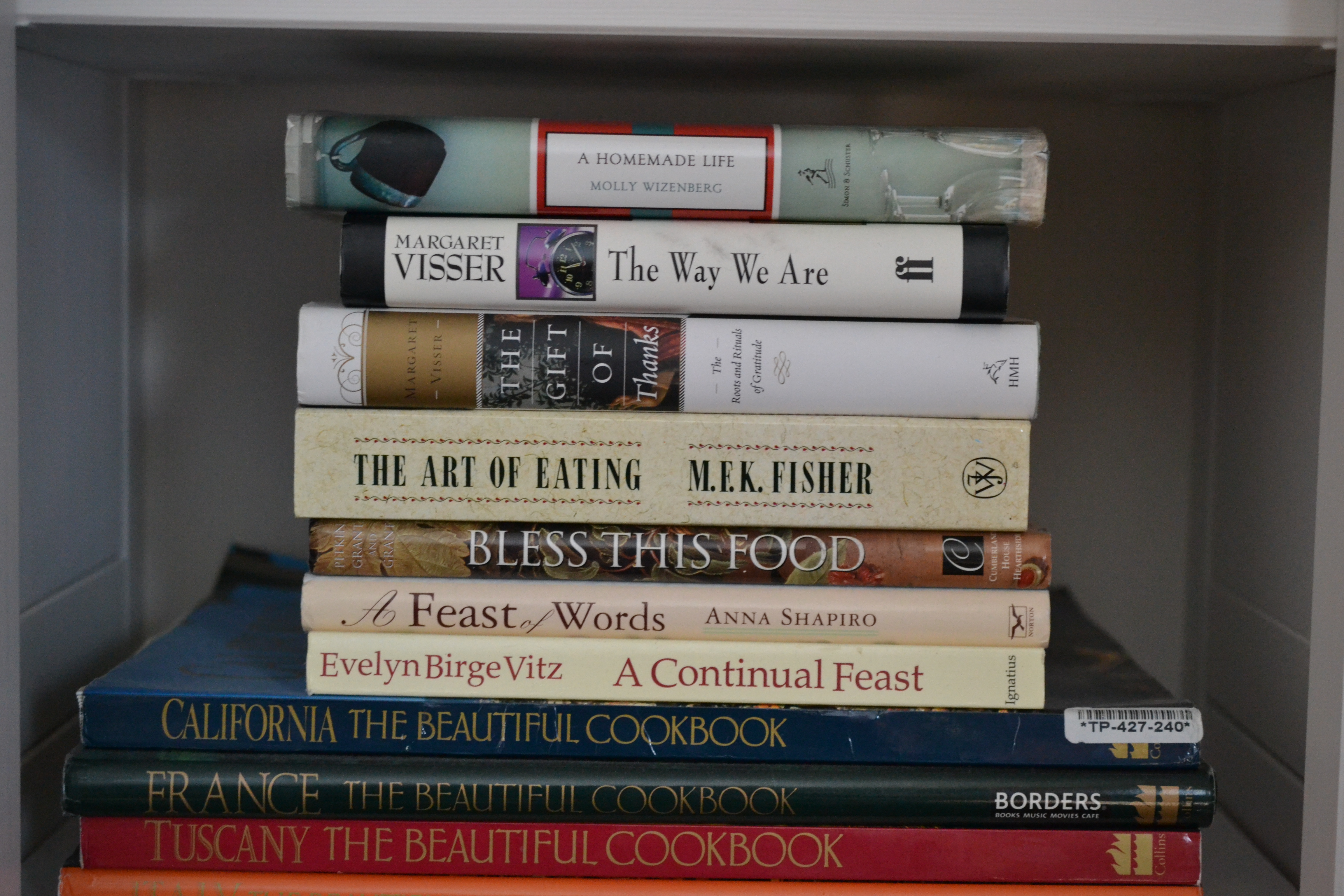
DSC_8186Foodie books!

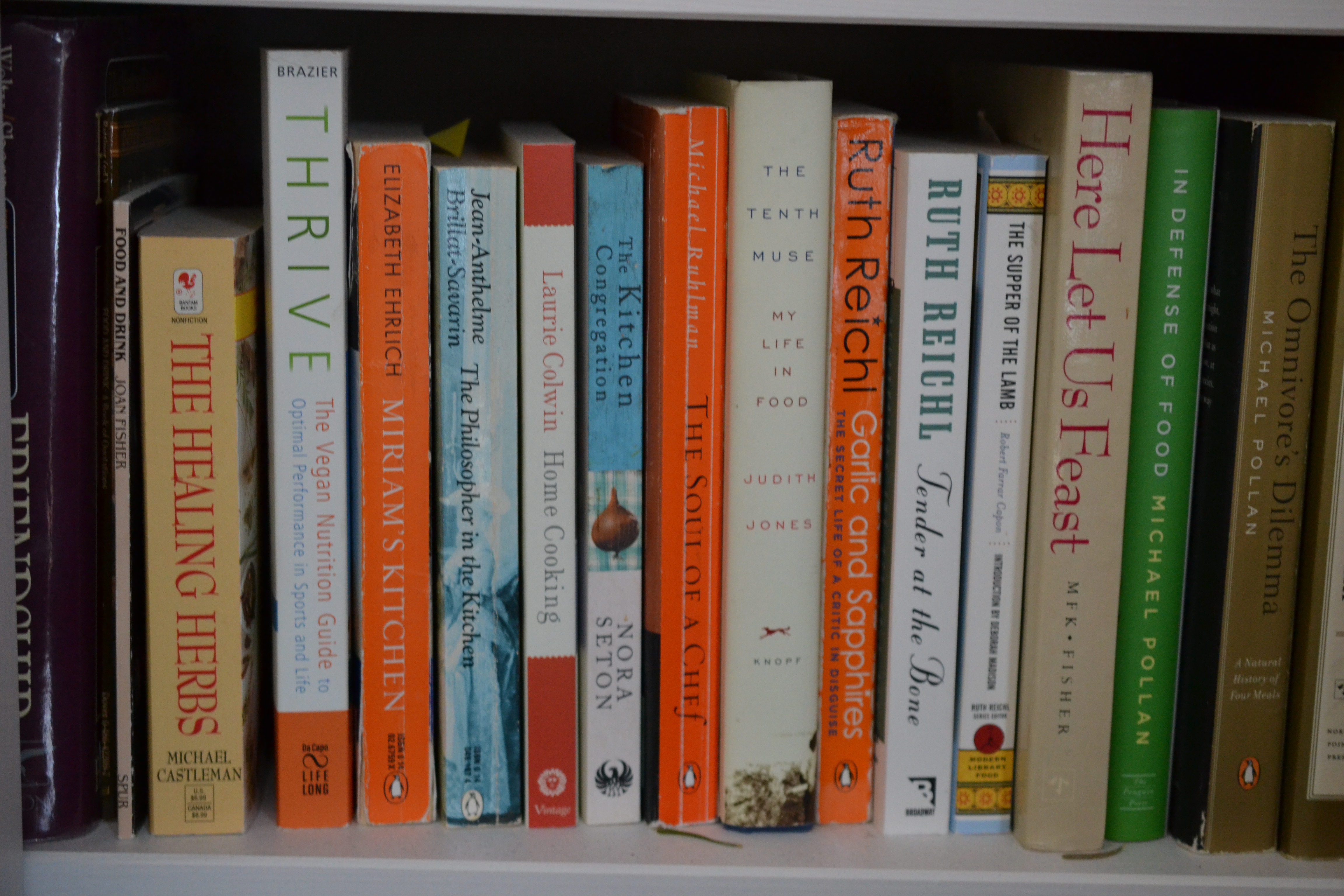
DSC_8187More foodie books.

DSC_8194True story: it’s easier for me to read about various methods of eradicating dust bunnies than to bend over and pick up the dust bunny.

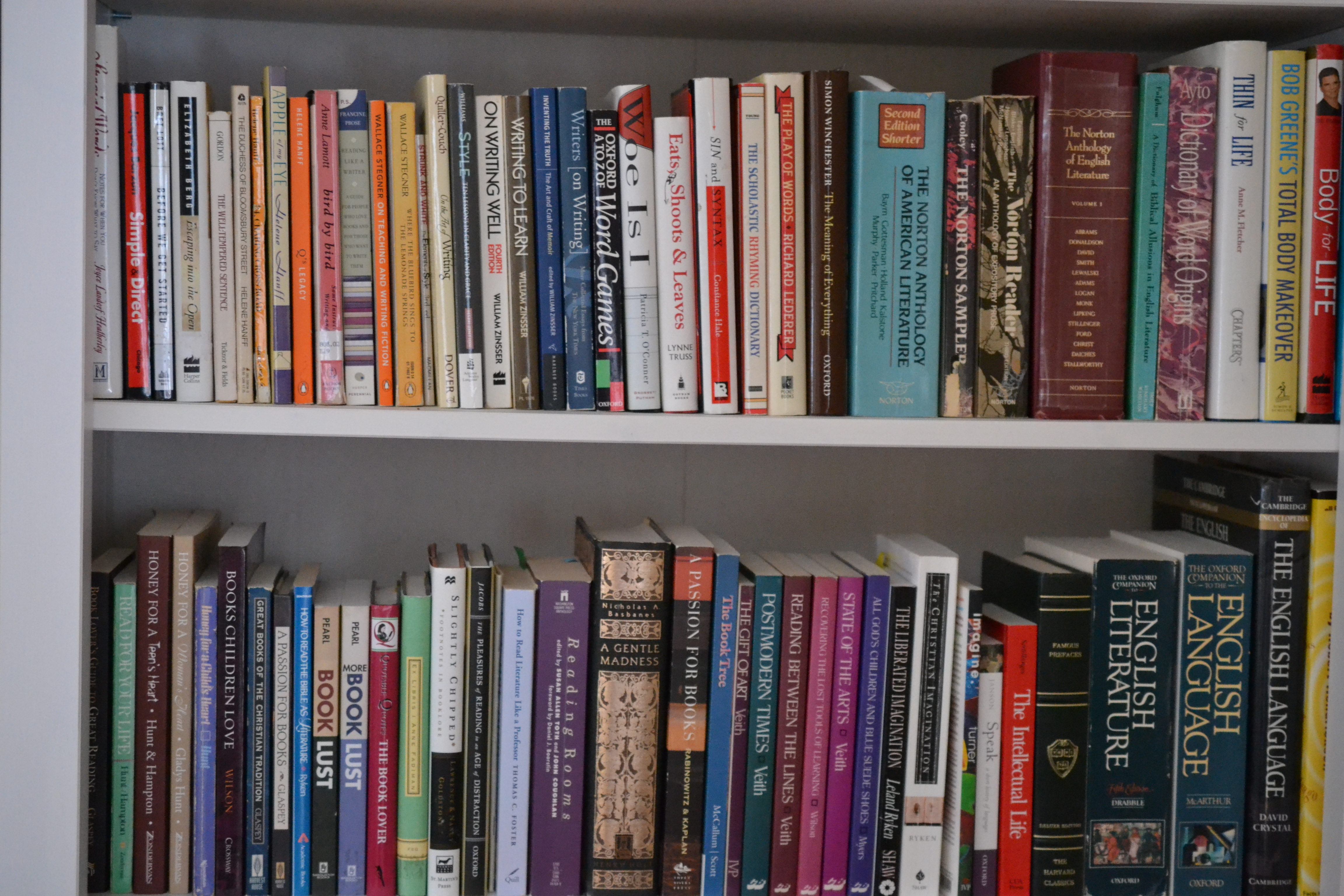
DSC_8195Books on writing and books on books. Pure deliciousness.

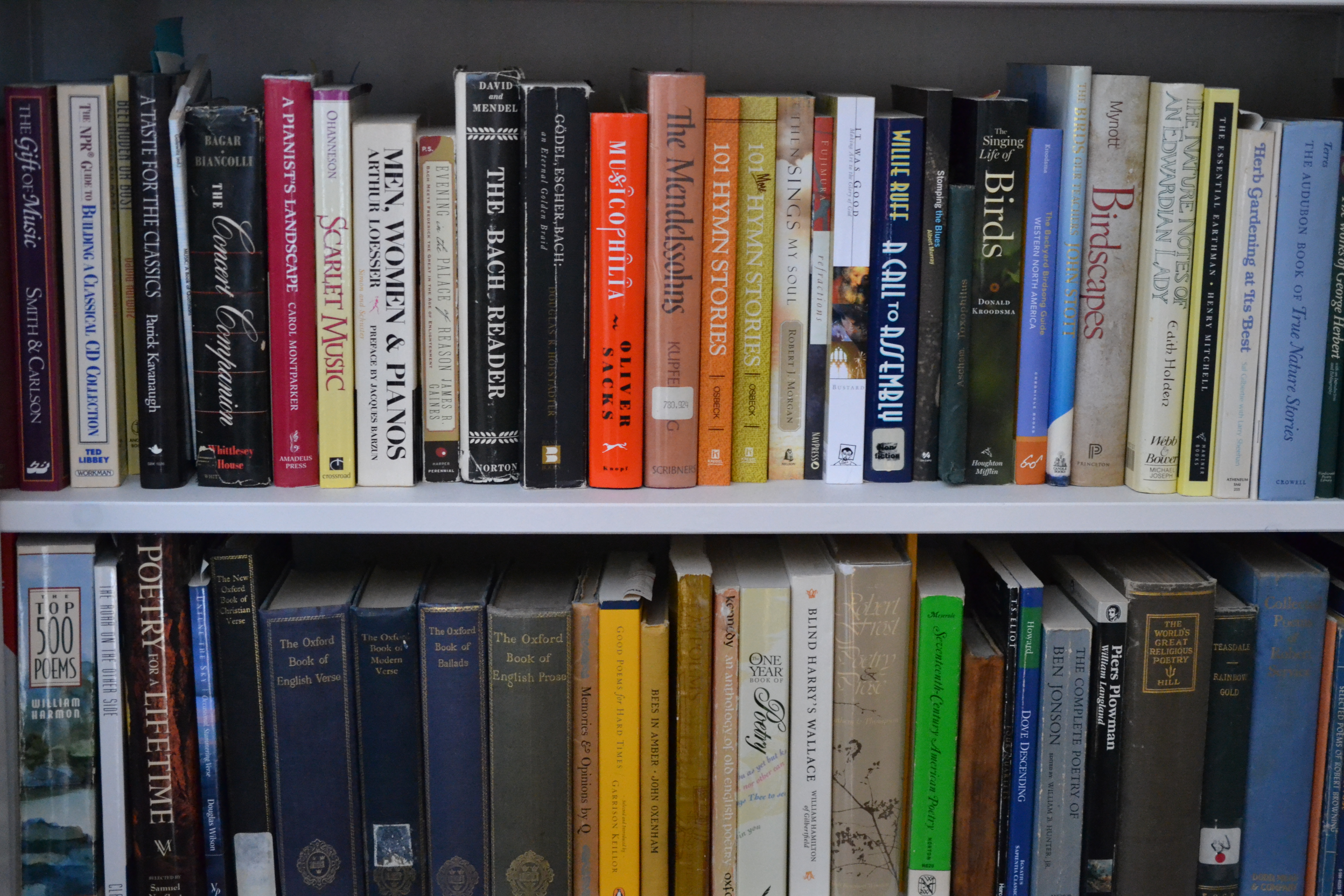
DSC_8196Music. Poetry.

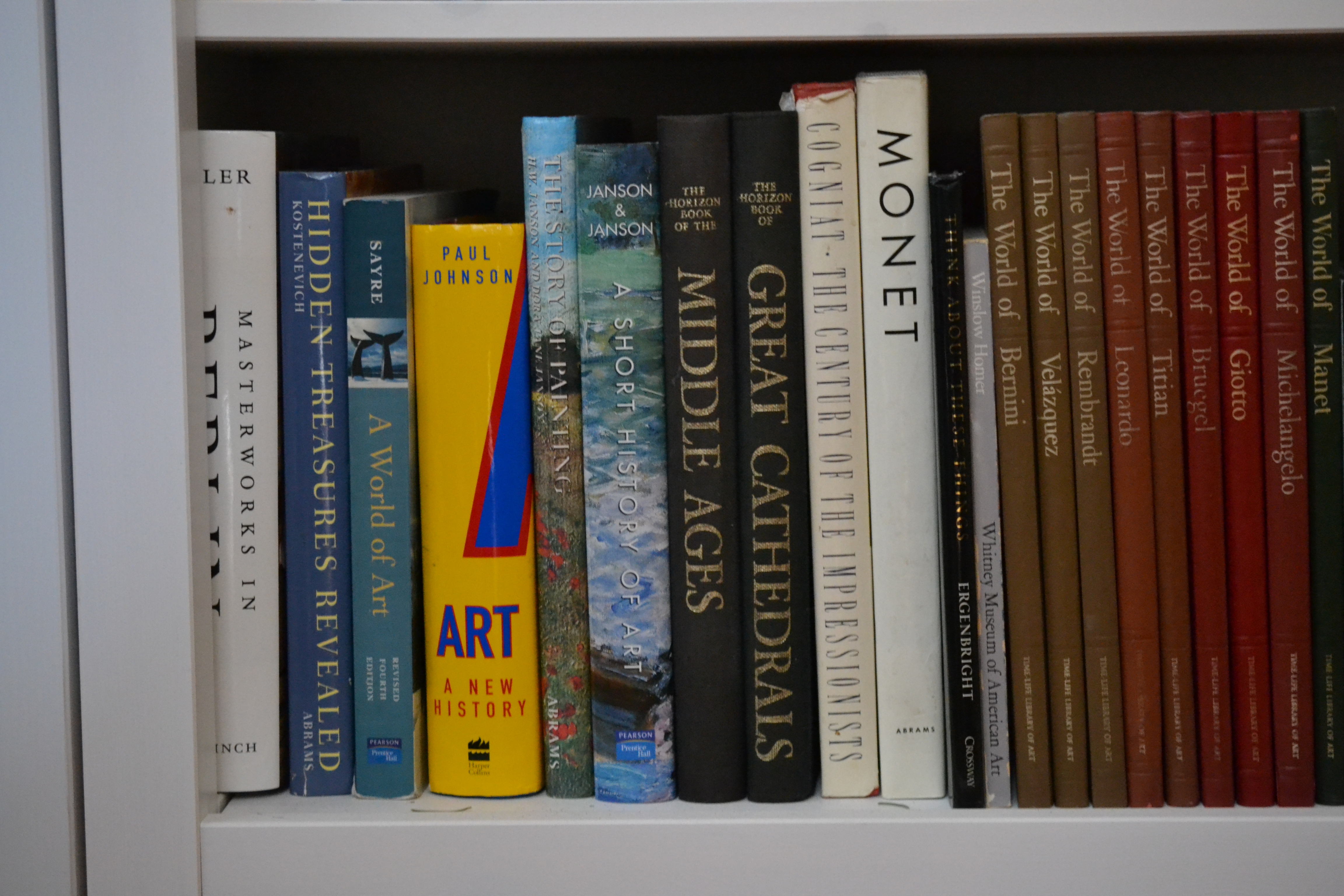
DSC_8198Art.

Children’s books, theology, travel and memoirs have their own bookcases. But they will have to get in line.

Intentional reading: the good life.

Hey! You with the eye for interior design? What would you recommend for the tops of my shelves? I’ve thought about framed photos (in matching frames) but I’m afraid they will make it too busy. Woven baskets? Eclectic collection of pottery/baskets? Empty? Your opinion is welcome.

A Kid’s Book About Venezuela

I bought Roberto’s Trip to the Top because the authors are Katherine Paterson’s husband and son. And I’m happy that I did.

Roberto is a young boy living in Caracas, Venezuela. He is excited to ride up a cable car to the top of a mountain and hike around with his father. The story is told in English with Spanish words sprinkled on each page. An alert reader will understand the Spanish by the context, but there is also a glossary in back.

I like the way the authors present problems in the trip, letting them exist without facile solutions. Roberto’s disappointments are acknowledged, but he has to deal with them. It was refreshing to read about a hike along a risky path without guardrails. I think I like this book because its tone matches my parenting style.

Renalto Arlacao’s illustrations are vivid and engaging.

My only reservation is that I don’t know if the book will hold a child’s interest through multiple readings. It would be fun to quiz a primary child on the Spanish words. What does barrio mean? It is a good book for exposing children to other cultures and a few words of Spanish.

This post contains Amazon affiliate links.

Reading Year in Retrospect

DSC_1833“I am an inveterate browser of people’s bookshelves, always curious to see what other people have been reading, and which books they choose to display. but I am equally curious about the manner in which they array them. Are their books neatly aligned, like the leatherbound books in the Levenger catalog, or do they teeter on the shelf at odd angles?”  — David Levy in Scrolling Forward: Making Sense of Documents in the Digital AgeI love looking back at my reading year, and yet I also shrink from the raised eyebrow of my inner critic. Deciding on categories and distributing my titles in those gives the same thrill that I get in organizing my books. This is my reading year in retrospect.

My own Book of the Year? It’s a tie! N.D. Wilson’s Death by Living: Life Is Meant to Be Spent was both the slowest and most profound read. I read it aloud to my husband a page or even a paragraph at a time. But reading through Jacques Barzun’s From Dawn to Decadence was also deeply satisfying. (confession: I have 60 pages to finish)

Africa
This Rich & Wondrous Earth Linda Burklin (life in boarding school)
When a Crocodile Eats the SunPeter Godwin (living in Zimbabwe)
The Elephant Whisperer: My Life with the Herd in the African Wild Lawrence Anthony (animal conservation)

British
Over the Gate Miss Read (cozy read)
Lark Rise to Candleford(trilogy) Flora Thompson (a portrait of a culture)
Lady Anna Anthony Trollope (novel of a marriage)
Cousin Henry Anthony Trollope (a study of a guilty conscience)
Tyler’s Row Miss Read (not my favorite Miss Read)

Catholic
The World, the Flesh, and Father Smith Bruce Marshall (story of a Scottish Priest)
Father Hilary’s HolidayBruce Marshall (priest gets involved in political intrigue)

Christian
Death by Living N.D. Wilson (memoir/family heritage/travelogue/random thoughts)
Life Together: The Classic Exploration of Faith in Community Dietrich Bonhoeffer (crammed with good stuff)
The Secret Thoughts of an Unlikely Convert Rosaria Butterfield (unusual story)

Culture
From Dawn to Decadence Jacques Barzun (500 years of cultural history, EXCELLENT) Scrolling Forward David Levy (e-book or bound book debate, written a decade ago)

Early American
Rip Van Winkle & Other Stories Washington Irving (some classics improve as we age)

Family
Fit to Burst : Abundance, Mayhem, and the Joys of Motherhood Rachel Jancovik (wise)
Real Marriage Mark and Grace Driscoll (yes and no: all the stats got old)

French
Lest Innocent Blood Be Shed Philip Hallie (5K Jews saved by people of Le Chambon)
The Elegance of the Hedgehog Muriel Barbery (postmodern novel, quotable sections)

History
First Family: Abigail and John Adams Joseph Ellis (very enjoyable read)

Kid Lit
Anne of Green Gables L.M. Montgomery (priceless)
Anne of Avonlea LMM (sad to lose Matthew Cuthbert)
Anne of the Island LMM (away at school)
Anne of Windy Poplars LMM (winning over the Pringles and Katherine Brooke)
Anne’s House of Dreams LMM (early marriage, bereavement)
Anne of Ingleside LMM (a houseful of kids and dear Susan)
Rainbow Valley LMM (add the Meredith kids to the Blythes: delightful)
Rilla of Ingleside LMM (I love Rilla; more Susan; a great view of WWI at home)
Chronicles of Avonlea LMM (12 short stories, Anne is just a cameo)
Further Chronicles of Avonlea LMM (includes a delicious story of a revival meeting)
The Story Girl LMM (she can make a story reciting the multipication tables)
The Golden Road LMM (a hilarious mistaken identity story)
Kilmeny of the Orchard LMM (a mute girl plays the violin)
Emily of New Moon LMM (appeals to all aspiring writers)
Emily Climbs LMM (word lovers will love Emily)
Emily’s Quest LMM (overcoming obstacles to writing)
The Blythes are Quoted LMM (more short stories)
Charlotte’s Web E.B. White, (classic, test-drove with a grandson)
Island Magic Elizabeth Goudge (Guernsey family, classic Goudge)

Memoir/Biography
The Story of the Trapp Family Singers Maria Augusta Trapp (must read for S o M fans)
God’s Arms Around Us William Moule (heart-pounding tale of family in WW2 Philippines)
Thinking in Pictures: My Life with Autism Temple Grandin (she translates autism)
The End of Your Life Book Club Will Schwalbe (terminally ill mom and son read books)
A Little Moule History William Moule (life of a vagabond adventurer)
Appetite for Life Noel Riley Fitch (bio of Julia Child)
The Bookseller of Kabul Asne Seierstad (daily life in Afghanistan)
The Alpine Path LMM (frustrating in its brevity)

Mystery
The Sweetness at the Bottom of the Pie Alan Bradley (I ♥ Flavia de Luce)
Speaking from Among the Bones Alan Bradley (another Flavia book)
Chop Shop Tim Downs (Bug Man is a forensic entomologist)
First the Dead Tim Downs (almost had a heart attack reading this)
Less than Dead Tim Downs (difficulty breathing while reading this thriller)

Plays
Twelfth Night W. Shakespeare (mistaken identities)
The Tempest Shakespeare (full fathom five thy father lies)
The Comedy of Errors Shakespeare (TWO sets of identical twins)

Recovery
Little Black Sheep Ashley Cleveland (the gift of willingness)
Sober Mercies: How Love Caught Up with a Christian Drunk Heather Kopp (story of addiction)

Science
The Immortal Life of Henrietta Lacks Rebecca Skloot (spellbinding story of HeLa cells)

TV Reading (one-night read without substance)
A Lancaster County Christmas Suzanne Woods Fisher (English stranded with Amish)

Travel
Shadow of the Silk Road Colin Thubron (China-Turkey by one of my fave travel writers)
In a Sunburned Country Bill Bryson (winsome writing…mostly)
Stephen Fry in America Stephen Fry (witty, sometimes coarse flyover)
Roads : Driving America’s Great Highways Larry McMurtry (he drives the interstates)

Western
The Whistling Season Ivan Doig (the Wendell Berry of Montana)

What have you been reading?

(This post contains Amazon affiliate links, which allows me to buy perhaps one or two new books a year. But I’m thankful if you decide to buy a book through the links.)

To Those Who Wait

Good things come to those who wait. It’s been a l-o-n-g time.

Redwall is now available in hardback. I never understood why all the other titles in the series could be bought in hardback, but not Redwall.

And this bibliophile, this relaxed-about-dustbunnies but OCD-about-books, the gal who loves sets of books that match… she’s exceedingly glad.

Reading Shakespeare

William-Shakespeare-007After what looked like yet another failed resolution, I’m making way with Shakespeare. In February I mapped out a plan: read one play a month, have all plays read by the end of 2015.

The excellent advice of my literature-loving sister-in-law—read through the entire play in one sitting—eliminated bedtime reading. I would fall asleep before I got through Act 2. The Big Gulp approach made sense to me. Who ever went to a play to watch Act 1 with a notice to come back to Act 2 next Friday?

I pulled out an old trick from my treadmill-reading days: read along with an audio version. The printed words help you listen and the audio helps you focus on the reading. The actors’ inflections grease the rails of comprehension. I could pause the audio to read a footnote, but not get dragged down too much in details.

After this epiphany, since November I’ve read/listened to The Tempest, Love’s Labor Lost, and Twelfth Night. My local library has about a dozen Shakespeare plays on CD; my internet library, using Overdrive, has them all. Even the sonnets. As the kids would say: Booyah!