Fine Art Friday & The Grapes of Wrath

Dorothea Lange’s Migrant Mother

The other five images Dorothea Lange took.
I know zip about photography, but the lesson here is clear:
Zoom in close. Lange’s famous photograph has so much
more power than the others; you can see the wrinkled brow.
More about the subject, Florence Owens Thompson.

Added Later:

“This benefit of seeing…
can come only if you pause a while,

extricate yourself from the maddening mob
of quick impressions
ceaselessly battering our lives,

and look thoughtfully at a quiet
image…

the viewer must be willing to pause,
to look again, to
meditate.”

~  Dorothea Lange

This famous picture had to accompany the Steinbeck review.
The obvious connection was confirmed in this quote from the Wikipedia article.

Florence remembered that “when Steinbeck wrote in The Grapes of Wrath about those people living under the bridge in Bakersfield – at one time we lived under that bridge. It was the same story. Didn’t even have a tent then, just a ratty old quilt.”

The Grapes of Wrath begins with a drought and ends with a flood.  The book was disturbing, uncomfortable, and yet … compelling.  Since most of you read this in high school English (why didn’t I ???) I’ll leave the plot and characters to your memory.

I’m always comparing books.  This book reminded me in many ways of Cry, The Beloved Country.  Both deal with tragedy, injustice, greed, violence.  But more than that, they both have these incredible little essays tucked in between the chapters that move the plot along.  The commentary and descriptive prose in both are haunting; they visit your mind long after you’ve finished.

Can we talk about obscenity and profanity in a book?  I don’t normally swear or cuss and I never use the Lord’s name casually in speech.  I inwardly cringe when someone says, “Oh God” let alone J.C. or C. Almighty.  For the most part,  my days have been insulated from a steady stream of profanity.  What I found with this audio version was the obscenity was in. your. face.  Or, rather, in my ears.  Inescapable.   I debated with myself about continuing. 

I thought Steinbeck had a message worth listening to, an indictment on corporate business methods that starve the little farmer out of his farm.  I was sick to my stomach at the image of car loads of oranges doused with diesel and burned while people were starving, not just starving but dying, so the price of oranges stayed up.  

So I struggled with the issue of keeping myself pure and the issue of being strong enough to sift through the grit.  This sounds unconnected, but last year I served on a grand jury rape case.   It was murky, messy, and needed the wisdom of Solomon.  At the same time that I felt slimed, I was able to inject some maturity and common sense into the debate.  I reflected that I was able to deal with the situation emotionally in a way that I wouldn’t have been able twenty years ago.

Wiser folk have written about this.  It would be a good study for my son and I to work through. These are matters that require wisdom.

“Wisdom doesn’t mean that you are smarter.  It means you are living out what you know.”   ~ Pastor Steve Schlissel

Thackery and Dickens

Much has been written comparing the writing of Dickens and Thackery, two prolific Victorian writers.  I recently finished listening to Thackery’s Vanity Fair on Librivox (tag line: acoustical liberation of books in the public domain) while I worked in the kitchen, close to the computer.

Opening sentence of Vanity Fair: A Novel Without A Hero by William Makepeace Thackery: “While the present century was in its teens, and on one sun-shiny morning in June, there drove up to the great iron gate of Miss Pinkerton’s Academy for Young Ladies, on Cheswick Wall a large family coach, with two fat horses in blazing harness, driven by a fat coachman in a three-cornered hat and wig, at the rate of four miles per hour.”

~   ~   ~
“…but the difference between Bunyan and Thackery is simply
this, —
that Bunyan made Vanity Fair a small incident
in a long journey,
a place through which most of us
pass on our way to better things;
while Thackery,
describing high society in his own day,
makes it
a place of long sojourn, wherein his characters spend

the greater part of their lives.”  ~ William Long, English Literature

It is tempting to see Becky Sharp as the lying, conniving, manipulating female and Amelia Sedley her foil as the pure, trusting, generous female.  No, NO!!  I believe Thackery is showing us the error of both sides of the ditch.  Amelia is as wrong in her lack of discernment, idolatrous love of her son, simpering, passive, mishmash; she is certainly not a role model. 

This book was pleasant enough to listen to.  If you have a pathological liar in your life, a person who, with wide open eyes, swears she is telling you the truth that you find out later are verifiable lies, you may find yourself more than a little amused at the dialog between Becky and anyone.  A phrase or paragraph occasionally grabbed me, but mostly it was ho-hum.  I much prefer Anthony Trollope.

On walks, in the car, in the garage, and other places, I listened to Oliver Twist by Charles Dickens.

Opening of Charles Dicken’s Oliver Twist: “Among other public buildings in the town of Mudfog, it boasts of one which is common to most towns great or small, to wit, a workhouse; and in this workhouse there was born on a day and date which I need not trouble myself to repeat, inasmuch as it can be of no possible consequence to the reader, in this stage of the business of all events, the item of mortality whose name is prefixed the the head of this chapter.”

Sigh.  William Strunk, Jr. and E.B. White were born a century too late.

Dickens is dark.  Dickens tends towards sentimentality.  This go around with Oliver, I found myself a cynic, questioning elements of the storyline and a little miffed that our precious Oliver was so perfect.  The good women in this story were smothering, cooing, schmaltzy, mushy pots of emotion. I have the distinct notion that I would not like an adult Oliver raised by one of these women. Yikes!

Dickens does has a way with words.  I will continue to read or listen to Dickens just for his character’s names.  One name in this book always went past me when I read it, but when I heard it I laughed out loud.  (It’s too ticklish to put on the blog; he makes his appearance in chapter 9)
I often wished I had a notebook handy to write down one of Dicken’s phrases. 

Thackery writes about high society; Dickens about low society.  I still prefer Anthony Trollope.

Going Somewhere, Limbo

George Grant’s book Going Somewhere makes a cameo appearance within itself (!), explaining its purpose .  Dan (Dante Alighieri Gylberd) is working on four manuscripts while he is traveling.

The third manuscript was a contemplative novel.  Because it contained
only two characters, a very limited frame of reference, and a strict linear
plot, it was essentially a novel of ideas. There was hardly any dialogue,
virtually no sensory descriptions, no significant character conflicts, and
no mystery or intrigue.  More than anything, it was an anthology of
cultural critiques set upon a modern stage after the pattern of Dante’s
Inferno or Thoreau’s Walden. If Seinfeld had been a television show
about nothing, this was a book about everything.  (p.26)         

Anthology of cultural critiques.  That’s it!

So the story is simply the platform for the stuff Grant wants to write about.  And it is great stuff!  Books (50 are cited), bookstores (specific stores in different cities), newspapers, ethnic food (real restaurants still doing business), kitsch, architecture, work, worship, culture and brief local history of twelve American cities.

If you know nothing about Dante’s Inferno you need to begin by learning the famous opening line:

Midway this way of life we’re bound upon,    
I woke to find myself in a dark wood,            
Where the right road was wholly lost and gone.

During a stint of jury duty, Bea reflects on how lost and fumbling many of us are:

Bea was struck by how many of these jurors seemed to benefit
little more than materially from their jobs. (snip) They were
mercenaries, working merely for money with little or no
sense of destiny, vision, or calling. (p.41)

The emphasis on mercenaries is mine, but that popped out and bit me when I read it.  Oh, it is a sad commentary of our impoverished culture that for far too many people, life consists of dragging the body out of bed, numbly performing a task, guiding their cars through a snarl of traffic and the maze of drive-through windows, clicking the remote, falling asleep, cycling through the routine in a coma.

Maybe that was why even she had taken to fantasizing
about getting away from it all more and more lately–
pondering what it might be life to actually do what
Dan had always dreamed of doing: selling everything
and heading off toward the blue horizon.  She read the
wonderful
bestsellers of Frances Mayes and Peter Mayle–
Mayes and her husband left their promising careers
and moved to Italy, recounting their adventures
in Under the Tuscan Sun, while Mayle and his wife
had dropped out and moved to France, telling
their tale in A Year in Provence.  She discovered
that rather than inspiring her, they left her
with a profound sense of yearning as well as
a bit of melancholy over her maniac lifestyle. (p.60)

Dan and his wife Bea (get it? Beatrice?!) decide to leave Limbo
(humorously enough, Wheaton, IL) in their VW named Virgil and travel
across the country on pilgrimage.  

Penny Plain


The first book from PaperBackSwap arrived and has posed a perplexing problem. 

This is 100 to 1 my favorite book to sit down and read in an evening or two.  It is a romance, but not at all the tawdry, gauzy stuff that is classified today as romance.  It is the kind of romance that C.S. Lewis would have enjoyed.  In my mind O. Douglas is a 20th century Jane Austen.

O. Douglas is the pen name for Anna Buchan, the daughter of a Presbyterian minister and sister of John Buchan, a Scottish novelist and all around Renaissance man.  I used to call Penny Plain my favorite cotton candy book, but that is misleading.  It is sweet but substantial, soothing but strengthening — a solid joy.  Literary and biblical allusions abound making it such a joy to re-read: Oh! now I get that one that slipped by me before. 

Here are a few random quotes to give you an idea without giving away the story.

She did not offer to help, for she knew that every
man knows best how to pack his own books…

You see, Biddy, I quite suddenly saw myself growing
old, saw all the arid years in front of me, and saw that
it was a very dreadful thing to grow old caring only for
the things of time. It frightened me badly. I don’t want
to go in bondage to the fear of age and death. 
I want to grow old decently,
and I am sure one ought to begin
quite early learning how.

She is the most happy change from the ordinary, modern
girl.  Her manners are delightful – not noisy, but frank and
gay like a nice boy’s. She neither falls into the Scylla of
affection nor the Charybdis of off-handness.  She has been
nowhere and seen very little; books are her world, and she
talks of book-people as if they were everyday acquaintances.
She adores Dr. Johnson and quotes him continually.

He won’t read a book that contains love-making
or death-beds. ‘Does anybody marry?’ 
‘Does anybody die?’
are his first questions about a book,
so naturally his reading is much restricted.


“It’s a beastly business putting away a dog,” said
Lewis Elliot. “I always wish they had the same lease
of life as we have.  Three score years and ten.
And it’s none too long for such faithful friends.”

What do I do with such a treasure?  The book is rare but not impossible to find. Fetchbook.info shows a few copies.  I’m thankful that this edition is large print.  I’ll need that when I grow old.  In the meantime, I think I’ll start a one book lending library.  If you would like to borrow this book to read (no due dates), please send me a message with your address.  I’ll keep a list in my journal and send it out to you as it becomes available.  I’d love to share this treasure with as many as would like to read it. 


Kristin Lavransdatter – Mistress of Husaby

The second book of the Kristin Lavransdatter trilogy is really the anatomy of a marriage.  Sigrid Undset sculpts an realistic profile of a difficult marriage.  Kristin has to face the weaknesses of her husband; eventually, with the help of her father no less, she sees some of her faults.  Early on, she compares her daily life with that of her parents.  There is a contrast in the orderly manner in which her folks carried on their affairs and the reckless neglect that has been the M.O. of her husband’s estate.  Studying the three marriages in this book (Kristin’s, her parents’, and her sister’s) would be fodder for some great discussion.

Which makes me wonder: how much of an issue is housekeeping in a marriage?  Not just sweeping the floor and doing laundry, although it includes that; but, how do we reconcile different approaches, different mindsets to work and leisure? 

In the first section, The Fruit of Sin, Kristin struggles with the guilt of her sexual immorality and disloyalty to her parents.  She embarks on a solitary pilgrimage, walking twenty miles by herself to the Archbishop, who can give her absolution.   When she arrives at the cathedral she ponders the architecture.

Human beings had never compassed this work of their own strength – God’s spirit had worked in holy Öistein, and the builders of this house that came after him.  Thy Kingdom come, Thy will be done on earth as it is in heaven – now she understood the words.  A reflection of the glory of God’s kingdom witnessed in these stones that His will was all that was fair.  Kristin trembled.  Aye, well might God turn in wrath from all that was foul – from sin and shame and uncleanness. (snip) The singing cut into her like a too strong light. (snip) The undeserved mercy broke her heart asunder; she knelt, crushed with penitence, and the weeping welled up out of her soul as blood flows from a death-wound. (pp 100-101)

In a parallel scene her husband takes a risky, solitary trip on foot to Lavran’s estate and seeks to make peace as well as make amends with his father and mother-in-law.  We see in Erlend a man who can charm and persuade, a fearless warrior who leads men into battle, but a man who finally lacks self-control.  Undset does such a good job of showing strengths and weaknesses: in Erlend, in Kristin, and in their marriage.

“You must have known it yourself, Erlend – a thicket of briers and thorns and nettles had you sowed around you – how could you draw a young maid in to your side and she not be torn and wounded and bleeding –” (p.87)

The rest of this book is not driven by plot as much as character development.  Kristin and Erlend have seven sons.  As Kristin’s marriage struggles wax and wane, the love between her father and mother becomes deeper and more secure. 

…all other love is but as an image of heaven in the water-puddles of a muddy road. (p.139)

And she tried to shut out from her mind all care for things wherein she could take no hand.  She would only think of those matters in which she could do some good by her carefulness.  All the rest she must leave in God’s hand.  (p.167)

For in her soul sin still had its being, as the root-tissue of the weeds is inwoven in the soil.  It flowered and flamed and scented the air no longer, but ’twas still there in the soil, bleached, but strong and full of life. (p. 281)

I haven’t finished the trilogy yet and I’m ready to begin re-reading it.  I have read the older Charles Archer translation.  Next time I’ll read Tiina Nunnally’s 1997 translation.  There are other Sigrid Undset books on my list. Another new author to explore.  Sigh.  Life is good.

Hudson and Gage

First, Fine Art Friday.  I think I’d title this one Comrades! Isn’t it charming?


The Watermelon 
Grace Hudson (1865-1937)

~     ~     ~     ~

When Circle of Quiet posted a list of what her readers are reading this summer, this book caught my attention.  My niece Emma is spending the summer working at the American embassy in Athens.  Her mom, my beloved SIL Kathie, is the mother of two world travelers.  She gave me the idea of reading books set in the location of their travels.  So I was on the prowl for a book about Greece.   When  I saw this, I immediately emailed Kathie about my plans to read it.  She emailed back and wondered if Eleni Gage was related to Nicholas Gage who wrote the book Eleni. She is his daughter.  Bingo!  Obviously, I couldn’t read North of Ithaka until I’d first read Eleni.

This is a true story, set in WWII and the subsequent Greek Civil War of 1946-1949, of a mother who sacrifices her life to save her children’s lives.  Her son, who lost his mother when he was nine, writes the story.  I listened to this story on my morning walks and the plot was so compelling that I put in many extra miles so I could keep listening.  Each night at dinner I told Curt and Collin vignettes from the book.  

In the same way that The Kiterunner immerses you into Afghani  culture, Eleni will immerse you into culture of the Greek mountain village of Lia.  There are more similarities.  Both authors write astonishing prose in a language not native to them.  The story grips your heart, and seeps into your soul.  Heartbreak takes up residence.  I will be thinking about this book in December, I know I will.  Nicholas Gage was an investigative reporter with the New York Times.  After he honed his skills investigating the mafia he moved back to Greece to investigate his mother’s execution by communist guerrillas.  Then he wrote this book.

His daughter’s book, North of Ithaka, is the story of Eleni Gage’s (Nick’s daughter) decision to move to Greece to rebuild Eleni Gatzoyiannis’ (Nick’s mother) home in Lia. Some reviewers have called it an ex-patriot story, comparing it to Under the Tuscan Sun.  However, I cannot start this book until I’ve read Eleni‘s sequel, A Place for Us, Eleni’s Children in America

The story is taken up when Nicholas and his sisters Olga, Kanta, and Fotini leave Greece, travel by ship to  America, moving to Worcester, Massachusetts where their father, Christos, has made a home. The most important job a Greek father has is to get his daughters married to a good Greek husband.  Think: My Big Fat Greek Wedding. Eventually Nick’s sister Glykeria was able to escape from the communists, join the family, and marry a good Greek boy.  After I have finished this book and have the context to the tight Greek community in America, I will be ready to read Eleni Gage’s story of moving back to Greece.

Cahill, Again

Thomas Cahill is on a mission.  In his series, The Hinges of History, he is telling the story of Western Civilization in the context of gift giving. 

But history is also the narratives of grace, the recountings of those
blessed and inexplicable moments when someone did something    
for someone else, saved a life, bestowed a gift, gave something     
beyond what was required by circumstance.                                   

After his books on the Irish, the Jews, Jesus of Nazareth, and the Greeks, Cahill turns to medieval history.  He focuses on the story and influence of a few people:  Hildegard of Bingen, Eleanor of Aquitaine, Francis of Assisi, Abelard and Héloïse, Thomas Aquinas, Chaucer, Giotto and Dante.  

Cahill’s Mysteries is very accessible, an easy to read book classified as pop history.  Without becoming too facile, he employs non-academic words, current idioms, and recent events in his writing: calling the Franciscans the first hippies, comparing earlier Islamic-Christian conflicts with the 9-11 attack by bin Laden and the war on Iraq. 

To name a child Astralabe [speaking Abelard and Héloïse’s love child]     
was to suggest that he was destined to be a very modern (and starry)       
trendsetter. It brings to mind the avant-garde rock musician Frank Zappa,
who named his daughter Moon Unit.
                                                         

The book contains many rich, colorful illustrations and photographs, especially of the art he reviews.  His style of footnoting is my absolute favorite: on the same page on a side column in a slightly smaller font.

The biggest blunder of this book is its title.  There are no cults in the book and the mysteries invoked in the title are intended to denote a sacramental wonder.  The subtitle doesn’t work at all.  At the end of the book Cahill looks at the current state of the (Roman) Catholic church.  I sense that a love for the (his?) church is the motivation for pages of text on the current priestly pedophilia crisis.  He argues for optional celibacy (married clergy, I think) and popular election of clerical positions which are now appointed.

I don’t think Cahill has ever matched the quality of work he did in How the Irish Saved Civilization.  I am grateful to have read Mysteries for two particular reasons:  His resounding recommendation of Kristin Lavransdatter; and his last two chapters on Dante which have primed my pump for reading The Divine Comedy

But I am thankful that I didn’t buy this book.  One read through was enough.


A Thousand Splendid Suns

Literature tells over and over again
the story of fallenness and brokenness,

as well as of a longing for the Eden we lost.

~  Kathleen Nielson

Hosseini has done it again: he’s written a story that will shred your heart into a thousand splendid pieces.  There is no logical reason why these books should be bestsellers.  They are set in a foreign country, full of foreign words, unfamiliar names and an unfathomable culture utterly unlike ours. 

But.  When Hosseini writes about everyday life in Afghanistan the reader can imagine being in that life.  His themes apply universally to us all.  While we cannot relate to the abuse and the restrictions of life under a totalitarian regime, we can relate to this:

The truth was, Laila loved eating meals at Tariq’s house as much as she disliked eating them at hers. At Tariq’s, there was no eating alone; they always ate as a family. Laila liked the violet plastic drinking glasses they used and the quarter lemon that always floated in the water pitcher.  She liked how they started each meal with a bowl of fresh yogurt, how they squeezed sour oranges on everything, even the yogurt, and how they made small, harmless jokes at each other’s expense.  Over meals, conversations always flowed. […]
 

Her time with Tariq’s family always felt natural to Laila, effortless, uncomplicated by differences in tribe or language, or by the personal spites and grudges that infected the air at her own home. pp 116-17


While we haven’t had to live with the whistle of incoming rockets, who hasn’t been in this kind of situation?

At this, Tariq burst out cackling.  And, soon, they both were in the grips of a hopeless attack of laughter.  Just when one became fatigued, the other would snort, and off they would go on another round.  p.141

Like The Kiterunner, I was propelled through this book by the astonishing, achingly beautiful prose.

Let me tell you something.
A man’s heart is a wretched, wretched thing, Miriam.
It isn’t like a mother’s womb.
It won’t bleed, it won’t stretch to make room for you. p.26


One character marvels “at how every Afghan story is marked by death and loss and unimaginable grief.”  The story overflows with violence, abuse, and the daily, wretched acts of oppression and wickedness.  The outrageous rules of life under the Taliban (my favorite rule: women will wear no charming clothes) reflect their tired, dreary philosophy. This may not be a book for the tender of heart. Yet, restoration of hope and simple gratitude do make their appearances. 

The final sentence was superb.  It captured the essence of the book and unleashed more tears.  It undid me.

Catwings


I’m looking forward to a Ursula Le Guin  visit to our small town.  My SIL, the children’s librarian, suggested I start with Catwings, in my get-up-to-speed Le Guin reading.  What a lovely, warm allegory-fantasy about four cats who have wings. When I read the first two sentences I knew I would enjoy these books.

Mrs. Jane Tabby could not explain why all four of her children had wings.  “I suppose their father was a fly-by-night,” a neighbor said, and laughed unpleasantly, sneaking around the dumpster.

This book is a great read aloud, a wonderful first chapter book, the perfect gift for cat lovers of all ages.  It would be a lovely gift to tuck under the arm of  a mother of a graduating student.  One more quote from this charmer: “The fish in the creek said nothing.  Fish never do.  Few people know what fish think about injustice, or anything else.”


In Catwings Return, we follow the story of four cats (two brothers and two sisters) who can fly. They have a lovely life in the country, but they want reassurance that their mother is well since she has married Mr. Tom Jones.  Back in the city they find a little black kitty who has been traumatized whom they discover is their sister Jane.  They rescue her and bring her home, taking turns carrying her on their backs as they fly.

“They half closed their eyes.  And they waited.  Cats are patient.  Even when they are anxious and frightened, they will wait quietly, watching to see what happens.”


“Alexander was the oldest kitten, the biggest, the strongest, and the loudest.  His little sisters were quite tired of him…[Mr. and Mrs. Furby said] “He’s not even afraid of dogs! Alexander is wonderful!”  Alexander was sure they were right.  He liked to think of himself as Wonderful Alexander. And he intended to do wonderful things.”

This is, paws down, my favorite Catwings book.  Alexander is a normal conceited cat (no wings) who wanders away from his adoring family.  When he gets stuck in a tree, Jane rescues him, not by flying away with him on her back, but by walking down the tree step by step, showing Alexander the way.  Who can resist this cat?

“I wish I could fly,” Alexander said.  “Because although I am a wonderful climber up, I am not a wonderful climber down.”

Jane has thrived with her siblings in the country.  She wants to know why she has wings if they only stay in their protected spot.  She takes an adventure, flying to the city, where she ends up with a doting “Poppa” who pampers Jane to pieces but keeps the window closed.  The illustration of Jane’s escape from Poppa’s prison home is rich.  

Jane finds her mother, the wingless Mrs. Jane Tabby, who washes Jane’s ears and makes a home for her with Sarah Wolf, an understanding old woman who leaves the windows open.

These warm, funny, charming books are worth a trip to the closest children’s library.  You may decide they need a place on your own bookshelf.

Kristin Lavransdatter

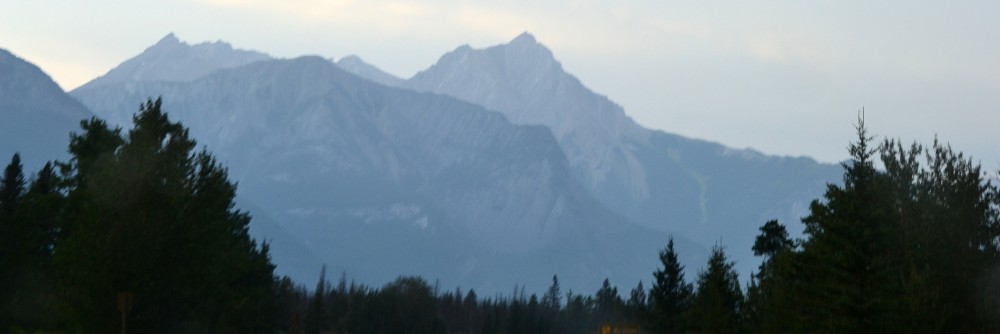
This photo was taken from the campground where we just spent two days with my husband’s folks.   We spent one day mushrooming (boy-howdy, did we get the morels) and one day bass fishing.

Curt and I have an understanding:  I bring a book and read until the fishing is hot.  Then, and only then, will I fish.  Otherwise, he gets to run the boat, cast away, reel in to his heart’s content.  Better yet, he doesn’t have to untangle lines.  We’re both content and get to be together doing what we love.  We soak up the quiet, punctuated by the plop of a  fish jumping, the quiet hum of the trolling motor or the gossipy chuck-chucking of a chukar on the bank.

My book fascinated and occupied me.  I first heard of Kristin Lavransdatter reading a book list; I took note when Elisabeth Elliot named it her favorite novel.  Set in medieval Norway, it tells the tale of a young woman who grows up her father’s favorite child, but refuses his choice of husband preferring a morally unsuitable man.  [I read the first book of the trilogy, The Bridal Wreath.]  Well.  This is a tale of universal application – girl loves the wrong boy. 

What I appreciated about this book is the same thing I liked in Anna Karenina. It is an honest portrayal of love, lust, sex and everyday life after the roll(s) in the hay.  The wages of sin is death, but we’re dishonest if we pretend that the advance draw isn’t delicious.   Sigrid Unset does an excellent job revealing the deceit, the subtle changes in thinking, the isolation and the separation that follow Kristin on the path she takes.

And sometimes in church, and elsewhere too, she would feel a great yearning to take part in all that this meant, the communion of mankind with God.  It had ever been a part of her life; now she stood outside with her unconfessed sin. (p.166)

When I was a girl at home ’twas past my understanding how aught could win such power over the souls of men that they could forget the fear of sin; but so much I have learnt now: if the wrongs men do through lust and anger cannot be atoned for, then must heaven be an empty place. (p.174)

It is painful to see the tight knit love between Kristin and her father Lavrans snag, tear and unravel.

You have wrought sorrow and pain to many by this waywardness of yours, my daughter — but this you know, that your good lies next to my heart. (p.211)

“Father,” said Kristin, “have you been so free from sin all your life, that you can judge Erlend so hardly–?” “God knows,” said Lavrans sternly, “I judge no man to be a greater sinner before Him than I am myself.  But ’tis not just reckoning that I should give away my daughter to any man that pleases to ask for her, only because we all need God’s forgiveness.” (p.226)

People in the midst of self-gratification seldom think of the effect their actions will have on other people, or how many people they will affect. 

“Much have I done already that I deemed once I dared not do because ’twas sin.  But I saw not till now what sin brings with it — that we must tread others underfoot.” (p.259)

In the end, Kristin gets what she wants – minus the joy.  What she thought would fulfill her doesn’t satisfy.